Pages

Showing posts with label seo general. Show all posts

Thursday, 5 January 2017

Are your paid search ads making the right impression?

Impression share may not be the ultimate measure of paid search success, but columnist Jacob Baadsgaard shows how tracking this metric can lead to paid search improvements that can really boost your bottom line.

Impression share is an interesting paid search metric. On the surface, you could argue that impression share is a fairly useless metric. In fact, I’ll admit that I’ve argued for years that impressions really aren’t an important measure of paid search success.
However, while I still strongly believe that ROI — not impressions, clicks or conversions — is the ultimate gauge of paid search success, impression share itself is far from a useless metric.
In fact, after auditing thousands of paid search accounts at Disruptive Advertising, we’ve found that impression share is often the difference between effective campaigns and ineffective ones.

Are you paying for the wrong impressions?

Typically, most advertisers consider paid search impressions “free.” And that makes sense; paid search advertising is based on a cost-per-click (CPC) model, not a cost-per-impression (CPM) model.
If you get 1,000 impressions and only one click, you only pay for the one click, right?
That’s technically true, but there’s a hidden economy to paid search advertising. If you can’t afford to pay for more clicks, Google stops showing your ads.
So, in effect, if you can’t pay for more clicks, you can’t pay for more impressions.
This hidden economy begs the question, “Are you paying for the wrong impressions?” After all, if impressions come at a cost, you really can’t afford to spend your budget on the wrong impressions (and, by extension, clicks).

What a waste!

To answer that question, we need to take a look at your keywords. Open your paid search account, adjust your date range to cover the past three to six months, and then choose the tab labeled “Keywords.”
After that, choose the Filter drop-down menu and create a new filter for Conv. rate < 2%. It should look like this:
See the problem here? Eleven percent of their ad spend is paying for five poorly converting keywords!

Making the wrong impression

Obviously, it’s frustrating to waste money on impressions that aren’t leading to conversions. Unfortunately, since most advertisers have limited budgets, all of that wasted ad spend also has consequences for their other campaigns.
This is where things start to get interesting. Change your filter to Conv. rate > 2%, click Columns > Modify columns, and then select “Search Lost IS,” “Search Exact match IS,” and “Search Impr. share” like so:
You’ll end up with a list that looks something like this:
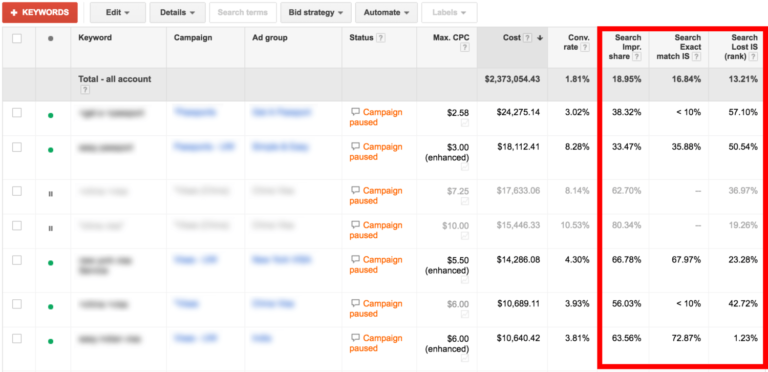
Now you can see just how wasted ad spend sucks the budget away from the best keywords.
Check out the second keyword. It has a conversion rate of 8.28 percent, but it only gets one-third of the potential impression volume — even when the exact keyword gets typed in!
The question is, why?

Search Lost IS (rank)

When you look at the column for Search Lost IS, you can see that this client is losing 50.54 percent of potential impressions due to rank issues.
You know what that means? Their bids are too low.
When a keyword is converting this high, that’s a big problem. Large chunks of the ad budget are being spent on keywords that do almost nothing for the client, while their best keywords don’t have enough budget to rank properly!
The easiest way to fix this is to simply turn up the bids. You need to remember, though, that upping your bids and ranking comes at a cost. Your CPC will increase, increasing your cost-per-conversion, which ultimately increases your cost-per-sale.
If the keyword is a clear winner like this one, that’s not a big deal, but if that keyword is barely profitable at the CPC it’s currently at, increasing the CPC to improve impression share might not be the best idea.

Search Lost IS (budget)

Low-ranking ads aren’t the only way you lose impression share. Remember, if you’re paying for the wrong impressions and clicks, you can’t afford to pay for the right ones.
Now, the Keywords report doesn’t show Search Lost IS (budget), so you need to find it in the Campaigns report. Jot down which campaigns your high-performing keywords happen to be in, and then click on those campaigns in the Campaigns tab.
Once you’re in the campaign, add a column for Search Lost IS (budget). This will let you see the percentage of potential impressions that are being lost in this campaign because of limitations of budget.
Remember that keyword with the 8.28 percent conversion rate? It was in a campaign that was losing 77 percent of its impression share because of budget limits.
That meant the keyword was only getting 33 percent of the potential impressions, and the campaign itself was only receiving 23 percent of the possible impressions due to insufficient budget.
And where was all that budget going? It was paying for worthless impressions!
I’m starting to sense an opportunity here. Are you?

Fixing things

Once you know which keywords are driving the wrong impressions and which ones are making a great impression, fixing things is actually fairly simple.
Cut the budget from your lame keywords. They don’t need it. Then, redirect that spend to your great keywords. Your top keywords should be getting at least 90 percent of the available impression share.
It might seem like a simple fix, but it really works. Here’s what happened for this client when we redirected their budget from their useless keywords to their high-performing keywords:
search-lost-is-vs-conversions
Literally the day after we switched things up for our client, their ads were showing for the proper searches twice as often! Oh, and sales increased by more than 50 percent within a month. After a year of optimization, sales were up by nearly 200 percent.

Conclusion

So, while impression share may not be the ultimate measure of paid search success, impression share is still an incredibly important metric to track.
Just remember, every click has a cost. Paying for one click means you can’t pay for another. And if you’re wasting your budget on the wrong clicks, you won’t have the budget to pay for the right ones.
To know more latest update or tips about Search Engine Optimization (SEO), Search Engine Marketing (SEM) - Fill ContactUs Form or call at +44 2032892236 or Email us at - adviser.illusiongroups@gmail.com.


Wednesday, 21 December 2016

Link campaigns: Strategy development and review

Whether you're planning to pursue links in 2017 or continue an existing link-building project, columnist Andrew Dennis reminds us that December is an ideal month to review your link campaign strategy.

Link campaigns need strategy.
Link building is a difficult, time-consuming process that doesn’t produce results overnight. However, strategic link acquisition is necessary to achieve long-term improvements in organic search.
It’s possible to grab “quick win” links here and there (and I’d encourage pursuing these opportunities), but you will need an ongoing campaign to achieve sustainable results.
A campaign model ensures research, strategy development and ongoing review and analysis as a project progresses.
Whether you’re planning to pursue links in 2017 or continue an existing link-building project, December is an ideal month to review your link campaign strategy and prepare for the new year.
December is a slow month for link building, with many people checked out for the holidays — either mentally, physically or both. Rather than sending outreach messages that return out-of-office auto-replies, you can work on your campaign strategy for the coming year.
My recommendation is to start planning, strategizing and organizing your link campaign now.
To prepare for your link campaign and piece together a link strategy:
  1. Perform an SEO audit.
  2. Review current links.
  3. Analyze competitors.
  4. Prospect for fresh links.
These four pillars of research and analysis will dictate strategy and lead to success in your link-building campaign.

1. Perform an SEO audit

Website audits should be the foundation of your entire SEO strategy; they are critical for successful link campaigns.
Not only will an audit be beneficial in planning your campaign, but it’s important to audit your site periodically to ensure there aren’t any new or lurking issues hampering performance.
A site audit should reveal:
  • technical issues: crawling/indexation issues, slow page speed, schema issues, title tags, H1/2/3s, meta descriptions and so on.
  • internal linking opportunities: as part of an effective link-building strategy.
  • issues caused by redesigns or migrations: 404s, 302s, redirect chains, site architecture issues, orphaned pages, images vs. text and so on.
  • forgotten or undervalued pages: potential linkable assets (pages that serve as a resource to your audience) that could fuel your next campaign.
  • content gaps and opportunities: gaps in your on-site content where potential exists for linkable asset creation.
Links may not help your website if you have ongoing technical or on-page SEO issues.
Even if you secure hundreds of quality links, but Google isn’t crawling your site, those links won’t impact search traffic.
There are a number of great tools designed to help you understand the technical performance of your site, such as:
  • Raven Site Auditor
  • MySiteAuditor
  • SEOptimer
  • Seomator
If you’re new to SEO or have never audited your own site, there are a few guides that will help you understand the process:
  • The definitive SEO audit (Part 1 of 3) by Dave Davies
    • Part 2
    • Part 3
  • How To Do Your Own 5-Minute SEO Audit by Tom Schmitz
  • SEO Audit Checklist for 2016 by Nathan Gotch
  • How to Perform the World’s Greatest SEO Audit by Steve Webb
Regardless, you should audit your site regularly to ensure it is performing properly and receiving the maximum value of your links.

2. Review current link strategy and sources

Before you can optimize your link campaign, you need to understand how you’ve secured links in the past, and which pages appeal most to your audience/niche. This is true for both new and existing campaigns.
If you’re launching a new campaign, you’ll have to dig into your backlink profile. For an existing campaign, the data should be contained within your own reports — although you should review your site’s backlink profile, too. Either way, analyze your links and ask yourself questions like these:
  • What types of sites link the most?
  • Which types of pages on our site have the most links?
  • What empowered our link acquisition? What led to links?
  • Which tactics fell short or had unexpected outcomes?
  • What was the average turnaround time on securing a link, from initial prospecting to the link going live?
  • Are there any relationships that could be leveraged in the future?
  • Are there prospects that didn’t link that might be worth contacting again in a future campaign?
Whether you’re currently building links or are planning a new initiative, there is important information to be gleaned from your website’s backlink profile.
Reviewing past strategies and analyzing results should be a part of your link-building process. You should always examine your site’s backlinks through backlink analysis to inform your link campaign.
The information will help you build links efficiently and effectively.

3. Analyze your search competitors

Competitive analysis is a cornerstone of any strategy development.
Reviewing the current competitive search landscape will inform your link campaign and help you understand why competitors are ranking in search and where you’re falling short.
Competitive analysis will also help you set reasonable expectations and project goals, as well as find new link opportunities.
During competitive analysis, evaluate and identify the following:
  • How many fresh links your competitors have
  • How competitor backlink profiles compare to your own
  • Common and successful strategies and tactics
  • Potential tactics you could implement in the future
  • Relevant link opportunities
  • Shifts in the competitive landscape and marketplace
  • Broken links pointing to competitors
  • New industry relationships and affiliations
Competitive analysis is critical to successful link projects, and it should be revisited at least once a year (Often, competitive analysis is ongoing throughout a campaign).
Search competition never ends. The web is a quickly evolving, always-shifting environment. Even as you secure more links and gain in search visibility and traffic, your competition also grows and fluctuates. And there are always additional search terms to target. No successful business is stagnant, and neither is SEO and link building.
Here are a few great posts that break down search competitive analysis in detail:
  • How To Compile A Top-Notch Competitive Analysis For Search by Brian Harnish
  • Competitive Link Building Analysis For Your Industry by Patrick Stox
  • Using Competitive Links To Inform Your SEO Strategy by Casie Gillette
  • 31 Link Building Tactics Discovered From Competitive Analysis by Kaila Strong
  • Link Building – Competitor Analysis Case Study by Chris Dyson
  • Determining Search Competitors – Tutorial Tuesday by Cory Collins
Conducting regular analysis on the competition helps you stay ahead of competitor tactics and ensures your campaigns remain strategic.

Prospect for fresh link opportunities

December is a great month to prospect for link opportunities in 2017, with the slow reply rate during the holiday season.
Of course, you shouldn’t abandon any current work, but because it’s hard to reach people in December, your time is often better spent searching for new link prospects. Building this list now gives you a jump-start for next year, so you hit the ground running in January.
You should already have a nice list of opportunities from the data you’ve collected thus far — links pointing to 404s on your site, near-miss opportunities worth revisiting, relevant sites that link to competitors, competitors’ broken links and so on.
I would also encourage you to prospect for fresh opportunities, to set yourself up for success in your campaign.
If you’re new to link building, I recommend checking out some of these posts about link prospecting and finding link opportunities:
  • Link prospecting tips and tricks by me (Andrew Dennis)
  • 21 Link Building Ideas That Have Nothing To Do With Guest Posting by Erin Everhart
  • 5 Pieces Of Content: 25 Link Ideas by Julie Joyce
  • The Opportunity Prospector: Link Development’s Most Undervalued Role by Garrett French
  • 9 Actionable Tips for Link Prospecting by Paul Rogers
  • The Realist’s Guide to Link Prospecting by David Farkas
  • The Importance of Finding And Seizing Link Opportunities by Cory Collins
Link acquisition is a continuous cycle of prospecting, outreach and securing links. By filling your prospect pipeline now, you’ll be set up to secure links on day one of the new year.
To know more latest update or tips about Search Engine Optimization (SEO), Search Engine Marketing (SEM) - Fill ContactUs Form or call at +44 2032892236 or Email us at - adviser.illusiongroups@gmail.com

Thursday, 8 December 2016

Why good SEO is strategic

To many on the upper rungs of the corporate ladder, 'SEO' is still a geeky term whose effects are considered to be marginal, rather than central to the company's marketing efforts. Columnist Kevin Lee explains why this view needs to change.
From its inception as a marketing discipline nearly a decade ago, SEO has generally had a tactical focus. And that’s fine. After all, the specific tactics used to gain links, mentions, rankings, traffic and other KPIs are amazingly interesting subjects in their own right. (I’ve long been fascinated by the exact position of the demarcation line between White Hat and Black Hat SEO).
But SEO is much more than tactics, hacks and tools. Today, in many organizations, SEO’s role as a strategic business driver is becoming more deeply felt.
Let’s itemize five ways that SEO has strategic impact.
  1. Lowering digital media costs. In many verticals, PPC costs range well beyond $10 a click. (In the legal field, paid clicks can exceed $200.) Favorable organic positions materially reduce these costs, freeing up digital ad dollars to deploy against segments that would otherwise be unaffordable. That’s an important, material and strategic impact of SEO that’s often discounted in the C-suite.
  2. Market share defense. Organic listings in the SERP don’t only increase your traffic and revenue; they take revenue from the competition. In B2B, where customer lifetime value is high, investing in high-quality content optimized for search should be a strategic goal. Any time you miss an acquisition opportunity in search (paid or organic), chances are that opportunity is going to the competition. SEO, in other words, is a strategic asset — with offensive anddefensive value — in the battle for market share.
  3. Branding impact. SEO and public relations aren’t the same thing, but they share a convergent goal: to increase the general visibility and favorable public impression of clients (which is why so many SEO agencies have added “PR” to their service offerings, while PR agencies have added “SEO” to theirs). Increasing awareness is a high-level strategic marketing goal. Today, online reputation management (ORM) always includes a tangible SEO component. SEO isn’t the only piece of the influence puzzle (paid media is especially vital when dealing with reputation management crises), but it represents a key component of any influence-building campaign.
  4. More efficient (non-search) media campaigns. Searchers often are compelled to begin query sessions because of exposure to some other marketing touch point (for example, a mention in a news story, in a TV drama, a remark of a friend or other offline event). Search traffic can therefore be used as a barometer of other media’s effectiveness. Search behavior can also reveal patterns in one’s targeted audience that provide unique, unexpected and strategic marketing insights.
  5. New product/service development. Search (both paid and organic) is a real-time, massively scaled focus group in which one can (with enough data) perform an accurate predictive analysis of what customers are looking for — and, in some cases, invent products for which there’s search demand (but no product yet). There’s huge potential upside in this kind of “virtual focus group” research, which in some cases has the potential to be more valuable to the organization than old-style qualitative consumer research studies.

How strategic is SEO in your organization?

Ask yourself this: Who does your SEO team leader report to?
  • The digital marketing director?
  • VP of Content/SEO?
  • The tech team (CIO)?
  • SEM Manager?
  • VP of Acquisition Marketing?
  • Director of Marketing (or CMO)?
  • The CEO?
Obviously, the higher the report, the more likely that SEO insights will be heard, appreciated and shared across the organization.
But the org structure rarely tells the complete tale. So ask yourself this:
Are SEO concepts and insights brought in at the conceptual stage of any new project or at the implementation stage? The earlier these concerns can be introduced, the greater the likelihood that web projects will not have to be re-engineered post-launch. SEO, as has often been said, is not a condiment to be sprinkled on a dish after it’s been cooked; it needs to be baked in from get-go.
How does one bring this about? In a Search Engine Land column posted back in 2012, Eric Enge quotes Adobe’s Warren Lee, who recommends a systematic, multi-step approach for kick-starting strategic SEO in the organization, including:
  1. enterprise-wide training on the importance of SEO, with specific training on a departmental basis.
  2. institution of integrated processes with cross-functional workflows.
  3. consistent meetings that ensure that search visibility is always top of mind in any marketing decisions made.
There’s much work to be done. To many on the upper rungs of the corporate ladder, “SEO” is still a geeky term whose effects are considered to be marginal/ignorable, not central/essential. SEO knowledge is often confined to impenetrable marketing silos.
Even the language often used in meetings — especially the not-so-innocent term, “from an SEO perspective” — puts SEO in a conceptual cage it doesn’t deserve to be in. The result is that the contributions by SEO teams are systematically undervalued, specific recommendations are often ignored and opportunities are lost.
The good news is that organizations able to build SEO into their marketing projects and processes — as an integral part, not an add-on — can do very well in the future.
Marketers should demand that their agencies and SEO consultants include training and SEO best practices integration into the organization’s workflows as part of their services. The better agencies are already recommending it, and many others will do it if asked, even though it sometimes means more SEO is done in-house.
To know more latest update or tips about Search Engine Optimization (SEO), Search Engine Marketing (SEM) - Fill ContactUs Form or call at +44 2032892236 or Email us at - adviser.illusiongroups@gmail.com

Saturday, 26 November 2016

How do our biases impact PPC performance?

With experience comes wisdom, but columnist Brett Middleton believes that search marketers can sometimes limit themselves by clinging to old habits.


I’ve come to believe that the essence of PPC management can be boiled down to two things:
  1. Never let one thing (keyword research, bid management, A/B testing ad copy and so on) take up so much of your attention that you let something else slip.
  2. What you did yesterday probably needs to be changed, and failing to adapt your methodology is as bad as having an empty “Change History” log.
As you gain more experience in PPC, you start to develop patterns and favorite tactics out of necessity. We bring tools that worked in the past to each new campaign or ad account. People are paying us for our past experiences and how these experiences translate into future potential.
But are the things we believe about PPC the very things holding us back from fully optimizing an account?
I will absolutely agree with anyone out there who feels that the biases we develop in fact make us much more efficient in management. However, I would also say that our biases can hold us back.
Let’s take a look at a three examples. As you read along, consider your own management habits and how you may have sped up the process over the years.

Spare the Bing, spoil the Google

I personally have been guilty of neglecting Bing Ads. I let Bing Ads move in but made it live in the closet under the stairs (and, much as you would expect, it became a wizard).
Now, part of this was because Bing’s universal event tracking (UET) is much less intuitive, and we simply didn’t take the right steps to make sure revenue tracking was working perfectly. It’s Bing Ads! Do we really need to try that hard to get it going? Why can’t it just be more like Google? After a meeting in which we reviewed the UET code implementation and got Bing’s revenue tracking working correctly, I watched the results in horror/excitement.
Our Bing campaigns are operating at an ROAS five times higher than Google. The search volume isn’t as high, that’s absolutely true — but almost every campaign has been severely limited by budget because we just didn’t see it as worth a major investment.
Every time you have taken on a new client (or, if you’re in-house, every time you’ve evaluated your PPC for optimization paths) and have failed to do a significant test of Bing Ads, you have probably done yourself a disservice. Obviously, there are several reasons that this bias came to be.
Video Player
People think Bing Ads is less reliable than AdWords, want to find out if it’s any good, and are just generally wondering if it’s even worth trying. I’ve always said that these are all reasons you should be in Bing Ads. As marketers, don’t we dream of finding that converting channel that our competitors aren’t in?
Can we all agree to get on board here and give Bing Ads a shot? Unless you’re in my industry, in which case, just ignore all of this.

Separating match types

Now, I don’t have another 1,000 words to get into the question of whether or not you should segment your ad groups and campaigns by match type. (I don’t think you should — but if you must, do it at the campaign level, please! At least you can control the budget that goes to each match type that way.)
The fact is, you probably made the decision on separating or not separating match types fairly early in your PPC career; you very likely also made the decision after someone told you what to do. I was very opposed to separating by match-type, but my current campaigns do it at the campaign level. That’s fine with me for right now, although I cringe when I see the number of campaigns.
screen-shot-2016-11-16-at-9-48-41-am
I can’t stress enough that when people make recommendations, it’s based on their own experience and biases. Don’t let that be the factor that determines EXACTLY how you will manage PPC campaigns. Every piece of advice, including the words I’m writing now, should be examined and tested by yourself.
If you have always separated match types into different ad groups within a campaign, why don’t you try separating them into campaigns for a quarter, and then don’t separate them at all in the next quarter? Shake things up! Make your own decisions!
Very subtle, Google.
One thing I have learned from attending search marketing conferences is that there is always someone out there who knows more than you do, and he or she will say things that get you excited to go home and try them out. That is an incredible thing to experience.
You should always chase after something if it makes you excited about your job, but I caution you to always test each idea against your current philosophy. The tactics and strategies you learn should give you something not only to potentially mimic, but also to act as a catalyst for ideas of your own.

Ad copy formatting

Oh boy, here’s another place where I’m simply not going to dive deep into how you should write your ad copy; that’s is a big topic. But consider how you typically write ads. Do you…
  • include a CTA in the headline, or just give info?
  • use all caps in the description, or follow capitalization rules?
  • use URLslugs as another line of copy, or leave it blank?
  • keep it short and sweet, or use every single character available?
Don’t you think you should have a constantly evolving process that encourages testing and retesting (and then testing that again)? Ad copy isn’t always brilliant. It isn’t always right. But when you write something new, spend some time on it and change the way you do it. You’re absolutely not going to like each ad, but keep iterating.
00:00
02:44

Final thoughts

The very next thing you do when you log into your AdWords account (after importing it into Bing) should be to start testing what I’ve said here, and not just think about the specifics I outline. Evaluate your entire management strategy on a monthly basis, and look for gaps, testing areas, things you do that you have just… always done.
Pushing yourself and adapting is how you make a noticeable difference. Best of luck, PPC people!
To know more latest update or tips about Search Engine Optimization (SEO), Search Engine Marketing (SEM) - Fill ContactUs Form or call at +44 2032892236 or Email us at - adviser.illusiongroups@gmail.com

Friday, 11 November 2016

Coaxing smarter paid search bidding decisions out of sparse conversion data

Columnist Mark Ballard explains how we can use statistics to supplement our conversion data and intuition when deciding on keyword-level bids in AdWords.

Paid search is an industry that’s grounded in data and statistics, but one that requires practitioners who can exercise a healthy dose of common sense and intuition in building and managing their programs. Trouble can arise, though, when our intuition runs counter to the stats and we don’t have the systems or safeguards in place to prevent a statistically unwise decision.

Should you pause or bid down that keyword?

Consider a keyword that has received 100 clicks but hasn’t produced any orders. Should the paid search manager pause or delete this keyword for not converting? It may seem like that should be plenty of volume to produce a single conversion, but the answer obviously depends on how well we expect the keyword to convert in the first place, and also on how aggressive we want to be in giving our keywords a chance to succeed.
If we assume that each click on a paid search ad is independent from the others, we can model the probability of a given number of conversions (successes) across a set number of clicks (trials) using the binomial distribution. This is pretty easy to do in Excel, and Wolfram Alpha is handy for running some quick calculations.
In the case above, if our expected conversion rate is 1 percent, and that is indeed the “true” conversion rate of the keyword, we would expect it to produce zero conversions about 37 percent of the time over 100 clicks. If our true conversion rate is 2 percent, we should still expect that keyword to produce no conversions about 13 percent of the time over 100 clicks.
It isn’t until we get to a true conversion rate of just over 4.5 percent that the probability of seeing zero orders from 100 clicks drops to less than 1 percent. These figures may not be mind-blowingly shocking, but they’re also not the types of numbers that the vast majority of us have floating in our heads.
When considering whether to pause or delete a keyword that has no conversions after a certain amount of traffic, our common sense can inform that judgement, but our intuition is likely stronger on the qualitative aspects of that decision (“There’s no obvious difference between this keyword and a dozen others that are converting as expected.”) than the quantitative aspects.

Achieving a clearer signal with more data

Now consider the flip side of the previous scenario: if we have a keyword with a true conversion rate of 2 percent, how many clicks will it take before the probability of that keyword producing zero conversions falls below 1 percent? The math works out to 228 clicks.
That’s not even the heavy lifting of paid search bidding, where we need to set bids that accurately reflect the underlying conversion rate of a keyword, not just rule out extreme possibilities.
Giving that 2 percent conversion rate keyword 500 clicks to do its job, we’d be right to assume that, on average, it will generate 10 conversions. But the probability of getting exactly 10 conversions is a little under 13 percent. Just one more conversion or less and our observed conversion rate will be 10 percent different from the true conversion rate (running at either 1.8 percent or less, or 2.2 percent or more).
In other words, if we are bidding a keyword with a true conversion rate of 2 percent to a cost per conversion or cost per acquisition target, there is an 87 percent chance that our bid will be off by at least 10 percent if we have 500 clicks’ worth of data. That probability sounds high, but it turns out you need a really large set of data before a keyword’s observed conversion rate will consistently mirror its true conversion rate.
Staying with the same example, if you wanted to reduce the chance of your bids being off by 10 percent or more to a probability of less than 10 percent, you would need over 13,500 clicks for a keyword with a true conversion rate of 2 percent. That’s just not practical, or even possible, for a great many search programs and their keywords.
This raises two related questions that are fundamental to how a paid search program is bid and managed:
  1. How aggressive do we want to be in setting individual keyword bids?
  2. How are we going to aggregate data across keywords to set more accurate bids for each keyword individually?
To set a more accurate bid for an individual keyword, you can essentially wait until it has accumulated more data and/or use data from other keywords to inform its bid. Being “aggressive” in setting an individual keyword’s bid would be favoring using that keyword’s own data even when the error bars on estimating its conversion rate are fairly wide.
A more aggressive approach supposes that some keywords will inherently perform differently from even their closest keyword “cousins,” so it will ultimately be beneficial to more quickly limit the influence that results from related keywords have on individual keyword bids.
For example, one of the simplest (and probably still most common) ways that a paid search advertiser can deal with sparse individual keyword data is to aggregate data at the ad group level or up to the campaign or even account level. The ad group may generate a one percent conversion rate overall, but the advertiser believes that the true conversion rate of the individual keywords varies a great deal.
By bidding keywords completely by their own individual data when they have achieved 500 or 1,000 clicks, the advertiser knows that statistical chance will lead to bids that are off by 50 percent or more at any given time for a non-trivial share of the keywords achieving that level of volume, but that may be worth it.
For a keyword with a true conversion rate of 2 percent, observed conversion rate will differ by plus or minus 50 percent from the true conversion rate about 15 percent of the time, on average, after 500 clicks, and 3 percent of the time after 1,000 clicks. If the alternative is for that keyword to get its bid from the ad group (based on its one percent conversion rate), then that will still be better than having a bid that is 50 percent too low 100 percent of the time.
This speaks to the importance of wisely grouping keywords together for bidding purposes. For an advertiser whose bidding platform is confined to using the hierarchical structure of their AdWords paid search account to aggregate data, this means creating ad groups of keywords that are likely to convert very similarly.
Often this will happen naturally, but not always, and there are more sophisticated ways to aggregate data across keywords if we don’t have to confine our thinking to the traditional ad group/campaign/account model.

Predicting conversion rate based on keyword attributes

There is a lot we can know about an individual keyword and the attributes it shares with keywords that we may or may not want to group in the same ad group or campaign for any number of reasons (ad copy, audience targeting, location targeting and so on)
The number of keyword attributes that could be meaningful in predicting conversion rates is limited only by an advertiser’s imagination, but some examples include attributes of the products or services the keyword is promoting:
  • product category and subcategories;
  • landing page;
  • color;
  • size;
  • material;
  • gender;
  • price range;
  • promotional status;
  • manufacturer and so on.
We can also consider aspects of the keyword itself, like whether it contains a manufacturer name or model number; the individual words or “tokens” it contains (like “cheap” vs. “designer”); whether it contains the advertiser’s brand name; its match type; its character length and on and on.
Not all attributes of a keyword we can think of will be great predictors of conversion performance or even generate enough volume for us to do a useful analysis, but approaching bidding in this way opens up our possibilities in dealing with the problem of thin data at the individual keyword level. Google itself has dabbled in this line of thinking with AdWords labels, though it has its limits.
When considering multiple keyword attributes in paid search bidding, the level of mathematical complexity can escalate very quickly, but even approaches on the simpler end of the spectrum can be effective at producing more accurate keyword bidding decisions.

Closing thoughts

I’ve really just scratched the surface on the topic of predicting keyword conversion rates and the basic statistics that surround paid search bidding. Most advertisers also have to consider some form of average order size or value, and seasonality can have a huge effect on where we want our bids to be.
Paid search bidding has also only grown more complex over time as properly accounting for factors like device, audience and geography have grown more important.
Clearly, there are many moving pieces here, and while our intuition may not always be sound when scanning through monthly keyword-level performance results, we can trust it a bit more in assessing whether the tools we are using to help us make better decisions are actually doing so smartly and delivering the kind of higher-level results that meet our expectations over the long term.

To know more latest update or tips about Search Engine Optimization (SEO), Search Engine Marketing (SEM) - Fill ContactUs Form or call at +44 2032892236 or Email us at - adviser.illusiongroups@gmail.com