Pages

Showing posts with label SEARCH ENGINE MARKETING. Show all posts

Saturday, 25 February 2017

Search in Pics: Google cigar box guitar, branded airplane head covers & a skateboard

In this week’s Search In Pictures, here are the latest images culled from the web, showing what people eat at the search engine companies, how they play, who they meet, where they speak, what toys they have and more.


Google Cloud umbrella:
Google building blocks:
Google skateboard wall art:
Google branded airplane seat head covers:
To know more latest update or tips about Search Engine Optimization (SEO), Search Engine Marketing (SEM) - Fill ContactUs Form or call at +44 2032892236 or Email us at - adviser.illusiongroups@gmail.com.


Tuesday, 21 February 2017

Growing your agency with retainer-based relationships

How agencies can use marketing automation to create profitable growth

Uncover some of the secrets behind building successful, ongoing relationships with clients — including leveraging marketing automation.
In this white paper from Sharp Spring, you will:
  • hear about the many benefits of retainer-based business.
  • get tips on how to approach client relationships.
  • learn how to identify which clients are a good fit for your agency.
Visit Digital Marketing Depot to download “Using Marketing Automation and Sales Strategy as a Foundation for Profitable Growth.”
To know more latest update or tips about Search Engine Optimization (SEO), Search Engine Marketing (SEM) - Fill ContactUs Form or call at +44 2032892236 or Email us at - adviser.illusiongroups@gmail.com.


Wednesday, 4 January 2017

Why you should budget for call tracking in 2017

Boost efficiency and sales across the organization with call tracking.

With the current fiscal year winding down and budgeting for FY2017 gearing up, marketers are faced with the annual task of tracking effectiveness and justifying budgets. The key is to invest in tools that help control costs and boost revenue — not just within the purview of marketing, but across the entire organization.
Download this white paper from CallTrackingMetrics to learn why call tracking should be your next investment
To know more latest update or tips about Search Engine Optimization (SEO), Search Engine Marketing (SEM) - Fill ContactUs Form or call at +44 2032892236 or Email us at - adviser.illusiongroups@gmail.com.

Thursday, 15 December 2016

How Google has changed a consumer’s path to making a physical purchase


Just as it does in the real world, physical location makes a huge difference on Google. Because people have their phone in hand at all times, they expect Google to serve them information based on where they are or where they’re headed. This means Google’s influence is not just broad, it is also deep.
From awareness to consideration to conversion, and finally advocacy — this white paper from MomentFeed shows how large brands can take advantage of their many locations on Google to drive more offline sales.
Learn more. Visit Digital Marketing Depot to download “Using Google to Drive Offline Sales.”
To know more latest update or tips about Search Engine Optimization (SEO), Search Engine Marketing (SEM) - Fill ContactUs Form or call at +44 2032892236 or Email us at - adviser.illusiongroups@gmail.com

Navigate your marketing automation options with this checklist

The first step is identifying the feature set you need from the software.

Companies using marketing automation see 53 percent higher conversion rates, according to the Aberdeen Group. But there are hundreds of software companies that have been identified as marketing automation platforms. Add in customer relationship management software, email marketing platforms and experience management tools, and the market is daunting at best.
Marketing Automation is a clear need. How do you identify the solution that’s right for your organization?
Download this checklist from Bridgeline and navigate the sea of marketing automation options. Visit Digital Marketing Depot to get your copy.
To know more latest update or tips about Search Engine Optimization (SEO), Search Engine Marketing (SEM) - Fill ContactUs Form or call at +44 2032892236 or Email us at - adviser.illusiongroups@gmail.com

Wednesday, 7 December 2016

Get answers to your marketing automation questions

What are the costs? Who are the major vendors? What should I be looking for?


Got questions about marketing automation? Marketing Land’s B2B Marketing Automation Platforms: A Marketer’s Guide has you covered.
The 49-page report reviews the latest trends, opportunities and challenges facing the market for marketing automation tools.
Included in the report are profiles of 13 leading vendors, pricing charts, capabilities comparisons and recommended steps for evaluating and purchasing.
Visit Digital Marketing Depot to download your copy.
To know more latest update or tips about Search Engine Optimization (SEO), Search Engine Marketing (SEM) - Fill ContactUs Form or call at +44 2032892236 or Email us at - adviser.illusiongroups@gmail.com

Tuesday, 29 November 2016

Are you doing attribution wrong?

Nothing is more top-of-mind for marketers than attribution. It’s a complex topic, and there are lots of questions.
This guide from AdRoll examines the history of attribution models and dives deep into platform data, third-party research and advertiser survey data to make the case for marketers to adopt a blended attribution model, one that combines both ad views and clicks.
Visit Digital Marketing Depot to download “The Blended Attribution Playbook” to learn more.
To know more latest update or tips about Search Engine Optimization (SEO), Search Engine Marketing (SEM) - Fill ContactUs Form or call at +44 2032892236 or Email us at - adviser.illusiongroups@gmail.com

Saturday, 12 November 2016

Meet a Landy Award winner: Wolfgang Digital integrates search and TV into a cross-channel campaign for a big Irish retailer

The result for Littlewoods Ireland: the most successful Christmas campaign ever


Retailer Little woods Ireland, founded in 1923, now sells its fashion, gadgets and home ware products exclusively online. The company makes almost half of its annual revenue in November and December.
Their search marketing agency, Wolfgang Digital, found that it usually takes four website visits before most visitors make a purchase. So Littlewoods asked Wolfgang Digital to create a campaign for their 2015 Christmas season built around this finding.
The result, in addition to boosting conversions by eight times more than standard campaigns in Littlewoods Irelands’ most successful Christmas campaign ever, is that Wolfgang Digital won this year’s Landy Award for Best Integration of Search into Cross-Channel Marketing.
“[Google Analytics] told us,” Wolfgang Digital CEO Alan Coleman said via email, “that it was unrealistic for us to expect people to click on a search ad, visit the website and buy.”
“So for a search ad to be effective,” he told me, “we needed to create at least three other touch points around it.”
“From other cross-channel campaigns for Wolfgang Digital clients, we’ve seen plenty of evidence that conversion rates increase as you communicate with the same user in a consistent manner across multiple channels.”
The first touch point in the Littlewoods campaign was a single TV ad, which was intended to drive viewers to the web, via a text overlay on the ad that recommended viewers “Shazam now to shop the ad.” That meant smartphone users should let the Shazam mobile app listen to the TV ad’s soundtrack. When it did, the user was brought to the campaign’s landing page on the web, which contained purchaseable product ads relating to the TV ad. Here’s a still from the littlewoods-ireland-christmas-2015-tv-ad-image-4
The second touch point: online ads. The TV ad also contained Littlewoods Ireland’s Facebook and Twitter locations, which similarly contained ads relating to the TV one, displayed around the times of the TV ad’s broadcasts. Here’s a Facebook ad from the campaign:littlewoods-ireland-chrismas-2015-fb-ad-1
Wolfgang expected some users to search Google for related terms when they saw the TV ad, so there were AdWords ready to be displayed for specific searches, for such terms as “toys” or “Christmas decorations.”
The campaign also utilized Google’s RLSA to target website visitors with their ads, when they searched on Google.
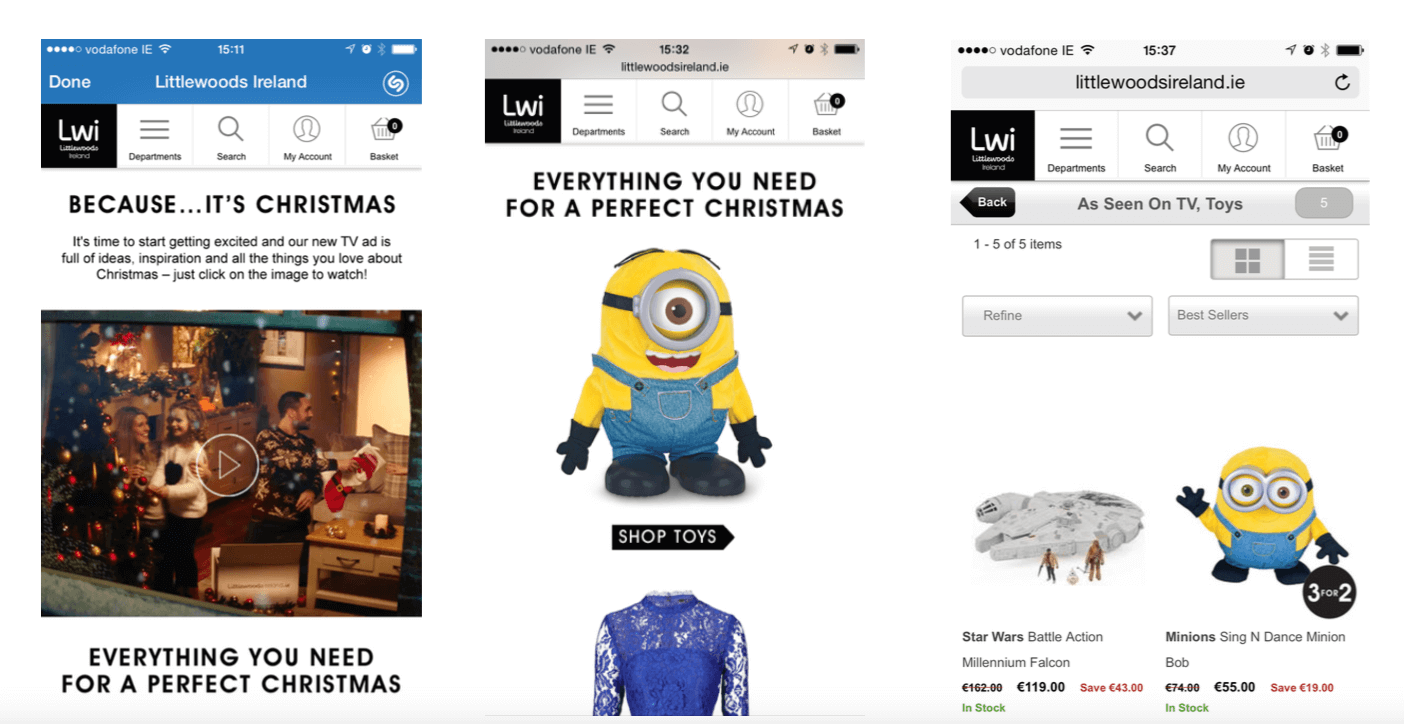
The landing page — the third touch point — linked to various behind-the-scenes videos about the TV ad on YouTube. Here are some of the mobile landing pages:mobile-landing-pages
The fourth touch point: Visitors to the landing page or the YouTube videos were retargeted via cookies or mobile ID, so they saw related ads on other sites across the web.
Additionally, there were “interesting facts” offered to the press:
For instance, Littlewoods Ireland found that, when looking at what sold best and when, it turned out that vacuum cleaners were most popular on Tuesdays, earrings on Saturday mornings, tights on Mondays, and, at 8:23 p.m. on Thursday evenings, it’s knickers — British slang for panties. Some publications picked up those and other interesting facts. When the publications were online, the tidbits were linked to the Littlewoods website.
And there was specific, linked content added to the Littlewoods blog, such as: “How to get the Best Black Friday Deals” and “Can’t Wait for Black Friday? Littlewoods Ireland has a sale right now!”
When an online sale was made, there was a secondary retargeting campaign offering a cash voucher to buyers if they recommended a friend.
“The unique element of this campaign,” Coleman told me, “is it took multiple marketing channels both offline and online and created a seamless cross channel communication to the user as they moved from awareness, to interest, to action and beyond to loyalty and advocacy.”

To know more latest update or tips about Search Engine Optimization (SEO), Search Engine Marketing (SEM) - Fill ContactUs Form or call at +44 2032892236 or Email us at - adviser.illusiongroups@gmail.com 

Friday, 11 November 2016

Coaxing smarter paid search bidding decisions out of sparse conversion data

Columnist Mark Ballard explains how we can use statistics to supplement our conversion data and intuition when deciding on keyword-level bids in AdWords.

Paid search is an industry that’s grounded in data and statistics, but one that requires practitioners who can exercise a healthy dose of common sense and intuition in building and managing their programs. Trouble can arise, though, when our intuition runs counter to the stats and we don’t have the systems or safeguards in place to prevent a statistically unwise decision.

Should you pause or bid down that keyword?

Consider a keyword that has received 100 clicks but hasn’t produced any orders. Should the paid search manager pause or delete this keyword for not converting? It may seem like that should be plenty of volume to produce a single conversion, but the answer obviously depends on how well we expect the keyword to convert in the first place, and also on how aggressive we want to be in giving our keywords a chance to succeed.
If we assume that each click on a paid search ad is independent from the others, we can model the probability of a given number of conversions (successes) across a set number of clicks (trials) using the binomial distribution. This is pretty easy to do in Excel, and Wolfram Alpha is handy for running some quick calculations.
In the case above, if our expected conversion rate is 1 percent, and that is indeed the “true” conversion rate of the keyword, we would expect it to produce zero conversions about 37 percent of the time over 100 clicks. If our true conversion rate is 2 percent, we should still expect that keyword to produce no conversions about 13 percent of the time over 100 clicks.
It isn’t until we get to a true conversion rate of just over 4.5 percent that the probability of seeing zero orders from 100 clicks drops to less than 1 percent. These figures may not be mind-blowingly shocking, but they’re also not the types of numbers that the vast majority of us have floating in our heads.
When considering whether to pause or delete a keyword that has no conversions after a certain amount of traffic, our common sense can inform that judgement, but our intuition is likely stronger on the qualitative aspects of that decision (“There’s no obvious difference between this keyword and a dozen others that are converting as expected.”) than the quantitative aspects.

Achieving a clearer signal with more data

Now consider the flip side of the previous scenario: if we have a keyword with a true conversion rate of 2 percent, how many clicks will it take before the probability of that keyword producing zero conversions falls below 1 percent? The math works out to 228 clicks.
That’s not even the heavy lifting of paid search bidding, where we need to set bids that accurately reflect the underlying conversion rate of a keyword, not just rule out extreme possibilities.
Giving that 2 percent conversion rate keyword 500 clicks to do its job, we’d be right to assume that, on average, it will generate 10 conversions. But the probability of getting exactly 10 conversions is a little under 13 percent. Just one more conversion or less and our observed conversion rate will be 10 percent different from the true conversion rate (running at either 1.8 percent or less, or 2.2 percent or more).
In other words, if we are bidding a keyword with a true conversion rate of 2 percent to a cost per conversion or cost per acquisition target, there is an 87 percent chance that our bid will be off by at least 10 percent if we have 500 clicks’ worth of data. That probability sounds high, but it turns out you need a really large set of data before a keyword’s observed conversion rate will consistently mirror its true conversion rate.
Staying with the same example, if you wanted to reduce the chance of your bids being off by 10 percent or more to a probability of less than 10 percent, you would need over 13,500 clicks for a keyword with a true conversion rate of 2 percent. That’s just not practical, or even possible, for a great many search programs and their keywords.
This raises two related questions that are fundamental to how a paid search program is bid and managed:
  1. How aggressive do we want to be in setting individual keyword bids?
  2. How are we going to aggregate data across keywords to set more accurate bids for each keyword individually?
To set a more accurate bid for an individual keyword, you can essentially wait until it has accumulated more data and/or use data from other keywords to inform its bid. Being “aggressive” in setting an individual keyword’s bid would be favoring using that keyword’s own data even when the error bars on estimating its conversion rate are fairly wide.
A more aggressive approach supposes that some keywords will inherently perform differently from even their closest keyword “cousins,” so it will ultimately be beneficial to more quickly limit the influence that results from related keywords have on individual keyword bids.
For example, one of the simplest (and probably still most common) ways that a paid search advertiser can deal with sparse individual keyword data is to aggregate data at the ad group level or up to the campaign or even account level. The ad group may generate a one percent conversion rate overall, but the advertiser believes that the true conversion rate of the individual keywords varies a great deal.
By bidding keywords completely by their own individual data when they have achieved 500 or 1,000 clicks, the advertiser knows that statistical chance will lead to bids that are off by 50 percent or more at any given time for a non-trivial share of the keywords achieving that level of volume, but that may be worth it.
For a keyword with a true conversion rate of 2 percent, observed conversion rate will differ by plus or minus 50 percent from the true conversion rate about 15 percent of the time, on average, after 500 clicks, and 3 percent of the time after 1,000 clicks. If the alternative is for that keyword to get its bid from the ad group (based on its one percent conversion rate), then that will still be better than having a bid that is 50 percent too low 100 percent of the time.
This speaks to the importance of wisely grouping keywords together for bidding purposes. For an advertiser whose bidding platform is confined to using the hierarchical structure of their AdWords paid search account to aggregate data, this means creating ad groups of keywords that are likely to convert very similarly.
Often this will happen naturally, but not always, and there are more sophisticated ways to aggregate data across keywords if we don’t have to confine our thinking to the traditional ad group/campaign/account model.

Predicting conversion rate based on keyword attributes

There is a lot we can know about an individual keyword and the attributes it shares with keywords that we may or may not want to group in the same ad group or campaign for any number of reasons (ad copy, audience targeting, location targeting and so on)
The number of keyword attributes that could be meaningful in predicting conversion rates is limited only by an advertiser’s imagination, but some examples include attributes of the products or services the keyword is promoting:
  • product category and subcategories;
  • landing page;
  • color;
  • size;
  • material;
  • gender;
  • price range;
  • promotional status;
  • manufacturer and so on.
We can also consider aspects of the keyword itself, like whether it contains a manufacturer name or model number; the individual words or “tokens” it contains (like “cheap” vs. “designer”); whether it contains the advertiser’s brand name; its match type; its character length and on and on.
Not all attributes of a keyword we can think of will be great predictors of conversion performance or even generate enough volume for us to do a useful analysis, but approaching bidding in this way opens up our possibilities in dealing with the problem of thin data at the individual keyword level. Google itself has dabbled in this line of thinking with AdWords labels, though it has its limits.
When considering multiple keyword attributes in paid search bidding, the level of mathematical complexity can escalate very quickly, but even approaches on the simpler end of the spectrum can be effective at producing more accurate keyword bidding decisions.

Closing thoughts

I’ve really just scratched the surface on the topic of predicting keyword conversion rates and the basic statistics that surround paid search bidding. Most advertisers also have to consider some form of average order size or value, and seasonality can have a huge effect on where we want our bids to be.
Paid search bidding has also only grown more complex over time as properly accounting for factors like device, audience and geography have grown more important.
Clearly, there are many moving pieces here, and while our intuition may not always be sound when scanning through monthly keyword-level performance results, we can trust it a bit more in assessing whether the tools we are using to help us make better decisions are actually doing so smartly and delivering the kind of higher-level results that meet our expectations over the long term.

To know more latest update or tips about Search Engine Optimization (SEO), Search Engine Marketing (SEM) - Fill ContactUs Form or call at +44 2032892236 or Email us at - adviser.illusiongroups@gmail.com 

Thursday, 13 October 2016

Rethinking today’s attribution problem in digital marketing

Proper attribution modeling is one of the biggest challenges facing marketers today. Columnist Christi Olson discusses the common gaps in attribution and some ideas for thinking more holistically about your digital marketing campaigns.


Attribution is the science behind assigning values to individual touch points throughout a customer’s decision journey. It’s not only a key driver in how we currently optimize marketing campaigns, but attribution is also used for media mix modeling and developing media budgets.
Herein lies the problem: marketers tend to look at attribution within our own channel silo, so it’s not easy to understand the full picture of a multi-channel environment.
As search continues to evolve in form and function, it’s raising some important questions around how we think about and use attribution models — and is putting some of our long-held practices to the test.

Do you have an attribution problem?

Attribution modeling has seen incredible progress over the years, offering increasingly better solutions to track touch points throughout a conversion. While progress has been made, the attribution models that most companies are using today offer a partial solution that tracks only online conversions and channels.
Most companies are just beginning to scratch the surface of multi-channel and cross-device attribution. Technology companies are still piecing together the components needed to provide a full solution to fill in the gaps in current attribution models. It leaves us to question, do we have an attribution problem that we might not be aware of?
The simple way to answer the question is to look at your analytics data and see if a significant portion of overall conversions have a long, multi-step path. Or in other words, are your customers engaging across multiple channels? If the answer is yes, a significant portion of your conversions come from paths that contain 2+ steps, then you most likely have an attribution problem.
Here is how you can see this for yourself: In Google Analytics, navigate to Conversions > Multi-Channel Funnels Report, and then look at the Path Length report. This report will provide you with a simple breakdown of the quantity of paths. You should also view the Top Conversion Paths report to understand which channels play a role at each step of the consumer’s digital journey.
I do want to acknowledge that this report is limited to just your digital channels, unless you’re pulling in additional conversion data from offline channels into analytics.

Mind the attribution gap

In June, Aaron Levy wrote an excellent post on the best attribution model for search. In it, he describes the top rules-based attribution models, along with the high-level pros and cons of each model.
I’m going to dig a little deeper into the topic, and I’m going to start by discussing the two major attribution gaps you need to be aware of when it comes to attribution models.
Online-to-offline attribution
The first gap in attribution is in understanding the impact of online channels’ ability to drive offline revenue. Most analytics platforms and their attribution models are only providing a partial solution by looking at the digital conversions and revenue, not including the online impact to offline sales/leads/in-store visits.
Of the two major gaps in attribution, this is one of the easiest gaps to solve with moderate accuracy based on extrapolating information from available data sources to link online activity to offline user behavior.
The easy solution that many businesses take is to use some sort of unique promotion code by channel to tie attribution together. This gives consumers a choice in where they can convert and allows you to track the conversion.
Google is working on solving this attribution problem with their “In-Store Visits” metric, which uses a number of signals to gauge online-to-offline impact, including Google Maps data, GPS, WiFi, visitor queries and data from over a million opted-in users, which is then used to create store visit estimates.
Analytics and advertising platforms are leveraging data from cell phones such as WiFi, GPS and beacons tied to in-app networks. Even mobile forms of payment like mobile wallets will help to answer the online-to-offline attribution question. While these methods aren’t a perfect solution because they don’t track a specific user’s behavior, they are a start in the right direction to solving the online-to-offline gap.
Cross-device attribution
The second and most difficult gap in attribution is in measuring consumer behaviors and interactions across screens and devices. Are we tracking consumers across devices and across channels? Canwe?
This is an attempt to answer the questions, “How do consumers engage with a brand across devices?,” “Which channels are they engaging with on each device?” and “On which device do they finally convert?”
This is one of the biggest attribution challenges because consumers use a multitude of screens (TV, desktop, tablets, smartphone and more) throughout their journey. As consumers switch across devices, it’s difficult — nay, almost impossible — to maintain the unique IDs to track the customer journey both offline (through TV viewing) and online. This is going to be the most difficult gap to close due to the complexity needed to track unique users across multiple screens.
Today, advertisers attempt to bridge the gap by looking at data and finding correlations between interactions across screens. There are a few large companies who can close this gap through logged-in states across multiple screens and devices (think Apple, Facebook, Comcast), though potentially not across all of the screens and devices we use regularly.
The cross-screen, multi-channel attribution will only get more difficult as search powers experiences away from the search box, such as voice search through personal digital assistants and Virtual Reality/Augmented Reality technology.
Regardless of the attribution model chosen and the gaps that exist across all attribution models today, the purpose is still the same: to understand the value each channel brings to the marketing mix in moving customers along their decision journey.
The goal we should be focusing on as marketers is understanding how to integrate search into the journey and create more holistic campaigns that focus on the consumer. Tallying touch points from a rules-based model may be detracting from the higher goal of creating deeper, lasting customer relationships.

First- & last-click see their last days

In my own experience, many companies employ either first-click or last-click attribution models. First-click (or first-touch) attribution models give 100 percent of the credit for a conversion to the consumer’s first touch point, whereas last-click attribution models assign conversion credit to the last touch point leading up to a conversion.
It’s easy to scrutinize either of these popular models because they focus solely on either the top of the funnel (first-click) or the bottom of the funnel (last-click). Indeed, as a result of their disregard for all other marketing activities, both first-click and last-click attribution models are heading toward their last days.
Using the last-click model means mean that you are either ignoring early, top-of-funnel activity and instead focusing on bottom-of-funnel elements like branded search and remarketing (which tend to drive the final conversion). Without giving value to the top-of-funnel channels, sooner or later, your remarketing efforts will dry up.
First-click attribution comes with similar problems — by giving all the credit to the first touch point, you obscure the true value of critical middle- and bottom-of-funnel efforts in moving the customer through the buyer journey and closing the sale.
Other attribution models, such as time-decay and metric-driven, offer more sophisticated modeling but still end up assigning arbitrary values and leaving gaps when customers switch between channels, especially when going from online to offline.
Even within our own channel, search is no longer about singular conversions. Keywords are now being evaluated in a much larger context, not just for immediate conversions but how they assist throughout the consumer decision journey. They are helping consumers explore, research, compare, locate, purchase and follow up.
Search has seen rapid growth in both form and function since its inception less than 30 years ago. In form, it’s broken out of the text box, appearing on our phones, in our cars, at home on our speakers, in our TV remotes and gaming systems. It’s in bed on our tablets and phones. Wherever we go, search is with us across devices.
In function, we’ve started relying on search as inter-communicative partners. Search has gone beyond simple voice input and is evolving to understand user intent and behaviors through available data to help consumers take action. Through search, we can order a pizza, rent a car, buy movie tickets and compare insurance quotes — all within the results pages.
How could search, or any digital channel for that matter, possibly still be graded on one click prior to a conversion? It simply can’t.

The future of campaigns

Rather than being a siloed line item in the marketing mix, search has proven itself to be an integrated component of a much larger machine focused on lasting relationships or CLVs (customer lifetime values).
Today’s marketers are adopting a new approach that tears down the siloed walls of search, social, display and offline channels to create one holistic brand experience. Holistic campaigns support deeper, more meaningful customer relationships and distinguish themselves.

Getting personal with digital fingerprints

Creating highly personalized campaigns is an extremely effective way to strengthen your customer relationships.  There are many new tools in search that allow you to personalize the search experience, such as remarketing or customer match. But before you launch individual campaigns, you should first think holistically about how a campaign will integrate with other campaigns.
Each consumer has a unique digital fingerprint, which is an evolved concept from the traditional “digital footprint” that centers around following a user’s online trail. A digital fingerprint signifies much more: a user’s unique online preferences as they embark on highly individualized journeys, “depending on cost of failure, frequency, cost and complexity of the task, and the type of shopper.” (Bing Ads Customer Decision Journey report).
Each consumer displays highly personal patterns and preferences throughout the relationship-building process. They may rely more heavily on email, spend more time on social, prefer tablets and so forth.
Your challenge will be to create a holistic brand experience that consumers can tap into based on their unique digital fingerprints. Although the three consumers below have unique digital fingerprints, they should all experience a unified, holistic brand.

Rethinking your future campaigns

As you rethink your future search campaigns with a new, holistic approach, we recommend the following:
  • Carefully select an attribution model that will support — and not work against — holistic marketing efforts. Refrain from using oversimplified models, such as either first or last click, which will not sustain long-term multi-channel campaigns.
  • Evaluate your keywords based on more than the final conversion metric. Look at assists to make sure that you’re supporting customers throughout the entire consumer decision journey. Look at other metrics based on where the keyword fits within the journey, such as time on site, page views, product page views and other customer loyalty indicators.
  • Include keywords that support customers throughout each stage of the consumer decision journey as they engage with search as an inter-communicative partner
  • Include campaign-specific keywords within your search campaigns so that consumers can easily find you after seeing a TV ad, remembering a billboard, hearing your jingle or seeing your logo.
  • In the case of tracking online to offline or vice versa, include unique promotional codes to tie purchases back to a unique marketing channel.
  • Be aware of your consumers’ unique digital fingerprints and how your customers will experience your brand across different channels at different times with different connectivity points.
To know more latest update or tips about Search Engine Optimization (SEO), Search Engine Marketing (SEM) - Fill ContactUs Form or call at +44 2032892236 or Email us at - adviser.illusiongroups@gmail.com 

Referece taken by - SearchEnginLand

How should your ad budget impact campaign building?

Wondering how to make the most of your AdWords budget? Columnist Brett Middleton shares his formula for calculating search impression share so that you can make ROAS projections based on budget reallocation.


Everyone running a PPC account typically has a budgeting question they are trying to figure out. For those with a tighter ad budget, the question becomes, “How do I get the most leads for this limited amount of spend I have?”
Larger accounts run into their own problems; finding points of diminishing returns and making small gains in efficiency while maintaining spend levels at a point that generates the growth you need can be a headache.
If you take away one point from this, it’s that search impression share may be the most ignored primary metric for most PPC managers who are up against a budget. Search impression share is the number of impressions your ads actually received, compared to the potential number they could have received. For example, if there were 100 searches for keyword X, and you received 75 impressions, that would mean you have 75 percent search impression share.
This is important to think about because you may be leaving valuable conversions on the table. In this article, I’ll show you a way to look at impression share and do your own calculation for how many potential conversions you are missing out on with your current campaign structure and budget. Those of you who don’t trust Keyword Planner, this is for you.
As someone who has managed accounts across a wide range of budgets, I’ve learned a few things along the way, and my search for efficiency with higher spends has led to some observations about mistakes I made managing smaller budgets. Get ready for PPC budget management talking points!

Build your PPC campaigns “deep” or “wide?”

Deep PPC campaign building: Identifying your best performing campaigns and funneling the majority (or entirety) of your ad spend through them. This often requires not advertising for other products or services your company/client may offer that have lower ROAS (return on ad spend).
Wide PPC campaign building: After creating your initial campaigns, optimize in an attempt to elevate your underperforming campaigns to the level of your top-performing campaigns. Advertise for all of your products or services, even if they are slightly lower on ROAS.
If you have a budget that is smaller than the max ad spend possible for your keywords, you have decisions to make regarding budget allocation. This is a common problem for advertisers with many different products and services, especially when they don’t have much keyword overlap.
For example, let’s say you run the AdWords account for a recruiting firm that specializes in marketing, creative and IT hiring. The keywords for these three services are drastically different, so you have separate campaigns built that run at $100/day each (Your monthly budget was set at $9,000/month). Every campaign is limited by budget. The steps you’ve taken so far are:
  1. Utilize the Search Terms report to find exact/phrase match keywords to increase relevance and make your budget go farther.
  2. A/B test ad copy.
  3. Test sending visitors to different landing pages (e.g., the home page vs. the job listings page).
Performance is trending up slowly. The IT campaign has the lowest cost per conversion by roughly $50/conversion, but you’re working on improving the others. Although the value of a lead to your business is certainly more than $50, does it make sense to continue spending more for these other leads and limiting IT to the same budget?
As advertisers, we need to consider the impact something like this has on our ability to grow revenue (and subsequently our ad budget), as opposed to any benefits that come from uniformity in the sales pipeline. There are potential negative effects if we lower ad spend in creative and marketing, and therefore limit our acquisition of new talent for these positions, but this is when we need to see this as an opportunity for creativity and optimization.
By either a) reallocating spend to IT to increase overall ROAS, or b) Taking steps to project increased revenue from upping IT spend and getting additional budget to reach these goals, we are moving from management to optimization. Although Google Keyword Planner can be a good reference point, there is a relatively quick way that we can do the work ourselves and know exactly how the math is done.

How deep can your campaign be?

What you’re about to look at isn’t brain surgery, and may in fact be less accurate for you than Google’s Keyword Planner; but what it will do for you is provide a way to make your own estimates of how many possible clicks, conversions and impressions you are missing out on due to limited budgets or poor ad rank.
By understanding your search impression share, we can project what may have happened if you were to increase budgets in one campaign vs. another; if you are currently running several campaigns that are limited by budget, you can take important first steps to increasing efficiency and ROAS.
  1. Open your highest-performing campaign.
  2. Make sure Cost, CTR, Cost/Conv, Conversions, Conv Rate, Impressions and Impression Share are selected as Columns. (For a generally useful spreadsheet beyond this experiment, also export Quality Score, Avg Position, CPC, Search Lost IS [rank].)
  3. Export data to a CSV.
  4. Open in Excel/Sheets/Numbers.
  5. Create a “Missed Conversions” column with the following formula:
    • =(((Impressions/Impression Share)*CTR)*Conv %)-Conversions
    • Example: =(((G1/Q1)*P1)*M1)–K1
  6. Copy this formula for all keywords.
  7. (Optional) Show estimated difference in spend per keyword with =Missed Conversions*Cost/Conv. This would obviously assume a static Cost/Conversion with scaling ad spend, but if you are concerned about this, it can be adjusted to =(Missed Conversions*Cost/Conv)*1.1 which would assume a 10-percent increase in cost per conversion with increased traffic.
What do you do with this data? First, take it with a grain of salt — it’s a projection. It doesn’t take into account shifts in CTR or CPC with increased budgets. But as you do this over time, you can start to compare your projections to actual data after you’ve made your budget adjustments and see how close you were.
You should also understand the average value of a lead or conversion, to tie results to dollars. This should allow you to get a better understanding of what will actually happen when you do this in the future; if you’re typically overshooting your conversion projections by 10 percent, you can make this a really valuable exercise by bringing that knowledge to each calculation. Being able to go into a meeting and say you’ll generate 50 more leads with an additional $2,000 in ad spend and have it actually happen is how you become a superstar.
Once we reach the point in our PPC management careers where learning the basics of bid management, A/B testing ad copy and other management tasks starts to feel easy, it becomes important to push ourselves and find new ways to push our campaigns. Every exercise like this that you put yourself through will be useful in some fashion.
The absolute worst-case scenario is that you do nothing with this information (or your proposal for budget reallocation or increases is turned down); but thinking about optimization in a way you haven’t before is absolutely crucial to your development as a PPC specialist. There will come a point where your work places far less importance on daily management tasks and requires innovative thinking/ financial analysis. Use this as a starting point.

(BONUS) I’ve narrowed focus, ad position is good. Now what?

When we consider Avg. Position to be a metric of importance, we’ve made a serious miscalculation. This isn’t to say that there’s no place for statements like, “We should increase bids on all keywords with less than x impressions and y average position.” The argument that average position often dictates opportunity isn’t what I’m arguing against. The problem comes when we don’t have an optimization strategy in place after this, beyond A/B testing ad copy or other techniques that often come into play.
When you’ve been managing PPC campaigns, or even if you’ve just researched AdWords’ ranking system, you are aware that the bid is only one component of your positioning. This can feel like the only thing we have control over, though — which is the wrong assumption to make.
When our keywords are in the position that gives us the best ROAS, the next step should be to focus on improving Quality Score. We need to fully understand how Quality Score is calculated and make this our immediate step two after bidding optimization.
A/B testing of ad copy should be done for a long enough time that differences in CTR are statistically significant, and Quality Score should be monitored while testing. Your landing page should carefully match ad messaging and needs to get the same attention as your ad copy. This can feel like the most daunting part of all. Enlist your developer to help with landing page edits, or use a builder/optimizer that gives you more flexibility in achieving message match.
The reason this needs to be an immediate next step after bid optimization is that without making Quality Score improvement part of our strategy at the onset of a campaign, it can all too easily fall by the wayside. Every PPC marketer wants their Quality Score to improve, but it’s important to take action and make this part of our routine.
To know more latest update or tips about Search Engine Optimization (SEO), Search Engine Marketing (SEM) - Fill ContactUs Form or call at +44 2032892236 or Email us at - adviser.illusiongroups@gmail.com 

Reference taken by - SearchEnginLand