Pages

Showing posts with label SEARCH MARKETING. Show all posts

Tuesday, 26 September 2017

Why going global is essential to your business

There are 7.5 billion people in the world. Are you reaching all of your potential customers with your search marketing campaign?

As the world becomes increasingly connected, it’s becoming more vital than ever for virtually all businesses, regardless of size, to have a global online presence. As Search Engine Land columnist Brendan McGonigle rightly notes, if you only advertise in the United States, you’re missing out on billions of potential customers. But taking a one-size-fits-all approach won’t cut it.
For example, while Google has a considerable presence in Russia, you won’t want to overlook the SEO and SEM options offered by market leader Yandex. And if you want to venture into China, it’s critical to know the ins and outs of the dominant search platform that serves the country, Baidu.
At SMX East, three acknowledged global search marketing experts will discuss how to jump-start your multinational campaigns. In “Why Going Global Is Essential To Your Business,” you’ll hear Frederic Schaub, a partner at the Swiss-based Consultancy Group and former senior manager of global strategy for Marriott Digital Services, discuss the right (and wrong!) approaches to international SEO, PPC, social and content, and how marketers can win when going global.
Then you’ll hear from Andy Atkins-Kruger, group CEO of WebCertain, an agency with clients in dozens of countries worldwide, and Aleyda Solis, an international SEO consultant based in Spain. They’ll take a deep dive into the important technical aspects of implementing multinational SEO during their “Speaking In Tongues: Mastering Multinational Search” presentation, including how to effectively use Hreflang annotations, ensuring proper translation and cultural localization, mastering hosting issues and working with different currencies, tariffs and payment systems, and much more.
Net, you’ll come away from these sessions knowing how to master the lingua franca of the international marketplace without making costly mistakes.

Don’t delay. Register today!

SMX East is just a month away, and the best preconference rate is still available. So be sure to register for SMX East now.
 know more latest update or tips about Search Engine Optimization (SEO), Search Engine Marketing (SEM) - Fill ContactUs Form or call at +44 2032892236 or Email us at - adviser.illusiongroups@gmail.com.

Monday, 4 September 2017

5 steps to creating a more efficient link-building campaign

Contributor Jeremy Knauff shares the steps his agency takes, and the tools they use, to create a structured and efficient link-building process.

Link building plays a critical role in SEO today, but despite its importance, many people still approach this component haphazardly. They enthusiastically jump in with both feet, but without a structured process, they fail to achieve the results they could.
In the past, I’ve taken both approaches: I’ve run some link-building campaigns with little to no structure, and I’ve run others with enough structure to make German engineers weep with joy.
I can tell you from firsthand experience that the latter results in a more efficient campaign every single time. Meanwhile, that efficiency leads to better results for your clients and higher profit margins for you. So today, I’m going to share five steps you can use to make your link-building campaigns more efficient.

Start with a plan

I once had a client who, despite having the best of intentions, reminded me of a squirrel who had just guzzled a double espresso. Each time we would develop a detailed marketing plan working toward his goals, he would tell us how much he loved everything, sign off on it, and then within a few weeks, decide that he wanted to focus on some new shiny goal. As you might imagine, this absolutely killed his progress.
Fortunately, he recently stepped down, and the new CEO bases his marketing programs on a plan rather than a whim.
Planning is not a luxury. It’s a necessity that keeps you on track, improves performance and helps you reach your goals more quickly and efficiently because it reduces wasted time and energy.
Think of it in the context of travel. How efficient do you think you would be if you just hopped in your car and started driving with no route in mind, no GPS or map, and only a destination with no plan on how to get there? It’s pretty safe to assume that it would not be an efficient trip, and that’s if you even made it to your destination at all!
You need to develop a detailed link-building plan to maximize your results. It’s not just a numbers game, so by determining exactly what you want to accomplish and outlining the steps necessary to do so, you’ll achieve far greater results, and you’ll do so more quickly.

Focus on a tighter niche

Most SEO professionals today understand the importance of relevance in their link-building campaigns, and I would take this approach a step further. Rather than going after any and every link that is relevant to your content, you should further refine your strategy to go after links from a smaller niche within that pool of relevant websites. That may sound limiting, but hear me out.
Let’s say you’re building links for an architectural firm. Obviously, links from home builders, commercial contractors and engineers would all be relevant, but they would each link to an architectural firm for their own particular reasons — so the content you would need to create to earn those links would be different in each case. Having to create all of these distinct types of content is relatively inefficient.
On the other hand, if you create some amazing content that appeals to home builders, and then systematically conduct outreach targeting that type of site, your workflow will be both more efficient and more productive. You’ll also likely develop contacts who know each other, which come into play later.
Speaking of workflow…

Follow a process

Jumping from activity to activity is a recipe for disaster because it reduces efficiency and makes it more difficult to measure and reproduce results. That’s why an assembly line is so much more efficient than one person building something from start to finish.
When my team builds links, we follow a well-documented process that starts with thorough planning. We will first identify a strategic goal, and then determine what topics we need to rank for to achieve that goal.
From there, we start planning our topics for the next four to 12 months, including core pages as well as blog posts. Next, we identify the ideal websites we want to earn links from and compile their information. Finally, we conduct outreach, build relationships and follow up until we’ve earned those links for our client.
Following a documented process not only helps us produce better results for our clients more quickly, it also helps us to scale our agency more effectively because we can bring new employees on board and get them productive faster.

Document your campaigns

Documenting the work you put into your link-building campaigns makes it easier for teams to effectively work together because everyone has real-time access to tasks and their statuses, any necessary files and a log of all communications, both internal and external. Even if you work alone, this is still a valuable step because it helps you to consistently reproduce results.
We use a project management system called Teamwork and a customer relationship management (CRM) system called Hubspot to do this, and when integrated with Gmail, we can log literally every single email we send without any extra effort. We also use Boomerang for Gmail to automatically remind our team to follow up if we don’t receive a reply within a specified time frame. (Of course, there are many project management and CRM tools available, and you should invest some time evaluating which work best for your needs, situation and workflow. What is best for my team might not be best for you.)
One of the most powerful features of using a CRM to document your link-building efforts is that you can assign contacts to specific campaigns and even apply tags so that you can categorize, track and report on your efforts.
This means that if I need a list of people with whom we have an existing relationship (because they have linked to our clients before), I can quickly and easily pull a list and connect. We’re far more likely to earn a link from one of these people than we would with a cold email to a stranger, so this can be a huge productivity booster.
These tools aren’t solely effective for existing relationships, though. The vast majority of your initial cold emails will be ignored or declined, but a CRM allows you to set reminders to follow up with link prospects. That way, over time, you can develop and nurture a relationship that makes it easier to eventually earn links from them in the future.
There is both art and science to doing this well, which is covered in a piece on Marketing Land called How to get your content amplified by influencers.
And once you’ve built those relationships…

Leverage your contacts

We’ve already talked about how you can use your CRM to repeatedly go back to the well for new links from existing contacts, but there’s another opportunity that few people take advantage of, and that is to leverage those contacts to earn introductions to new contacts.
We start by first running a crawler, like Screaming Frog, on their website to identify outbound links, and then sort the resulting data to identify potential link opportunities. From there, it’s a simple matter of asking your contact for an introduction via email. You might try something like this:
“Hey Alex, I wanted to ask a quick favor. I noticed you have a link to xyz.com — do you know someone over there? If so, could you introduce me to them? Since we cover similar topics, I think we would be good contacts for each other.”
It’s important to point out that this approach will only be effective if you’ve previously been in dialogue with a contact. Ideally, someone who already owes you a favor. This is another situation where the tactics outlined in the “how to get your content amplified by influencers” article come into play, because you’ll achieve far better results if you build a relationship with someone and do them a favor first — before you need something from them.
After an introduction has been made, you can pitch the content you want them to link to. After nurturing the relationship, you can also use this same approach to meet that new person’s contacts.
know more latest update or tips about Search Engine Optimization (SEO), Search Engine Marketing (SEM) - Fill ContactUs Form or call at +44 2032892236 or Email us at - adviser.illusiongroups@gmail.com.

Friday, 24 March 2017

How much is a happy customer worth?

[Reminder] Live Webinar: Tuesday, March 28, 2017 at 1:00 p.m. ET (10:00 a.m. PST)

In today’s highly analytical marketing world, is it really possible to place a value on customer happiness? Well, yes. And that’s just what we’re going to cover in our upcoming webinar, “The Value of a Happy Customer: Action steps to a great customer experience.”
We’ll hear from customer experience expert Christine Crandell, who will explain why – and how – brands must focus on building positive customer experiences at every digital touchpoint.
Katy Keim of Lithium will then share the results of a new Harris Poll, that quantifies the value of a positive customer experience. In today’s sharing economy, where customers can instantly amplify their experiences, savvy marketers know how – and where – to connect with and build a loyal customer base.
Join us to learn how to build and maintain loyal, happy customers – and deliver positive results to your bottom line.
Register today for “The Value of a Happy Customer: Action steps to a great customer experience,” produced by Digital Marketing Depot and sponsored by Lithium.

know more latest update or tips about Search Engine Optimization (SEO), Search Engine Marketing (SEM) - Fill ContactUs Form or call at +44 2032892236 or Email us at - adviser.illusiongroups@gmail.com.

Wednesday, 15 March 2017

How 7 leading brands are winning at paid search

See how Predictive Search Bidding outperforms traditional bid methods in every head-to-head test across multiple industries.

Whether your goal is to maximize revenue generated with existing budgets, boost profitability, reduce costs or grow revenue within targets, using seven real-life examples, this white paper from [24]7 can help you get there. This white paper covers:
  • how Predictive Search Bidding gives you the power to optimize every bid, maximize ROI and reduce costs.
  • how to use Predictive Search Bidding to meet a variety of specific financial goals depending on revenue targets and budget constraints.
  • real examples of how seven leading brands reach a variety of target metrics, all with impressive results.
Visit Digital Marketing Depot to download “How Leading Brands Win at Paid Search.”

know more latest update or tips about Search Engine Optimization (SEO), Search Engine Marketing (SEM) - Fill ContactUs Form or call at +44 2032892236 or Email us at - adviser.illusiongroups@gmail.com.

Tuesday, 14 March 2017

SMX West is just days away. Reserve your seat now!

Join us for cutting-edge SEO and SEM tactics, search marketing solutions, and networking

We’re one week away from the 10th edition of SMX West – the premier search marketing conference on the West Coast! Don’t miss your chance March 21-23 in San Jose to get actionable SEO and SEM tactics that will drive your campaign’s success. It’s not too late to secure the best pre-conference rates!
Become a better search marketing professional. Attend SMX West for:
  • Tactics you can use immediately: 60+ sessions covering proven tactics in search advertising, SEO, mobile, social, analytics, and more. Check out the agenda.
  • Career-defining networking: Connect with new and old friends to share what’s working and what’s changing in the world of search marketing. You’ll get facetime with experts at multiple events including: SMX Meet and Greet, “Obsessed with…” lunch tables, Expo Hall Reception, Janes of Digital, Google Dance Networking, and more. Get all the details here.
  • Proven insights from the pros: Learn practical tips and best practices from experts who are in the trenches, tackling the daily challenges you face in SEO and SEM. See who’s speaking.
  • Solutions and demos: Discover new solutions to improve your business at the Expo Hall. You’ll have access to over 30 solution providers, including Google, Bing, Bruce Clay, and more. See the Expo Hall lineup.

Select the pass option that fits your needs

One size doesn’t always fit all. Choose from multiple options to customize your SMX experience:
  • Get it all with an All Access Pass: You’ll get access to all conference sessions, networking events, expo hall, hot meals, WiFi, and more! One day passes are also available. Register now.
  • No budget… no problem: The Expo+ Pass provides unlimited access to solution providers in the Expo Hall, full days of programming from Bing (March 21) and Google (March 22), and more than 20 presentations in the SMX Theater.
Hurry, SMX West is almost here – register today!
P.S. We asked Search Engine Land’s Founding Editor Danny Sullivan to record this quick video message for you!

know more latest update or tips about Search Engine Optimization (SEO), Search Engine Marketing (SEM) - Fill ContactUs Form or call at +44 2032892236 or Email us at - adviser.illusiongroups@gmail.com.

Friday, 24 February 2017

Four US presidents in the KKK? Google’s latest problem with featured answers

In a featured snippet, Google lists four US presidents as Klan members, even though there's no conclusive evidence any were.

If you’re trying to research US presidents who may have been Ku Klux Klan members — don’t believe everything you see on Google. While there appears to be no conclusive evidence any actually were Klan members, Google lists four.
A Google search for “presidents in the klan” returns a featured answer listing four specific US presidents. Technically called a “featured snippet,” this is where Google has so much confidence that the facts from a website are absolutely correct, it elevates the website’s content by displaying it in a special box above all other listings:
The site providing this answer actually took the content from another site that, in turn, appears to be using an article posted in various places across the web, making it difficult to know who, or what site, originally published the content.
Wikipedia — which isn’t perfect but is under constant review by editors — dismisses the charges against presidents Warren G. Harding and Harry S. Truman. The other two, Woodrow Wilson and William McKinley  aren’t discussed.
The failed direct answer came to our attention via Peter Shulman, a professor at Case Western Reserve University in Ohio, who tweeted about it after a student cited Google as a reference:
A related search for “presidents in the kkk” gives the same featured answer. A search for “presidents in the ku klux klan” also serves up a featured snippet, but with a slightly different list of US presidents pulled from a different source.
This isn’t the first time one of Google’s featured snippets led users astray. Three years ago, Google claimed Barack Obama was the King of the United States. In June of 2015, a featured snippet pointed users to a religious website for queries asking, “what happened to the dinosaurs.”
Last year, Google gave a one-sided answer to a political question, and elevated an answer for “are women evil” — which resulted in this embarrassment happening on Google Home:
While, technically, this is a different issue than Google’s fight to combat fake news, an argument can be made that Google’s failed featured answers play right into the larger problem around false news sources being widely circulated online.
To know more latest update or tips about Search Engine Optimization (SEO), Search Engine Marketing (SEM) - Fill ContactUs Form or call at +44 2032892236 or Email us at - adviser.illusiongroups@gmail.com.


Tuesday, 21 February 2017

Keeping an eye (or three) on your AdWords competitors

Columnist Daniel Gilbert of Brainlabs unleashes another AdWords script -- this time helping you keep track of what your competitors are up to.

We all love to know what our competitors are up to. We shouldn’t care that much — we should probably just get on with being the best. But we just can’t help ourselves.
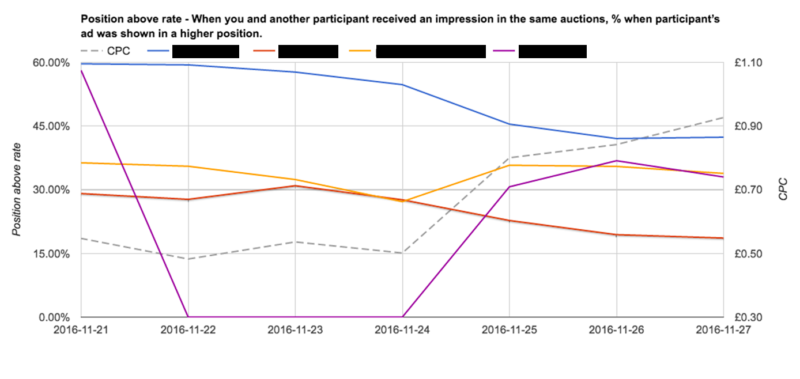
The best (and only empirical) source of competitor data is the AdWords Auctions Insights report. The only problem with this report is that it’s not easy to see changes over time, you can’t do any filtering, and you can’t add in any of your own performance data to see how competitor changes affected anything. And it can’t be pulled automatically, even after it’s been available for four years.
Anyway, a while back we shared how we visualize the Auctions Insights report at Brainlabs HQ to solve all of these problems. Now we’re back with a souped-up version 2.0 of our script. As well as CPC (cost per click), you can now see how CTR (click-through rate), impressions or searches vary alongside the auction data, and you can pick out which competitors to show. You can also see the same reports for different devices or compare your performance in one stat between devices. This should be handy, now that separate desktop and tablet modifiers are here!
You may be wondering why we’re giving away all this PPC gold. Well, it’s like this:
  1. I’m a legend.
  2. This stuff is too good to keep to ourselves.
  3. It’s cool, but still quite lightweight compared to the Enterprise version in the Brainlabs Tech Stack.
So, here’s what the output will look like. Read on below for a how-to.
To make things easier for you, we have a template spreadsheet with the required sheets and the script already set up. The first step is to open the template, go to the File menu and click “Make a copy…” so you have your own version to fill with your own data.
Then, go to your AdWords account, select the campaigns you want to look at, and download the Auction Insights report, segmented by day, week or month. Copy it to the spreadsheet in the Auction Insights tab. Include the title in the top row — the headers should be on the second row of the spreadsheet.
(If you’re having problems with numbers or dates being wrong — like if Sheets is reading the day as the month, or not recognizing numbers with decimal places — you may need to change the locale of the spreadsheet. To do this, go to File, click “Spreadsheet settings…” and select your country from the Locale drop-down. If you’re using Excel, also make sure the columns are wide enough to show the data when you copy them, otherwise you may find all your dates turned into #####.)
Do the same with the Auction Insights report segmented by the same time period, but also segmented by device. Copy and paste that into the Auction Insights By Device sheet (again, make sure the headers are on the second row).
Lastly, if you want CTR, CPC, impressions or searches, then download a performance report for the same set of campaigns for the same date range, segmented by the same time period and (if you’re looking at device data) by device. You could go to the Dimensions tab and into the Time reports, then download them segmented by device. Or, if you’re only looking at some campaigns, you can go to the campaign view, filter it to only include the campaigns you’re after, and then download it segmented by time period and device. Just make sure there are clicks, impressions and cost columns — CTR, CPC and searches will be calculated from these. Copy this into the Performance Data sheet.
(If there are lots of campaigns, you may hit the limit of the number of cells in a Google Sheet. If that happens, then you can add up all the campaigns’ data for each day and device combination, and copy that into the Sheet — just keep the column headers the same and have them on row 2.)
Then, go to the Settings sheet. The cells I’ve highlighted in yellow in the screen shot below are filled in automatically. This includes the competitor names (listed in order of highest impression share), the device names and the column headings (both in the Reports to Make table).
In the Names From Reports section at the top, make sure that Date matches the name of the date column in your reports (which should be “Day,” “Week” or “Month” if the report is in English). Display URL Domain is the name of the column containing competitor names: “Display URL Domain” for Search campaigns or “Shop Display Name” for Shopping campaigns.
You shouldn’t need to change anything else if your reports are in English, but if you’re using a different language, you’ll need to update them: most are column names, and “You” is what the Auction Insights report shows as the domain/display name when it gives your performance.
Formatting is used to format the data. Feel free to replace the date format (e.g., with dd-MM-yyyy or MM/dd/yyyy) and the currency symbol (note the script won’t do any currency conversion for you!).
The Stats To Report section lets you pick which extra columns go in the data tables and which go into charts. Put “Yes” in the relevant cell to include a stat. Some things to note:
  • You can only add, at most, two stats to the chart. If you select more, then only the first two are included.
  • Note that if you want something in the chart, it has to be in the table (because that’s where the chart gets its data from).
  • If you haven’t copied anything into the Performance Data sheet, you can just leave all of these blank.
  • “Searches” is (approximately) the total number of available impressions. It is calculated as impressions divided by impression share; as the impression share is rounded, it is not a precise figure, especially if your impression share is low.
The Competitors To Include section should have a list of competitor display domains, drawn from the Auction Insights sheet. Put “Yes” by their names to include them in your reports, or leave the space next to them empty to ignore them.
  • All selected competitors will be in the data tables.
  • To prevent the charts from being too crowded, only the first six selected competitors are included.
The Reports To Make section lets you pick which reports are generated. The top row is filled out automatically with the column headers from the Auction Insights sheet (because the columns will be different if you’re looking at Shopping rather than Search campaigns, or if your report is in another language).
  • The Total row gives you a report of your and your selected competitors’ performance (alongside your selected stats) for all devices. This uses data from the “Auction Insights” sheet.
  • There are then three rows for devices, using the names from the “Auction Insights By Device” sheet. Putting a “Yes” for these rows gives you a report of your and your selected competitors’ performance (alongside your selected stats) for the named device.
  • The last row is Compare All Devices, which gives you your total average performance and performance segmented by device. This report does not include competitor data.
  • You can’t make a Compare All Devices report for columns like “Position above rate,” as they don’t have any data on your performance.
When you’re all ready, hit the “Click Here To Generate Reports” button! You’ll need to give authorization the first time you do this so the script can run. Your reports should all be generated, one report per sheet. If there are any issues, there should be a message box to say what the problem is.
You can also delete all reports with the “Delete Reports” button. Note that if you’ve run the report before, it will delete and remake any of the reports you’ve selected — so make sure you save the output somewhere!

As always, feel free to send me questions/praise/insults on LinkedIn. Unfortunately, I can’t fix this for you if it’s broken — but I promise it works, and it’s amazing!

Some opinions expressed in this article may be those of a guest author and not necessarily Search Engine Land. Staff authors are listed here.

To know more latest update or tips about Search Engine Optimization (SEO), Search Engine Marketing (SEM) - Fill ContactUs Form or call at +44 2032892236 or Email us at - adviser.illusiongroups@gmail.com.


Friday, 17 February 2017

How retailers can leverage search and social media data for optimal local marketing performance

Which search and discovery sites do your customers rely on?

Gathering insights such as who your consumers are, how they found you, when they’re likely to visit your store, and the products they’re interested in, can help your business make intelligent decisions backed by actionable analytics.
This white paper from Sweet IQ, reveals why your brand needs to gather data from Google My Business, Facebook, Foursquare, Bing and Yelp for smarter marketing.
Visit Digital Marketing Depot to download “Data for Retailers: Harnessing Insights for Optimal Local Performance.
To know more latest update or tips about Search Engine Optimization (SEO), Search Engine Marketing (SEM) - Fill ContactUs Form or call at +44 2032892236 or Email us at - adviser.illusiongroups@gmail.com.