Pages

Showing posts with label LOCAL SEO. Show all posts

Wednesday, 20 September 2017

5 easy-to-miss SEO mistakes blogs make

Is your content great, but not ranking? Columnist Kristopher Jones shares some of the more common SEO errors bloggers and content marketers make.

The digital marketing landscape has evolved significantly over the last two decades. And between Google’s ever-changing algorithm and the deluge of misinformation floating through the digital marketing sphere, it’s easy to lose sight of basic practices we should be employing in our own SEO and content marketing strategies.
With every new algorithm update and technological shift in search, we become obsessed with how the field of SEO will enter a wholly new paradigm, and we shift our focus to reflect this. Yet as much as the medium may change, the core principles remain the same — and it’s time to get back to the basics.
We all understand the secrets and best practices of SEO, so why do we often fail to leverage these tactics? Let’s explore five common blogging mistakes you may be making right now.

Unoptimized keyword structure

Despite the rise of semantic search and machine learning technology, keyword research should still take precedence when modeling an internal content marketing campaign. All on-site content should be thematically linked by topics and keywords to your overall business objectives.
If our content is simply covering topics and not keywords, how do we know what users really demand? Without keyword research, how can you truly know who your audience is and who you are writing for?
Keywords serve as the bridge between user intent and informational/transactional content. Keyword-optimized content helps to position individual web pages to rank higher organically and drive impressions for targeted searches. This effectively makes blog content a lead generator.
For on-site blogs, the focus should remain on informational long-tail keyword phrases. Common examples include question phrases beginning with how, what, when, where and why.
Other keyword ideas could include actionable phrases that are often searched for, such as the top “tips” and “hacks” to improve upon some process.
Bloggers often fail to optimize their headers, meta tags and content with targeted keyword phrases. Consider the fact that specific keyword phrases will often be bolded within the meta description of a SERP listing, potentially increasing your click-through rate.
Inadequate keyword research runs deeper than failing to optimize your header structure (e.g., title, meta description). Many bloggers fail to leverage semantic SEO, or similar keyword phrases with the same meaning. Semantic SEO allows bloggers to create more thorough and readable content that can drive impressions for multiple keyword phrases, answer more user questions and qualify your content to be a featured snippet — think of the rise of voice search.
On the other hand, over-optimized content could cross a dangerous line as well. Keyword stuffing, or possessing a high keyword density, will qualify your content as spam. Keyword stuffing also obstructs your content’s readability, which results in poor user signals.
Following SEO best practices, it’s still important to optimize all relevant site elements, such as URLs and meta tags, with targeted keywords to categorize and rank individual web pages. And aside from signaling to search engines the main focus of your on-site content, keywords also serve an important function for your site architecture.

Inconsistent internal links

Internal linking is probably one of the most overlooked aspects of SEO optimization, and issues with internal links frequently occur on SEO agency websites themselves!
There are many functions of proper internal linking for SEO:
  • Establishes paths for users to navigate your website.
  • Opens up crawling to deep linked web pages and increases crawl rate.
  • Defines site architecture and your most important web pages to search engines.
  • Distributes “link juice,” or authority, throughout your website.
  • Indexes linked-to web pages by the keywords used in the hyperlink anchor text.
While backlinks remain the gold standard of search engine ranking factors, their magic can be amplified through strategic internal linking.
Ideally, you’ll want at least three to five internal links per blog post, and a drop-down or navigation menu on your home page to provide deep links to inaccessible web pages. Just because a piece of content is posted to your blog, it doesn’t mean Google or Bing can automatically access it.
Conduct a thorough internal link audit and record which web pages have the most authority. Simply insert internal links on these pages to other high-value internal pages to distribute authority evenly throughout your domain.
Many websites display featured posts in a drop-down menu or on the home page to distribute authority to their blog posts. A blogger’s home page will be his/her most authoritative. Limit the number of links between each blog post and your home page to evenly distribute link juice throughout your domain.
Don’t overlook the importance of a sitemap, either. This will ensure all web pages are properly crawled and indexed — assuming URL structures are clean and keyword-optimized.
Finally, optimize all anchor text to categorize and drive impressions for linked web pages. Be sure to use varying anchor text phrases for each link so that you can rank your web pages for multiple search queries.

Poor page copy

As we often say in digital marketing, it’s important to write for readers and not search engines. Keep content light, don’t try to show off knowledge with excessive jargon, and write for readers on an eighth-grade reading level.
In most cases, on-site content is not about publishing, but building awareness around a need. I always suggest placing actionable tips in informational content to provide value.
Content marketing is as much a branding exercise as it is a marketing tactic. Consistent content production establishes your brand’s ethos and also creates your voice as an author. In turn, this establishes you as an authority in your niche.
Don’t sacrifice this authority with poor body copy.
Look over your blog post as a whole. What does a reader experience when they first encounter your web page? Consider the fact that the average attention span is estimated to be eight seconds. Optimize your header structure and meta tags to encourage easy scanability and communicate a clear purpose.
Leverage a powerful headline to pique reader interest, and nurture this interest with a strong introductory paragraph. Always insert clear transition phrases, and consider using animated GIFs and videos to give users a mental break between long chunks of paragraphs. These will also increase your average user dwell time.
Make your content visually appealing by utilizing white space properly and inserting images after every 400 words or so. This essentially chunks content and prevents information overload.
Finally, edit fiercely. Many writers live by the rule that about two-thirds of writing should be editing and reworking. Use tools such as Grammarly and the Hemingway App to create concise and clean body copy.

Unoptimized images and videos

Speaking of poor page copy, most bloggers still ignore image and video optimization. Unoptimized image file formats and sizes are the most common load time mistakes that deteriorate SEO performance.
All on-site images should be formatted as .jpg, and all vector images as .png.
Always optimize image alt text to position it to rank in a targeted keyword image search. The alternative text is what’s displayed when a browser fails to actually display the image and tells search engines the content of your image. (It’s also used to describe images to those with screen readers.)
When optimizing video files, host all of your video files in a single folder and create a video site map for search engines to index your videos. You should optimize the meta description of all video pages with targeted keywords for indexation. Leverage a call to action in your meta description and video annotations.
Video marketing can be distributed from multiple channels, as well as your blog. According to a recent survey by HubSpot, 43 percent of consumers want to see more video from content marketers.

Poor content promotion

This leads us to probably the greatest error that plagues bloggers and stumps small businesses. We’re told that a good piece of content should serve as a natural link magnet and even rank highly based on the merits of the writing itself. To be candid, from experience we’ve discovered this isn’t always true.
Consider the idea that a 10-hour project totaling 3,245 words, featuring exquisite content and imagery, is just as useless as a poorly written 400-word listicle if it doesn’t drive conversions or traffic. This is what I refer to as potential energy. Without a proper technical structure or any content promotion strategy at work, your awe-inspiring content is a dud.
What if, after writing his Theory of Relativity, Einstein had simply posted his theory on his front door and waited for someone to discover it? Content distributed over a blog on a young domain won’t gather backlinks or social shares without promotion.
Leverage your connections, and follow these strategies to promote content and allow it to compound over social media:
  1. Have influential members of your organization share and promote a piece of content.
  2. Contact influencers over social media to share content.
  3. Request a quote from an industry thought leader to place in your content; advertise this in your rich snippet on social media channels.
  4. Repurpose content into a video or infographic for greater shareability.
  5. Contact websites that have linked to similar content in the past.
  6. Submit your content to replace relevant broken links on authoritative sites.
  7. Run a paid advertisement campaign over social media to place content directly in front of targeted audience members.
Content promotion involves thorough audience analysis. Segment audience members into one of three boundaries based on habits, demographics and psychographics. Investigate what social media channels each audience segment uses the most and the points of time when they are most active.
Understand which pieces of content perform best over specific social media channels. The most viral content examples include:
  • “How-to” tutorials
  • Infographics
  • Videos
  • Listicles
  • “Why” articles
Content serves as an effective pull marketing tactic and inbound lead generator. Yet, if content is simply sitting on the shelf and gathering dust, it’s a lost investment.
Social and user signals factor greatly into organic ranking. Essentially, social promotion will draw users to your content, which will determine — based on their engagement — the efficacy of your content.

Conclusion

SEO agencies and content marketers often tell clients about technical and onsite errors they may be making. But sometimes it takes a little realism to take a step back and analyze our own campaigns for greater success in the long run.
Hopefully, you’ll take the news that your SEO content strategy is imperfect in the right way. It’s an opportunity to refine and improve.

Some opinions expressed in this article may be those of a guest author and not necessarily Search Engine Land. Staff authors are listed here.
 know more latest update or tips about Search Engine Optimization (SEO), Search Engine Marketing (SEM) - Fill ContactUs Form or call at +44 2032892236 or Email us at - adviser.illusiongroups@gmail.com. 

Thursday, 14 September 2017

Leading up to the mobile-first index, Google has some advice

Want to take your mobile site from an m-dot to responsive? Here is how Google recommends you do it.

We all know the Google mobile first index is coming soon, probably in the next few months or so. To prepare, it seems like Google is encouraging webmasters to go responsive with their web sites.
Google has just published a how-to on moving your m-dot site to responsive. The techniques are pretty basic but it is an excellent reminder that while Google supports many mobile implementations, they do recommend responsive. In fact, Google has recommended that if you are switching to responsive, do it before the mobile first rollout.
Here are the steps Google wrote to move from m-dot to responsive:
  1. Get your responsive site ready
  2. Configure 301 redirects on the old mobile URLs to point to the responsive versions (the new pages). These redirects need to be done on a per-URL basis, individually from each mobile URLs to the responsive URLs.
  3. Remove any mobile-URL specific configuration your site might have, such as conditional redirects or a vary HTTP header.
  4. As a good practice, setup rel=canonical on the responsive URLs pointing to themselves (self-referential canonicals).
know more latest update or tips about Search Engine Optimization (SEO), Search Engine Marketing (SEM) - Fill ContactUs Form or call at +44 2032892236 or Email us at - adviser.illusiongroups@gmail.com. 

Sunday, 10 September 2017

Don’t follow the leader: Avoid these 5 common e-commerce SEO mistakes

We often look to industry leaders for inspiration, but columnist Brian Weiss notes that big e-commerce players are often making critical SEO mistakes that should not be emulated.

Competitive research is an important part of any SEO program — after all, it’s a zero-sum game that we’re playing. However, there is often a tendency for companies to become fixated on what dominant competitors in the marketplace are doing. The assumption is that because they’re getting the most SEO traffic, they must be doing things right.
In many industries, it is true that the high SEO traffic sites really are doing an exceptional job. But in the world of e-commerce, this is often not the case. Many of the highest traffic e-commerce sites are doing things that are objectively bad for SEO. It turns out that a strong backlink profile and other prominent brand signals can make up for an awful lot of mistakes.
Getting things right for enterprise e-commerce SEO can be really challenging. You often have to merge very different sources of product data into a single system and make everything work. There are more pages than you could ever curate manually. And in most cases, SEO is not the largest driver of traffic and may have to take a back seat to other priorities. It’s tough.
Eventually, people are going to figure out how to address the issues that make e-commerce SEO so cumbersome and hard to scale. Sites that apply these new techniques will gain an advantage, and then everyone will race to copy them and this article will be outdated. I believe that point is still some years away.
Until then, there are opportunities to gain an SEO advantage over most of the major e-commerce players by simply avoiding their most common mistakes.

1. Faceted navigation disasters

When faceted navigation isn’t controlled, you can often end up with more category URLs, by orders of magnitude, than total products on the site. Clearly, something is wrong with that picture.
On the other end of the spectrum, you have companies that are so scared of creating too many pages that they noindex their entire faceted navigation or canonical everything to the root page. Doing this can prevent indexation of potentially valuable pages (usually ones with two or one attributes selected) and it still may not fix the crawl problems that their navigation poses.
There is a middle path, and few try to walk it. While fixing your filtered navigation is an entire topic of its own, a good starting point is to consider using dynamic AJAX sorting for thin attributes, so users can refine the product set without changing the URL.
There is plenty of readily available data about the impact of site speed on conversion and bounce rates. A couple of seconds can make an enormous difference in user engagement. So why do retailers seem to be competing to load the most external scripts? The retail market is underinvested in speed and overinvested in lag-inducing features that often have marginal benefits and may even serve to overwhelm the user.
My experience is that the SEO benefits of page speed are not yet as substantial as the conversion optimization impact. With all the information Google is sharing about the user benefits of fast, streamlined sites, it’s only a matter of time until speed becomes a more prominent ranking factor. However, when UX impact is also taken into account, there’s no reason to wait.

3. Reliance on XML sitemaps for indexation

If there is one simple piece of SEO wisdom that every enterprise manager should remember, it’s that each page needs to have a crawl path to have a chance to rank for competitive queries. There are many unique and exciting ways (from the perspective of someone who is paid to fix websites) that sites are able to orphan a large percentage of their product or other important pages from their browsable architecture.
Possibilities include broken pagination, creating nearly infinite URL spaces, and any form of link generation logic that doesn’t systematically ensure that every product has a crawl path.
If you’re unsure about whether you have an adequate crawl path, crawl your site and see if all your important pages are showing up. If you are not able to do a complete crawl of your site, that means either that you have too many pages or you need a better crawler. If you have a very large site, you likely need help with both. And if you’re spending lots of time looking at the sitemaps dashboard in Google Search Console, wondering why your pages aren’t being indexed, it’s most likely because they don’t have a good crawl path.

4. Using tags completely wrong

Many e-commerce sites have conflicting tagging signals on their category pages and tagging structures that are suboptimal. I have seen at least two Fortune 500 owned e-commerce sites that were making all the pages on their site canonical to the home page, which is equivalent to telling Google that none of the other pages on the site have anything else to offer. I have seen more sites than I can count on one hand do their pagination tagging incorrectly, which is surprising, because it’s a plainly spelled-out specification.
I suspect that Google’s assumed omniscience sometimes hinders the careful adoption of standards. People think they can get it close enough and Google will figure it out. Sometimes they do. Sometimes they don’t. And sometimes, even if Google can figure out all your mistakes, it’s still a loss — especially if they are having to crawl extra pages to do so.

5. Ugly URLs

Here’s a thought experiment. Let’s set SEO aside for a moment and look at two different URLs that we might see in a SERP:
Site 1: www.madfancylad.com/c/armani-fedoras
Site 2: www.bromendous.com/search?product%20line=fedora&brand=Armani&REFID=23ghaWHY23093482
Which site seems more likely to make things easy for their shoppers, and which site seems more likely to make things easy for themselves? What kind of conscious and unconscious assumptions might a shopper make about each?
My experience is that short, clear and concise URLs tend to rank well and get more traffic than long, parameter-laden addresses. There are some correlational studies that support this observation. I don’t consider any of them definitive — but I know what I would choose to do for my site.

Some opinions expressed in this article may be those of a guest author and not necessarily Search Engine Land. Staff authors are listed here.
know more latest update or tips about Search Engine Optimization (SEO), Search Engine Marketing (SEM) - Fill ContactUs Form or call at +44 2032892236 or Email us at - adviser.illusiongroups@gmail.com.

Friday, 8 September 2017

6 things you need to know about Google’s Q&A feature on Google Maps

Noticed the new 'questions & answers' section in Google Maps app listings? Columnist Joy Hawkins shares her observations about this helpful new feature.

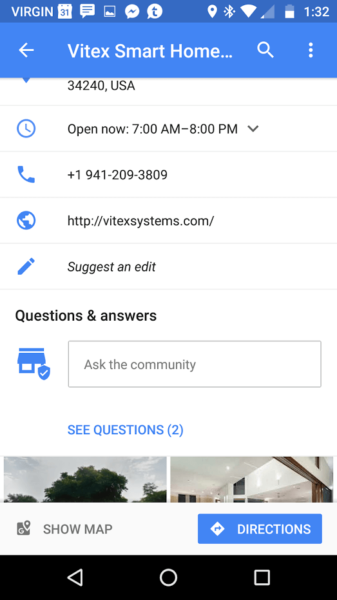
In mid-August, Google rolled out a new feature on the Google Maps app for Android called Questions & Answers. This feature is currently also available on mobile browsers.

Here are some aspects of this new feature that business owners and marketers may need to be aware of.

1. If you don’t see the feature, you might need to update the app

I’ve spoken to many users who don’t see the feature on listings, but once they go to the Play Store and install an update to the app, they are able to see it.

2. Customers don’t get notifications (yet)

If a user asks a question, he or she won’t get notified when someone responds. This is contrary to what Google stated in their announcement: “When you get an answer, we’ll notify you through Google Maps.” In every test I have done thus far, the user who asks the question doesn’t get a notification when you respond to it. My assumption is that this is a bug that will get corrected over time.

3. Business owners will need the Google Maps app to keep track of questions

In order to be notified about questions submitted by customers, business owners must have the Google Maps app and must be signed in with the same Google account that they use to manage their listing in Google My Business. These notifications don’t show up anywhere currently in Google My Business, so if you’re not using the Google Maps app, you will have no idea when someone asks a question about your business.
To test this, I had another user submit a question on a listing that I manage via Google My Business. Within seconds, I got a push notification on my phone on the Google Maps app.

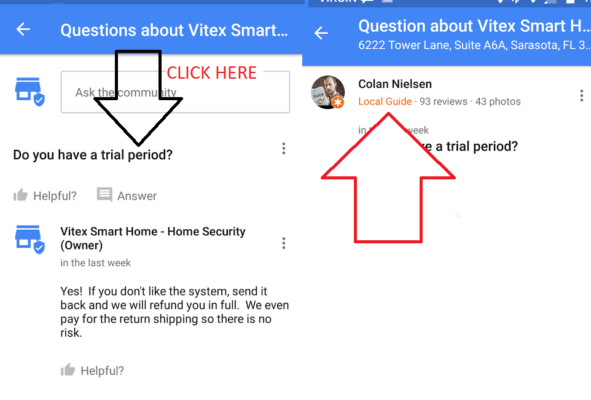
4. You can see the profile and name of the person who asked the question

On the initial screen that shows the questions, you don’t see any information about who submitted the question — but all you need to do is click the question itself to see this info.

5. Business owners should avoid answering with a generic “yes” or “no”

Tom Waddington pointed out that a business owner would have no idea if the user goes back and edits their question later. For example, I could post a question on the listing for a restaurant asking, “Are there vegan options?” If they responded with just “yes,” I could go back and edit my question to change it to, “Have you been cited by the health department?” and the answer would stay the same.
It’s always best to stay one step ahead of spammers. We all know this feature is going to get abused at some point.

6. Upvoting questions will impact how they show up

In their announcement, Google mentioned that “upvoting makes popular questions more visible.” I tried this out on a listing to see what the impact was. Before the question had any votes, this is how it appeared:
I had someone go and “like” the question (not the answer), and a few minutes later, the listing now looked like this:
Notice how the question and answer both show up on the actual listing itself now, without the user having to click further.

Final thoughts

I anticipate that Google will continue to make developments to this feature to help make it more useful to both users and businesses. If you have any success stories about Questions & Answers that you want to share, feel free to reach out to me on Twitter.

Some opinions expressed in this article may be those of a guest author and not necessarily Search Engine Land. Staff authors are listed here.

know more latest update or tips about Search Engine Optimization (SEO), Search Engine Marketing (SEM) - Fill ContactUs Form or call at +44 2032892236 or Email us at - adviser.illusiongroups@gmail.com.

Thursday, 9 March 2017

Big changes are coming to local marketing, are you ready for them?

Don't wait for the future to happen to your business.

If you manage marketing or search for a multi-location brand, you already know the game-changing potential of local search. But just when you think you’ve got everything figured out, the rules change.
The local marketing industry has been over-focused on listings management, and today it’s primed for a rapid evolution. In 2017, local search will be about generating ROI from your efforts by getting more customers to your locations.
In this white paper, SweetIQ outlines 5 strategies you can apply to local marketing right now and bring the future to all your locations.
Visit Digital Marketing Depot to download “The Future of Local Marketing is Now: 5 Ways Local Marketing Will Impact The Way You Do Business This Year.”

 know more latest update or tips about Search Engine Optimization (SEO), Search Engine Marketing (SEM) - Fill ContactUs Form or call at +44 2032892236 or Email us at - adviser.illusiongroups@gmail.com.

Friday, 17 February 2017

How retailers can leverage search and social media data for optimal local marketing performance

Which search and discovery sites do your customers rely on?

Gathering insights such as who your consumers are, how they found you, when they’re likely to visit your store, and the products they’re interested in, can help your business make intelligent decisions backed by actionable analytics.
This white paper from Sweet IQ, reveals why your brand needs to gather data from Google My Business, Facebook, Foursquare, Bing and Yelp for smarter marketing.
Visit Digital Marketing Depot to download “Data for Retailers: Harnessing Insights for Optimal Local Performance.
To know more latest update or tips about Search Engine Optimization (SEO), Search Engine Marketing (SEM) - Fill ContactUs Form or call at +44 2032892236 or Email us at - adviser.illusiongroups@gmail.com.

Tuesday, 27 December 2016

Improve search rankings and increase productivity with local marketing automation software

Managing online citations, claimed and unclaimed listings, reviews and ratings, landing pages and data feeds for hundreds or thousands of locations has become time-consuming and costly for enterprise brands. Automating these processes can improve search rankings, increase productivity and lower CPCs due to better SEO.
Marketing Land’s “Enterprise Local Marketing Automation Platforms” examines the market for local marketing automation platforms. The 50-page report reviews current trends and issues in enterprise local marketing automation, including omnichannel marketing, tag management and mobile measurement and optimization.
Also included in the report are profiles of 17 leading enterprise local marketing automation vendors, pricing charts, capabilities comparisons and recommended steps for evaluating and purchasing.

To know more latest update or tips about Search Engine Optimization (SEO), Search Engine Marketing (SEM) - Fill ContactUs Form or call at +44 2032892236 or Email us at - adviser.illusiongroups@gmail.com.

Thursday, 22 December 2016

BrightLocal opens its 2016 local SEO survey to see how the industry has changed over the last year

Survey questions cover everything from SEO agency size and revenue to services offered and retainer fees.

BrightLocal has posted its annual local SEO survey, asking SEO professional to answer 22 questions about the state of the local search marketing industry.
Questions range from the size of the survey participant’s company and its annual revenue to services offered and retainer fees.
“The goal of this survey is to help us gain a better understanding about the evolution and changes in the local search marketing industry, and what the mood and outlook is for local SEO in 2017 and beyond,” wrote a BrightLocal spokesperson in an email to Search Engine Land.
BrightLocal says it will share survey results with the participants, its customers, followers and the SEO industry at large on January 18, 2017. Survey responses will be collected until January 15, 2017, and anyone who completes the survey can enter their email address for a chance to win a $1,000 Visa gift card.
The survey can be completed on BrightLocal’s website at: Local SEO Industry Survey 2016.
Last year’s BrightLocal survey results were covered on Search Engine Land by the company’s founder and CEO Myles Anderson: 78% Of SEOs Believe That 2016 Is Going To Be A “Great” Year For Business
To know more latest update or tips about Search Engine Optimization (SEO), Search Engine Marketing (SEM) - Fill ContactUs Form or call at +44 2032892236 or Email us at - adviser.illusiongroups@gmail.com.

Friday, 16 December 2016

Why data amplifiers matter in a world of omnichannel discovery

Local customers now expect a seamless omnichannel experience with your brand, and columnist Adam Dorfman believes that targeting data amplifiers will ensure that you're present with accurate data across devices and channels.

In my October Search Engine Land column, I discussed the rise of data amplifiers — or data aggregators (such as Neustar) and publishers (such as Google) that share a business’s location data across the digital world, where people conduct “near me” searches.
I believe data amplifiers will become even more important in 2017 because of the impact of the on-demand, omnichannel consumer. To be effective with location marketing in 2017, any brand that operates multiple locations needs to make it a high priority to share their location data with amplifiers.
Data amplifiers wield an inordinate amount of influence because of their reach, size and ability to innovate. At SIM Partners, we identify the main data amplifiers this way:
  • Data publishers: The heavy hitters of the search world, such as Google and Apple, which have either built their own search ecosystems or actively shape search. Our short list of the most influential publishers consists of Apple, Bing, Facebook, Foursquare, Google and Yelp. If you want your data shared on crucial discovery platforms such as Google Maps, you had better make sure your location data is shared with publishers.
  • Data aggregators: A bit less-known outside the realm of location marketing, but they’re important because they share a brand’s data to the publishers. We tend to count Acxiom, Factual, Infogroup and Neustar as the principal aggregators.
Although both aggregators and publishers act as sources of local business information for discovery platforms such as apps, data services and Web directories, we make the distinction between data aggregators and data publishers to clarify how they relate to each other.
In a multichannel world, amplifiers are becoming more important because they are the most efficient, cost-effective way for any business to keep pace with omnichannel consumers. As I mentioned in my last column, omnichannel consumers are discovering brands across an increasingly complex web of apps, channels and devices. Consider the following:
  • Roughly four out of 10 businesses interact with consumers across five or more channels, per Experian.
  • According to Google, approximately 60 percent of online consumers start shopping on one device but continue doing so on another.
  • Consumers spend 85 percent of their time on smartphones using native apps, according to Forrester.
And here’s the challenge for businesses: omnichannel consumers expect you to be present no matter what apps, devices or channels they use… which leaves businesses with two very big problems:
  • Missed opportunities. It’s extremely difficult for businesses to be everywhere consumers expect them to be in an omnichannel world.
  • Customer experiences at risk. It’s equally difficult for businesses to keep their location data up to date everywhere consumers look for them, resulting in consumers encountering inaccurate location data and having a poor experience.
The challenge is only increasing as automobiles become more sophisticated data delivery devices, apps continue to proliferate, and businesses figure out more creative ways to respond to on-demand consumers on platforms such as Uber and Pinterest through one-click ordering and buying.
I can easily think of 100 search engines, directories, social media sites and internet yellow pages where brands need to be present, and another 30 auto-related navigation systems that form the core of the consumer discovery experience.
Put another way, the local data ecosystem is in immense flux because of the constantly evolving apps and tools that use location data. If a brand is not paying attention to its data layer — the part of the brand’s identity beyond the presentation layer, where location-related data resides — then they’ll be left behind in a constantly changing world of omnichannel discovery.
Some brands make the mistake of trying to directly manage their location data across a vast sea of tier-two directories, hoping that a scattershot approach will cover most of the search universe.
Those brands are always going to be behind the curve and focusing on perceived problems that don’t affect performance, forever playing a game of catch-up amid an explosion of discovery platforms. They’re also wasting valuable time, resources and money in the process.
The better approach is to invest one’s time more efficiently across a smaller cluster of high-impact data amplifiers. Because of their brand strength, scale and reach, data amplifiers can influence far more places where consumers do “near me” searches across multiple channels, apps and devices. Doing so, you will reap many benefits:
  • You will invest your money and resources more efficiently by targeting a smaller core of players who have more reach. The same Forrester study about smartphone app usage also noted that Facebook and Google alone account for 25 percent of total minutes spent by US consumers on smartphones, making them the two most popular destinations. (Apple also made the list of most popular apps.) Just from the perspective of time consumers spend on smartphone apps, these two data amplifiers are huge.
  • You will be more visible across all the places where consumers are looking for you and your competitors.
  • You will benefit from the innovations that data amplifiers typically develop each year, such as Google’s many algorithm changes and product updates. When Google changes the search ecosystem, you’ll be right there with them.
Omnichannel consumers long ago escaped the strictures of doing Google desktop searches. They are going to find what they want on their own terms — and where they find you tomorrow will be different from where they’re looking for you today. Data amplifiers will ensure that you’re present with accurate data any time, any place.
To know more latest update or tips about Search Engine Optimization (SEO), Search Engine Marketing (SEM) - Fill ContactUs Form or call at +44 2032892236 or Email us at - adviser.illusiongroups@gmail.com

Thursday, 17 November 2016

Moz beefs up Moz Local with new features, distribution and automation

With new activity alerts, GMB sync and reputation management, the expanded Moz Local is intended to equally serve the small business, agency and enterprise markets.


Moz has overhauled and enhanced its Moz Local offering, adding new features and automation the company says were requested by users and the broader local SEO community. The product previously offered listings monitoring and syndication.
Moz says that it had conversations with its numerous customers, agency partners and the broader community before revamping the product. The new features add speed and workflow improvements, according to the company.
These new features include:
  • Google My Business sync: automatically synchronizes listings with GMB. Users can manage changes and updates directly from the Moz dashboard
  • Listing alerts: provides an activity feed if listings data are overwritten or in some other way changed vs. the information in the Moz-managed listing
  • Reputation monitoring/management: new monitoring of Google reviews, which joins comparable functionality for a range of directories, including Foursquare, Yelp, YP and others. New reviews are also available as they’re published, within the Moz dashboard. Users can respond to Google reviews as well.
  • Expanded distribution: new data providers/partners added to its existing sources (Acxiom, Factual, Infogroup, Neustar Localeze and “a few powerful directories”). Those new distribution sources include Hotfrog, Apple Maps, HERE, TomTom and Navmii. Some of these come through a partnership through NavAds.
  • Improved SEO metrics for organic rankings and the Local Pack.
In the same post announcing the product expansion, Moz identifies its major competitors:
  • Brandify
  • Bright Local
  • MomentFeed
  • Rio SEO
  • SIM Partners
  • Vendasta
  • Yext
One of the more interesting new features is the activity feed, which shows agencies or marketers that the system is working. This has been one of the challenges for SEO practitioners, especially when it comes to the SMB market: proving that listings/presence management is actually delivering value.
Expanded reputation management has been added, in part because Google review counts and corresponding scores are now ranking factors. However, it’s also a key consumer consideration. Moz competitor Yext recently launched a new reviews product because of their growing importance on various fronts.
Many will read this and think these features already exist else where. Indeed they do; however, Moz argues its local SEO expertise is unsurpassed and that, holistically, the new tools together produce a superior product. Moz also says that use of its software delivered a nearly 20 percent average “Listing Score” increase across its customer base, as well as greatly improved visibility/reach.
The new and improved Moz Local is intended to equally serve the small business, agency and enterprise markets. It’s available in three tiers: essential, professional and premium, which range in price from roughly $9 to $21 per month.
To know more latest update or tips about Search Engine Optimization (SEO), Search Engine Marketing (SEM) - Fill ContactUs Form or call at +44 2032892236 or Email us at - adviser.illusiongroups@gmail.com