Pages

Showing posts with label CONTENT & WRITING. Show all posts

Wednesday, 20 September 2017

5 easy-to-miss SEO mistakes blogs make

Is your content great, but not ranking? Columnist Kristopher Jones shares some of the more common SEO errors bloggers and content marketers make.

The digital marketing landscape has evolved significantly over the last two decades. And between Google’s ever-changing algorithm and the deluge of misinformation floating through the digital marketing sphere, it’s easy to lose sight of basic practices we should be employing in our own SEO and content marketing strategies.
With every new algorithm update and technological shift in search, we become obsessed with how the field of SEO will enter a wholly new paradigm, and we shift our focus to reflect this. Yet as much as the medium may change, the core principles remain the same — and it’s time to get back to the basics.
We all understand the secrets and best practices of SEO, so why do we often fail to leverage these tactics? Let’s explore five common blogging mistakes you may be making right now.

Unoptimized keyword structure

Despite the rise of semantic search and machine learning technology, keyword research should still take precedence when modeling an internal content marketing campaign. All on-site content should be thematically linked by topics and keywords to your overall business objectives.
If our content is simply covering topics and not keywords, how do we know what users really demand? Without keyword research, how can you truly know who your audience is and who you are writing for?
Keywords serve as the bridge between user intent and informational/transactional content. Keyword-optimized content helps to position individual web pages to rank higher organically and drive impressions for targeted searches. This effectively makes blog content a lead generator.
For on-site blogs, the focus should remain on informational long-tail keyword phrases. Common examples include question phrases beginning with how, what, when, where and why.
Other keyword ideas could include actionable phrases that are often searched for, such as the top “tips” and “hacks” to improve upon some process.
Bloggers often fail to optimize their headers, meta tags and content with targeted keyword phrases. Consider the fact that specific keyword phrases will often be bolded within the meta description of a SERP listing, potentially increasing your click-through rate.
Inadequate keyword research runs deeper than failing to optimize your header structure (e.g., title, meta description). Many bloggers fail to leverage semantic SEO, or similar keyword phrases with the same meaning. Semantic SEO allows bloggers to create more thorough and readable content that can drive impressions for multiple keyword phrases, answer more user questions and qualify your content to be a featured snippet — think of the rise of voice search.
On the other hand, over-optimized content could cross a dangerous line as well. Keyword stuffing, or possessing a high keyword density, will qualify your content as spam. Keyword stuffing also obstructs your content’s readability, which results in poor user signals.
Following SEO best practices, it’s still important to optimize all relevant site elements, such as URLs and meta tags, with targeted keywords to categorize and rank individual web pages. And aside from signaling to search engines the main focus of your on-site content, keywords also serve an important function for your site architecture.

Inconsistent internal links

Internal linking is probably one of the most overlooked aspects of SEO optimization, and issues with internal links frequently occur on SEO agency websites themselves!
There are many functions of proper internal linking for SEO:
  • Establishes paths for users to navigate your website.
  • Opens up crawling to deep linked web pages and increases crawl rate.
  • Defines site architecture and your most important web pages to search engines.
  • Distributes “link juice,” or authority, throughout your website.
  • Indexes linked-to web pages by the keywords used in the hyperlink anchor text.
While backlinks remain the gold standard of search engine ranking factors, their magic can be amplified through strategic internal linking.
Ideally, you’ll want at least three to five internal links per blog post, and a drop-down or navigation menu on your home page to provide deep links to inaccessible web pages. Just because a piece of content is posted to your blog, it doesn’t mean Google or Bing can automatically access it.
Conduct a thorough internal link audit and record which web pages have the most authority. Simply insert internal links on these pages to other high-value internal pages to distribute authority evenly throughout your domain.
Many websites display featured posts in a drop-down menu or on the home page to distribute authority to their blog posts. A blogger’s home page will be his/her most authoritative. Limit the number of links between each blog post and your home page to evenly distribute link juice throughout your domain.
Don’t overlook the importance of a sitemap, either. This will ensure all web pages are properly crawled and indexed — assuming URL structures are clean and keyword-optimized.
Finally, optimize all anchor text to categorize and drive impressions for linked web pages. Be sure to use varying anchor text phrases for each link so that you can rank your web pages for multiple search queries.

Poor page copy

As we often say in digital marketing, it’s important to write for readers and not search engines. Keep content light, don’t try to show off knowledge with excessive jargon, and write for readers on an eighth-grade reading level.
In most cases, on-site content is not about publishing, but building awareness around a need. I always suggest placing actionable tips in informational content to provide value.
Content marketing is as much a branding exercise as it is a marketing tactic. Consistent content production establishes your brand’s ethos and also creates your voice as an author. In turn, this establishes you as an authority in your niche.
Don’t sacrifice this authority with poor body copy.
Look over your blog post as a whole. What does a reader experience when they first encounter your web page? Consider the fact that the average attention span is estimated to be eight seconds. Optimize your header structure and meta tags to encourage easy scanability and communicate a clear purpose.
Leverage a powerful headline to pique reader interest, and nurture this interest with a strong introductory paragraph. Always insert clear transition phrases, and consider using animated GIFs and videos to give users a mental break between long chunks of paragraphs. These will also increase your average user dwell time.
Make your content visually appealing by utilizing white space properly and inserting images after every 400 words or so. This essentially chunks content and prevents information overload.
Finally, edit fiercely. Many writers live by the rule that about two-thirds of writing should be editing and reworking. Use tools such as Grammarly and the Hemingway App to create concise and clean body copy.

Unoptimized images and videos

Speaking of poor page copy, most bloggers still ignore image and video optimization. Unoptimized image file formats and sizes are the most common load time mistakes that deteriorate SEO performance.
All on-site images should be formatted as .jpg, and all vector images as .png.
Always optimize image alt text to position it to rank in a targeted keyword image search. The alternative text is what’s displayed when a browser fails to actually display the image and tells search engines the content of your image. (It’s also used to describe images to those with screen readers.)
When optimizing video files, host all of your video files in a single folder and create a video site map for search engines to index your videos. You should optimize the meta description of all video pages with targeted keywords for indexation. Leverage a call to action in your meta description and video annotations.
Video marketing can be distributed from multiple channels, as well as your blog. According to a recent survey by HubSpot, 43 percent of consumers want to see more video from content marketers.

Poor content promotion

This leads us to probably the greatest error that plagues bloggers and stumps small businesses. We’re told that a good piece of content should serve as a natural link magnet and even rank highly based on the merits of the writing itself. To be candid, from experience we’ve discovered this isn’t always true.
Consider the idea that a 10-hour project totaling 3,245 words, featuring exquisite content and imagery, is just as useless as a poorly written 400-word listicle if it doesn’t drive conversions or traffic. This is what I refer to as potential energy. Without a proper technical structure or any content promotion strategy at work, your awe-inspiring content is a dud.
What if, after writing his Theory of Relativity, Einstein had simply posted his theory on his front door and waited for someone to discover it? Content distributed over a blog on a young domain won’t gather backlinks or social shares without promotion.
Leverage your connections, and follow these strategies to promote content and allow it to compound over social media:
  1. Have influential members of your organization share and promote a piece of content.
  2. Contact influencers over social media to share content.
  3. Request a quote from an industry thought leader to place in your content; advertise this in your rich snippet on social media channels.
  4. Repurpose content into a video or infographic for greater shareability.
  5. Contact websites that have linked to similar content in the past.
  6. Submit your content to replace relevant broken links on authoritative sites.
  7. Run a paid advertisement campaign over social media to place content directly in front of targeted audience members.
Content promotion involves thorough audience analysis. Segment audience members into one of three boundaries based on habits, demographics and psychographics. Investigate what social media channels each audience segment uses the most and the points of time when they are most active.
Understand which pieces of content perform best over specific social media channels. The most viral content examples include:
  • “How-to” tutorials
  • Infographics
  • Videos
  • Listicles
  • “Why” articles
Content serves as an effective pull marketing tactic and inbound lead generator. Yet, if content is simply sitting on the shelf and gathering dust, it’s a lost investment.
Social and user signals factor greatly into organic ranking. Essentially, social promotion will draw users to your content, which will determine — based on their engagement — the efficacy of your content.

Conclusion

SEO agencies and content marketers often tell clients about technical and onsite errors they may be making. But sometimes it takes a little realism to take a step back and analyze our own campaigns for greater success in the long run.
Hopefully, you’ll take the news that your SEO content strategy is imperfect in the right way. It’s an opportunity to refine and improve.

Some opinions expressed in this article may be those of a guest author and not necessarily Search Engine Land. Staff authors are listed here.
 know more latest update or tips about Search Engine Optimization (SEO), Search Engine Marketing (SEM) - Fill ContactUs Form or call at +44 2032892236 or Email us at - adviser.illusiongroups@gmail.com. 

Thursday, 14 September 2017

How to conduct an SEO content audit

Columnist Thomas Stern shows how a content audit, when done right, can help you assess whether your content is relevant not only to your brand goals and SEO objectives, but also to the customer’s needs.

Google has thrown a ton of changes at marketers over the last few years. From major algorithm updates to voice search, all of these changes follow Google’s ultimate goal of creating the best search experience for its users.
The upshot is that it’s not enough to develop and optimize website content for just search engines anymore. As better language processing has become a major focus for improving search results, your brand’s site content is no longer speaking to search engines alone, but to actual people.
To appeal to both people and search engines, brands must evaluate their site content through an audit process to discover what may (or may not) be working and determine where to improve. A website content audit is the cornerstone of your entire content strategy.
When done right, a content audit helps to determine whether your website content is relevant to not only your brand goals and marketing objectives, but also to the customer’s needs. Audits can identify problems with accuracy, consistency, voice and tone; they can also provide direction for SEO.

Review existing content

Not every content audit is the same; it takes familiarity in many different digital marketing channels to set up a framework for success. However, each content audit has a few things in common, like evaluating quantitative and qualitative metrics for each page of a website.
The first step in each content audit is to record all of a website’s existing content. At ZOG Digital, we find it easiest to centralize the data and break out information like URLs, page titles, conversion rates, meta descriptions and so forth in a single spreadsheet to begin our process.
Take the time to evaluate your audience’s search habits and any historical data you have available. Some of the tools we like to use include:
  • Screaming Frog crawls websites’ pages, links and images and allows us to export the data to a spreadsheet.
  • Google Analytics lets us export the success metrics of each page, broken out by marketing channel.
  • Ahrefs allows us to look at the backlink profiles of each of our target pages.
Next, we layer in qualitative data about the page from a brand level and a content quality level. For our clients, we measure key pages against intended audience segments and brand objectives. As you evaluate each page, you should be able to appropriately grade each page and define next steps for them, too.
With each content audit, you need to define problems with your site’s overall health and identify any strengths and weaknesses. If you decide that the content lacks substance or has weak traffic but is essential to the brand, the content needs to be refreshed for current audiences. You’ll begin to see themes in each category page and be able to make informed recommendations for each part of the site.

Content creation for audience segmentation

After defining next steps, you need to be able to execute it effectively for your target audiences. Successful content marketing is all about targeting a niche and then, of course, making the most out of it in terms of engagement and revenue. Through audience segmentation, you can have laser-focused strategies around each audience type.
For an organization with a large B2B audience segment, like GE, product page or case study content may be the most important piece of content for their target audiences. For Nest, an innovative home and security brand, videos and testimonials might be more effective to establish the use case and value.
You have to refine your marketing tactics in a thoughtful manner when it comes to reaching your target audience. While defining, segmenting and prioritizing your audiences, you also need to define what content type will fill in a gap found in your content audit while also resonating your target audience.
This is where many brands will struggle — they need an agile team of experts to solve the problems uncovered by an initial content audit, while also aligning with target audience segments. Upon evaluating all aspects of current site content, you can fill in the gaps and create more appealing verbiage for your target audiences. Few brands have mastered this technique, and it’s key to be aware of their tactics and how they validate success.
For example, Mercedes-Benz ensures that a majority of their content is made for (and visible to) those who are willing to pay for their high-quality cars. However, they know they want to break into a younger demographic of drivers as well. That’s why they also create content and products that fit in with a millennial’s values, like high value for an affordable price, as well as a strong customer-brand relationship.
You’ll notice in the screen shot below that the first feature listed on the page is phone connectivity, rather than features like mileage or horsepower.
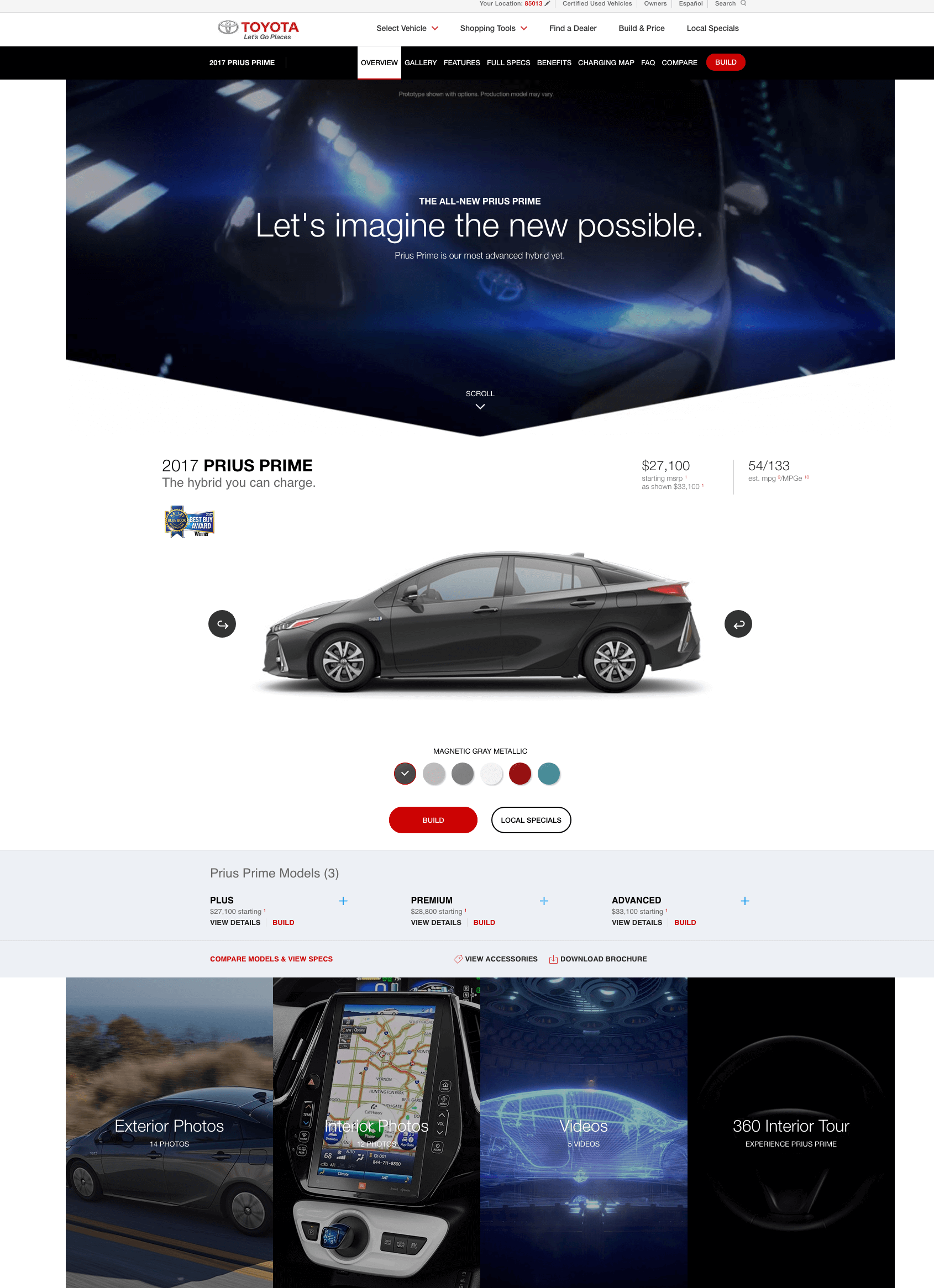
Meanwhile, Toyota’s been marketing their Prius Prime. The auto company claims this to be their most advanced hybrid yet, at a more affordable price than luxury car dealers. Toyota uses infographics to target millennials in the market for new cars who also care about energy efficiency.

Both car brands use different types of content to target their audiences on a deeper level. Notice that the goal is to focus on educating the consumer — they focus on audience segments before anything else.
It’s critical to take the time to augment the quantitative data by evaluating each page based on what humans value. For content audits, you need to appeal to both people and Google by being descriptive with a human touch. You can use the following tools to evaluate the quality of your content and formulate a clear understanding when it comes to content creation:
  • Google’s definition of high-quality content includes important factors like trustworthiness and expertise.
  • Triblio allows you to create personalized content for multichannel campaigns by persona.
  • Google AdWords Keyword Planner provides information on the interest (search volume) of target topics.
  • HemingwayApp grades pages based on how difficult they are to read.
We recommend doing a content audit every six to 12 months to ensure consistency and effectiveness of your on-site content as people and search engines evolve. An initial content audit will establish a baseline of data and insights to help you improve content quality. The subsequent content audits will then show you how your pages have grown since you implemented changes, as well as pinpointing any weaknesses that should be addressed.

Final thoughts

By developing a comprehensive content strategy around what you uncover with a robust content audit, you’ll be better able to improve your content development methods and have a baseline for any future changes or updates.

know more latest update or tips about Search Engine Optimization (SEO), Search Engine Marketing (SEM) - Fill ContactUs Form or call at +44 2032892236 or Email us at - adviser.illusiongroups@gmail.com. 

Monday, 2 January 2017

What you’re missing with SEO that will make a world of difference

While long-term efforts are SEO mainstays, contributor Julian Connors suggests more short-term reactive strategies can also have significant rankings impact.

There are two approaches to take when it comes to developing new digital marketing or online reputation strategies.
The first approach sees marketers and SEO strategists creating proactive campaigns that push content to consumers with the intention of soliciting immediate reactions.
The second method is considered to be responsive, where marketers create content that capitalizes on a particular concept or event to improve consumer awareness of their brand and its offering.
An example of responsive marketing is when solar energy companies distribute branded press releases when new tax incentives are approved by federal or state governments.

Proactive and reactive approaches to SEO

The vast majority of SEO strategists’ efforts are going to fall into the active position since they are always reviewing upcoming trends to determine how to maximize opportunities months in advance.
However, there are particular opportunities that allow strategists to combine both marketing approaches to improve brand awareness and solicit consumer reaction.
Consider these opportunities when creating a new SEO initiative.

1. Capitalize on internal events

If your company is on the verge of releasing a new product or service, you’re about to hire a well-known executive from a competing brand, or you’re expanding into new emerging markets, make sure you let the world know about it!
Smaller to mid-size businesses tend to keep these pivotal points of their history quiet, not realizing they are missing out on the opportunity to increase brand awareness, which would generate more traffic on their website.
Notable internal events are excellent opportunities to submit optimized press releases that have the potential to spark stories by local or national news outlets. (Keep in mind that Google considers some press release distribution methods to be link schemes, which are grounds for a penalty or removal from search results.)
When this happens, your company’s online presence is awarded more traffic from new potential customers/clients, a spike in new backlinks that come from reputable sources and an influx of consumer citations.

2. Turn internal events into guest author opportunities

If one or more of your internal events are capturing significant attention, you may be able to use this as a means of improving your brand’s credibility within your industry.
This type of positioning creates opportunities to author content for notable brands and publications that cater to similar audiences. Every piece of content your company executives contribute to industry publications can help build your organic authority, as it gives you a chance to improve referral traffic from relevant third-party sources, while also adding more links to your portfolio.
If you choose to follow through with this opportunity, make sure that you are only working with other industry authorities who have significant organic equity in the markets where your business operates. Working with low-authority sources or social media influencers who cater to foreign audiences will not lead to any organic or transactional growth.

3. Get in front of a new, interesting subject

A quick search for any concept on the internet will show you how hard it is to create original content.
There are millions of content creators throughout the world who are developing lists, how-to guides, buyer guides, white papers and other forms of content that ultimately offer duplicative information on a particular topic.
Coming up with unique ways to present information or being the first to expose new concepts can be extremely beneficial for improving your organic authority, as you will have a chance to:
  • improve brand awareness.
  • attract new potential customers.
  • increase your organic visibility.
  • improve your online reputation and industry authority.
  • acquire new, meaningful backlinks.

4. Build content around keywords that your competitors are missing

Keyword research continues to change based on the ongoing development of search algorithms. However, there are opportunities for brands to capitalize on emerging keywords that their competitors are missing out on.
Use tools like Soovle and Google Keyword Planner to continuously research new keywords that your consumers are using when searching for products or services your brand offers.
Ideally, you can uncover keywords that have significant search volume and little competition, then create meaningful content around them. When you can accomplish this, you are likely to improve your backlink profile, increase site traffic and earn more social connections.

5. Monitor your competitor’s social interactions

If one or more of your competitors use their social media profiles to manage customer engagement, make sure to keep your eyes open for opportunities that allow you to offer their audience a better experience.
When you see customers complaining about their services on Facebook or Twitter, send the user a sympathetic direct message that includes an incentive for working with your brand, such as a coupon or rewards membership.
Capitalizing on these opportunities requires a measured approach that sees you actively monitoring competitive and consumer environments to get in front of upcoming trends.
When such opportunities do arise, it is important that you act swiftly, as your competitors are likely to provide a response at some point.
While following through with one of these concepts will not position your brand as an absolute industry authority, strategically fulfilling all of these recommendations over time will improve your organic search presence to a point where you can notice significant growth.

To know more latest update or tips about Search Engine Optimization (SEO), Search Engine Marketing (SEM) - Fill ContactUs Form or call at +44 2032892236 or Email us at - adviser.illusiongroups@gmail.com.

Friday, 2 December 2016

Canonical chaos: doubling down on duplicate content

Search engines are getting smarter. There is little doubt about that. However, in a CMS-driven web where content can often exist on several URLs, it is not always clear what is the authoritative URL for a given piece of content. Also, having content on several URLs can lead to problems with link and ranking signals being split across several variations of a piece of content.
It is hard enough standing out in the often hypercompetitive search landscape, so you would imagine that most businesses had these foundational SEO issues under control. Unfortunately, our experience would tell us otherwise. In fact, it seems that in the wake of many sites moving towards HTTPS for the promised ranking boost, we are seeing even more issues of URL-based duplicate content than before.
Fortunately, we have the canonical tag. With rel=canonical, we can easily specify the authoritative URL for any piece of content. Google and the other engines will then consolidate link and rank signals for all variations of this content onto a single URL. This is, of course, if rel=canonical is correctly implemented.
In this article, I take a look at how incorrect implementation of canonical URLs can exacerbate URL-based duplicate content. I also share an example of a UK-based e-commerce store that recently saw their home page de-indexed (just the home page) due to what seemingly ended up being an issue with the canonical URLs.

Dodgy duplicates

It is not unusual for a piece of content to exist on multiple URLs. This could be on one site or many. It could be due to subdomains. It could be due to your CMS creating multiple entry points for a single piece of content. It could also be due to running your site over HTTPS in line with Google’s latest recommendations.
There are a bunch of potential situations that can lead to a piece of content being available on multiple URLs, but the most common tend to be:
  • Dynamic URLs — e.g., http://example.com/?post=1&var=2&var=3
  • Mobile sites — e.g., m.example.com and www.example.com
  • International sites without correct geo-targeting
  • www and subdomain issues — e.g., www.example.com or example.com
  • CMS generating multiple URLs
  • Content syndication on other blogs
  • Running your site on both HTTP and HTTPS
We also tend to see a mixture of these issues, and it is not unusual to find sites that run HTTP and HTTPS and have content available on the www and non-www version of the site. This can quickly create a situation where the same piece of content (or the home page) can be available on several different URLs.
As an example, just the very common running of the site with and without www, and over HTTP and HTTPS, can create four potential URLs for every piece of content on the site:
  • http://example.com/page
  • http://www.example.com/page
  • https://example.com/page
  • https://www.example.com/page

Canonical chaos

Now, in an ideal world, your canonical URL would sort this out, and each of the four URLs would have the same canonical URL specified. It could be any of the above, but if you have HTTPS, you may as well run with HTTPS, so let’s say your canonical URL is https://www.example.com. You’d put this piece of code into the HTML head of all the other versions:
  • http://example.com/page canonical = http://example.com/page
  • http://www.example.com/page canonical = http://www.example.com/page
  • https://example.com/page canonical = https://example.com/page
  • https://www.example.com/page canonical = https://www.example.com/page
Clearly, this is not ideal. The canonical tag is designed to resolve these very issues, but in this instance, it further exacerbates the situation. Each URL here is saying, “Me, me, index me!!!” The search engine then has to do what it can with this mess.
Issues like this impact trust and confidence. Trust and confidence impact rankings. Poor rankings impact your business. That may all sound like something the SEO Yoda may say, but the reality is that a goofed canonical tag will only impact your results in a negative way.
We recently worked with a UK business that saw their home page mysteriously de-indexed, which hit them hard for the big keywords they target. They typically sit among amazon.co.uk and other huge brands in the top three, so there is no room for these issues. After checking all the usual suspects, we identified issues with the canonical tag implementation — this was fixed, the site was crawled, and the home page popped back in again. I was somewhat staggered, but it drives home the importance of solid technical SEO.
Fortunately, this happened and we resolved it just before the big Christmas rush — but had this issue cropped up now, the financial impact could have been far worse.

HTTP and HTTPS

The move to HTTPS is generally a good thing. Security matters. And the web is faster than it once was. However, we have seen all manner of problems here, usually due to the site being indexed on both HTTP and HTTPS URL variations.
Unfortunately, we also tend to see the canonical tags use both HTTP and HTTPS, which again further exacerbates the underlying issue that the canonical tag should resolve.

Why does this happen?

I believe there are a couple of reasons we see these issues:
  1. The site is running on HTTP and HTTPS, and the CMS has no way to force the protocol and/or subdomain for canonical URLs.
  1. Developers take a checklist approach to SEO, implementing the canonical tag without really understanding what it is for and populating it with the address bar URL.

Correcting your canonicals

In most cases, duplicate content issues can be resolved pretty easily. Fixing the canonical is one way, but this can be tricky with some web CMS software, so we can utilize permanent HTTP redirects (301). This is typically the fastest and most logical approach in that the page variation is never crawled and Google does not have to analyze multiple pages — they just follow the redirection.
  1. 301 redirections. If you can redirect, do redirect. This is the faster and preferred approach, as stated by John Mueller from Google. Redirect to your preferred subdomain. Redirect to your preferred protocol. Often, you can implement a simple sitewide, catch-all redirection rulethat deals with 90 percent of this in one fell swoop.
  1. Correct canonicals. Where a canonical is required, you need to implement a page-level canonical from one variation to the other. As above, determine your primary subdomain and protocol, and ensure all duplicates have a canonical pointing to the primary page.
That is pretty much it — always redirect if you can, as it deals with duplicate content issues in the quickest and most efficient way (from a workload and ranking perspective).
Then, where this is not possible or desirable, implement page-level canonical tags. This may need some developer support.
Certainly, for WordPress there is a simple fix using the wpseo_canonical filter from the WordPress SEO plugin. This allows you to force HTTP or HTTPS or the subdomain with some fairly basic PHP. Your developer can often do the same to help you with other CMS and bespoke builds. This is not terribly complicated — it just requires a clear understanding of why the canonical exists.

One URL to rule them all

It’s not unusual for a piece of content to appear on multiple URLs. There is no duplicate content penalty as such. However, for a search engine to be 100 percent confident in the correct URL to return and to ensure all equity is consolidated in one primary version of a page, we need accurate redirections and canonical URLs.
Simply adding an SEO plugin or having your developer hack in a canonical URL is not enough — it must be implemented in a way that ensures that each piece of content has one authoritative URL.
To know more latest update or tips about Search Engine Optimization (SEO), Search Engine Marketing (SEM) - Fill ContactUs Form or call at +44 2032892236 or Email us at - adviser.illusiongroups@gmail.com

Monday, 7 November 2016

For e-commerce success: SEO > aesthetics

For those in the online retail space, columnist Julian Connors shares his advice for making your e-commerce website SEO-friendly.

The world of e-commerce optimization is vast and complex, and it demands a particular level of attention in order to function and perform correctly.
Over the last 10 years, I have had the opportunity to manage a variety of enterprise-level e-commerce websites that offer everything from athletic gear to office supplies.
Regardless of the intended audience, most e-commerce sites suffer from similar optimization issues. These issues prevent them from maximizing their exposure to qualified traffic and the related revenue.
Usually, these problems are connected to how business stakeholders approach the development of their e-commerce platform, placing user experience and aesthetics over search engine optimization (SEO).
When brands focus on building e-commerce environments that are attractive and functional but ignore or forget about SEO, they immediately lose opportunities to attract and convert new customers from organic channels.
The good news is that by adhering to the following e-commerce optimization recommendations, you can create an environment that is functional and attractive and introduces your brand to new potential customers (what we in the biz call a “win-win” situation).
E-commerce Optimization Tips

Create unique product descriptions

Most e-commerce brands are managed by internal specialists or merchants who are experts on their products. However, these individuals aren’t usually aware of what SEO is or how it works.
Because of this, most people who are responsible for managing online inventories tend to exclude product descriptions, create shallow descriptions or pull descriptions directly from the manufacturer.
Without product descriptions that are informative, engaging and unique, your products will be unable to rank well within premier organic search listings.
Regardless of what products your brand offers, try to create 150- to 300-word descriptions that speak to your target audience’s search intentions, while also framing the products in environments where they are best suited.
Here is a condensed example based on the concept of office supplies:
“Acme’s office supplies support entrepreneurs, office managers, and other professionals who need basic materials in order to complete the job. From recycled printer paper to pens and other writing instruments, our office supplies fit perfectly within any workspace, regardless of whether you work at an agency, own your own company or work from home.”
The description lists specific products related to the larger category of “office supplies,” which allows search engines to attribute authority to individual and top-level terms.
It also speaks directly to the target audience, while placing them in specific environments.
This format allows the description to align with the concept of semantic search and thus, supports the ability to align with more qualified organic consumers.

Implement product reviews

Posting product reviews alongside each item your brand offers is an excellent way to inject relevant content into your product pages.
Amazon does well at leveraging this particular tactic, as their more popular items can have tens of thousands of reviews that inform their customers and drive conversions.
The demand for peer-to-peer education continues to rise, with 80 percent of online consumers giving product reviews just as much weight as personal recommendations offered by their friends.
80% of consumers trust online reviews as much as personal recommendations
This dynamic makes it even more important to provide quality information that’s based on real consumer experiences, not marketing materials engineered by your brand.
Product reviews are user-generated, which means they are free for you to leverage.
Try to attract as many consumer reviews and testimonials as possible in order to demonstrate value and authority to search engines, while also driving more conversions from your customers.

Optimize for relevant search queries

Your internal marketing team may love coming up with creative ways to label your products, but if your customers don’t understand those labels, their efforts become ineffective.
Optimizing your products by name is critical for allowing search engines to understand what you have and who your products are made for. Do not optimize your products for secondary details such as SKUs, colors or sizes.
Include brand names and model numbers in your title tags, meta descriptions, image alt tags and header tags.

Do not cram keywords into product pages

Keyword Stuffing
Cramming product descriptions with keywords instead of intelligent content will not help you attract more organic visitors or gain keyword authority.
Instead of embedding your product’s name throughout your description, offer information that helps your customers and describes the value of your services. Doing so will improve user engagement, enhance organic authority and drive conversions.

Fulfill all image alt text

Considering how many images tend to appear within e-commerce sites, it’s important that each is accompanied by relevant alt text.
In order for search engines to understand what each picture represents and how it ties into your brand, make sure that every image’s alt text clearly describes the image. Where appropriate, you may wish to include a key term that you’re trying to rank for (don’t overdo it!), as well as your brand’s name.
Example: “office supplies for small business owners — Acme”

Create unique titles

Title tags allow search engines to understand the content of specific landing pages.
Avoid creating duplicate titles across your site by forgoing the use of manufacturer or vendor titles, as these are likely the same titles they have sent to your competitors.

Expose all filtered class pages

This concept is critical when it comes to eliminating duplicate content from your e-commerce site and maximizing the volume of unique pages and key terms your site can rank for.
If users are able to select a variety of filters for one specific type of product, and these filters are not located within the HTML source code of your product pages, Google and other search engines won’t understand the difference between the filtered page and its parent category.

URLs

seo friendly urls for e-commerce sites
Instead of including item numbers or category IDs in your URLs, try to use actual product and/or category names that are easily understood by your target audience.
URLs that are built with users in mind help your online audience (and search engine crawlers) understand where they are within your site, as well as how they can continue working their way down the conversion funnel.
For tips, check out this great infographic by John Lincoln and Brian Dean on SEO-friendly URL structure.

Meaningful content

Similar to product descriptions listed within individual product pages, your primary and subcategory pages should have enough content to be recognized by search engines as true authorities within the competitive space.
Try to create 450 to 500 words worth of content that:
  • speaks to your list or category of products;
  • speaks to your intended audience(s);
  • frames your list or category of products within specific, relevant environments; and
  • includes information that resolves common questions your target audience asks when searching for or using your products.

Include social sharing functionality

User engagement derived from social sharing has a direct influence on organic rankings, as well as the actual signals that are sent to search engines every time someone shares one of your pages.
Make sure that all product pages contain social sharing icons that are easy to find and speak to the most popular platforms, e.g. Facebook, Twitter, LinkedIn, Google+ and Instagram.

Create adaptive XML sitemaps

Every e-commerce site should have automated sitemaps that update as new products and/or pages are added to your site. This is the best way to ensure that all of your offerings are recognized by search engines and indexed for consumers to engage with.
Most reputable e-commerce content management systems (CMS) offer automated sitemaps or provide some type of plugin that satisfies this demand.
Manipulating and transferring products or categories throughout your site on a regular basis can create a significant amount of stress for search crawlers. That’s why it’s important to create an adaptive sitemap.xml that is capable of aligning with every change you make to your site.

Content development and internal linking

E-commerce sites that offer buyer guides or educational articles and create internal links that pass page authority from primary to subcategory environments are excellent ways to drive organic authority and conversions.
Creating buyer guides that educate consumers on the value and benefits of your products supports keyword and concept authority and helps drive consumers down the conversion funnel.
Linking from articles to specific product or category pages helps inform users about your services, while also transferring organic authority throughout your site.

Implement redirects where appropriate

Proper redirect systems should all remain top-of-mind when trying to maximize e-commerce success.
Based on how often you publish and/or take down products, you need a redirect process or system that automatically redirects outdated content to a relevant updated URL in order to avoid broken links.
Review the following types of redirects to determine the best way to approach this situation:
  • Redirect to a newer product model. Use 301 redirects when you’ve phased out an older version of a product and replaced it with a newer one — for example, if you no longer sell the iPhone 5, try redirecting that URL to the iPhone 7 page. Implementing 301 redirects will transfer users from old pages to new ones and signal to search engines what page you want to rank.
  • Redirect to a primary category page. The purpose of this is to resolve consumer navigation problems or to retire outdated products and redirect users to the most relevant parent category.
  • Reuse URLs to preserve organic equity. You can reuse existing or old URLs in cases where your brand sells generic products that are not dependent on technical details or model numbers. Doing this allows you to preserve and leverage the organic equity of an existing page, which supports your ability to rank well within search listings.

Page speed matters a great deal

PageSpeed and e-commerce optimization
Depending on how your site is coded, a page containing a large number of page elements (images, ads, scripts) can slow down your site’s load time.
Use Google’s PageSpeed Insights tool in order to understand what specific issues exist and how you can minimize your site’s load time in order to improve user engagement and get ahead of your online competitors.
To know more latest update or tips about Search Engine Optimization (SEO), Search Engine Marketing (SEM) - Fill ContactUs Form or call at +44 2032892236 or Email us at - adviser.illusiongroups@gmail.com 

Reference taken by - SearchEnginLand