Pages

Showing posts with label SEO COLUMN. Show all posts

Monday, 2 October 2017

Moving to HTTPS? Don’t miss this unique opportunity!

Google recently announced that forms on web pages over HTTP will be marked as 'not secure' in Chrome starting this month. Columnist Fili Wiese believes this presents a good opportunity to make the switch to HTTPS -- and that webmasters can take advantage of this switch to implement other SEO improvements.

Most SEOs have heard by now that moving web pages with forms to HTTPS is necessary to avoid being shown as “not secure” in Chrome 62.
Moving to HTTPS is a good step to take for a number of reasons, but there is also an unique SEO opportunity which is often overlooked — an opportunity that can significantly help your website with its SEO rankings, if done properly.
So, what is the opportunity? Moving to HTTPS will encourage Googlebot to recrawl most of your URLs. Googlebot has its own mechanism for determining and prioritizing which URLs to recrawl; however, when Googlebot detects a move to HTTPS, it tends to temporarily increase the crawl rate in an attempt to crawl as many URLs as possible within a short time frame. As such, this is a unique, one-time opportunity to improve your overall website’s signals in the Google Index.

Crawl budget

Most sites have a certain crawl rate, based on a number of factors such as page speed, internal linking, external linking and popularity. For larger websites (i.e., those with more than 100,000 URLs), this often means that it can take a while before Googlebot picks up on new SEO signals.
Check the server log files of the last few years and see how many unique URLs Googlebot has attempted to crawl during this time frame. That is at least the number of unique URLs Googlebot knows about. And due to Googlebot’s own prioritization mechanism, the SEO’s hands can be a bit tied when it comes to making improvements, although optimizations are still certainly possible.

Once-in-a-lifetime opportunity

Any seasoned SEO would love it if they could ask Googlebot to recrawl their entire website (on the same domain/hostname) after implementing SEO improvements. And this is where the move to HTTPS comes in. If your website is large and not yet moved to HTTPS, this presents a unique opportunity to have your site recrawled — so consider implementing some major SEO improvements right before doing so.
I recommend the following steps:
  1. Perform an SEO audit as soon as possible. Keep in mind that it can take a few weeks to complete an SEO audit.
  2. Have a development team ready to implement the recommendations of the SEO audit without delay.
  3. Test your infrastructure for HTTPS and HTTP/2 (This can be done parallel during the SEO audit).
  4. Once the SEO audit has been completed and the recommendations implemented, then and only then, move your website to HTTPS.
Once moved to HTTPS, Googlebot will recrawl most of your website’s URLs, which at this stage will have improved SEO signals.

How about the ‘not secure’ warning after October?

It is possible that, even after taking the steps above, your website may still show the “not secure” warning on form web pages in Chrome for a while, especially if it takes a long time to complete your SEO audit and implement the recommended changes. However, your website will not be the only one. This is not the time to fret about a few months of a warning when users are not yet fully used to it and other large, well-known websites are displaying these warnings as well.
Instead, plan to complete the steps recommended above within the next few months (preferably before the end of the year or in Q1 2018), and your website will reap the benefits from moving to HTTPS: renewed and improved SEO signals in the Google index.

Some opinions expressed in this article may be those of a guest author and not necessarily Search Engine Land. Staff authors are listed here.

 know more latest update or tips about Search Engine Optimization (SEO), Search Engine Marketing (SEM) - Fill ContactUs Form or call at +44 2032892236 or Email us at - adviser.illusiongroups@gmail.com.

Thursday, 14 September 2017

How to conduct an SEO content audit

Columnist Thomas Stern shows how a content audit, when done right, can help you assess whether your content is relevant not only to your brand goals and SEO objectives, but also to the customer’s needs.

Google has thrown a ton of changes at marketers over the last few years. From major algorithm updates to voice search, all of these changes follow Google’s ultimate goal of creating the best search experience for its users.
The upshot is that it’s not enough to develop and optimize website content for just search engines anymore. As better language processing has become a major focus for improving search results, your brand’s site content is no longer speaking to search engines alone, but to actual people.
To appeal to both people and search engines, brands must evaluate their site content through an audit process to discover what may (or may not) be working and determine where to improve. A website content audit is the cornerstone of your entire content strategy.
When done right, a content audit helps to determine whether your website content is relevant to not only your brand goals and marketing objectives, but also to the customer’s needs. Audits can identify problems with accuracy, consistency, voice and tone; they can also provide direction for SEO.

Review existing content

Not every content audit is the same; it takes familiarity in many different digital marketing channels to set up a framework for success. However, each content audit has a few things in common, like evaluating quantitative and qualitative metrics for each page of a website.
The first step in each content audit is to record all of a website’s existing content. At ZOG Digital, we find it easiest to centralize the data and break out information like URLs, page titles, conversion rates, meta descriptions and so forth in a single spreadsheet to begin our process.
Take the time to evaluate your audience’s search habits and any historical data you have available. Some of the tools we like to use include:
  • Screaming Frog crawls websites’ pages, links and images and allows us to export the data to a spreadsheet.
  • Google Analytics lets us export the success metrics of each page, broken out by marketing channel.
  • Ahrefs allows us to look at the backlink profiles of each of our target pages.
Next, we layer in qualitative data about the page from a brand level and a content quality level. For our clients, we measure key pages against intended audience segments and brand objectives. As you evaluate each page, you should be able to appropriately grade each page and define next steps for them, too.
With each content audit, you need to define problems with your site’s overall health and identify any strengths and weaknesses. If you decide that the content lacks substance or has weak traffic but is essential to the brand, the content needs to be refreshed for current audiences. You’ll begin to see themes in each category page and be able to make informed recommendations for each part of the site.

Content creation for audience segmentation

After defining next steps, you need to be able to execute it effectively for your target audiences. Successful content marketing is all about targeting a niche and then, of course, making the most out of it in terms of engagement and revenue. Through audience segmentation, you can have laser-focused strategies around each audience type.
For an organization with a large B2B audience segment, like GE, product page or case study content may be the most important piece of content for their target audiences. For Nest, an innovative home and security brand, videos and testimonials might be more effective to establish the use case and value.
You have to refine your marketing tactics in a thoughtful manner when it comes to reaching your target audience. While defining, segmenting and prioritizing your audiences, you also need to define what content type will fill in a gap found in your content audit while also resonating your target audience.
This is where many brands will struggle — they need an agile team of experts to solve the problems uncovered by an initial content audit, while also aligning with target audience segments. Upon evaluating all aspects of current site content, you can fill in the gaps and create more appealing verbiage for your target audiences. Few brands have mastered this technique, and it’s key to be aware of their tactics and how they validate success.
For example, Mercedes-Benz ensures that a majority of their content is made for (and visible to) those who are willing to pay for their high-quality cars. However, they know they want to break into a younger demographic of drivers as well. That’s why they also create content and products that fit in with a millennial’s values, like high value for an affordable price, as well as a strong customer-brand relationship.
You’ll notice in the screen shot below that the first feature listed on the page is phone connectivity, rather than features like mileage or horsepower.
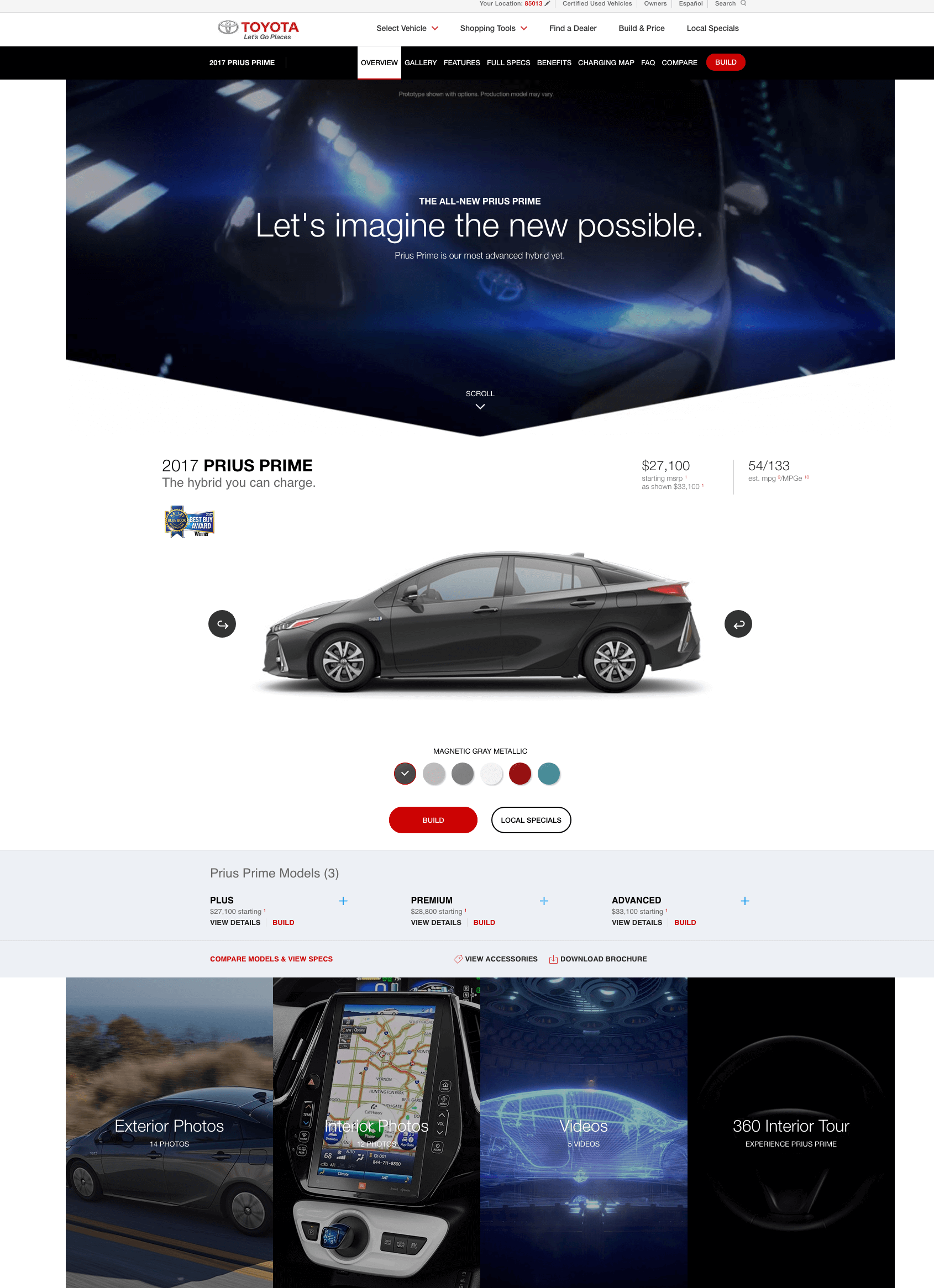
Meanwhile, Toyota’s been marketing their Prius Prime. The auto company claims this to be their most advanced hybrid yet, at a more affordable price than luxury car dealers. Toyota uses infographics to target millennials in the market for new cars who also care about energy efficiency.

Both car brands use different types of content to target their audiences on a deeper level. Notice that the goal is to focus on educating the consumer — they focus on audience segments before anything else.
It’s critical to take the time to augment the quantitative data by evaluating each page based on what humans value. For content audits, you need to appeal to both people and Google by being descriptive with a human touch. You can use the following tools to evaluate the quality of your content and formulate a clear understanding when it comes to content creation:
  • Google’s definition of high-quality content includes important factors like trustworthiness and expertise.
  • Triblio allows you to create personalized content for multichannel campaigns by persona.
  • Google AdWords Keyword Planner provides information on the interest (search volume) of target topics.
  • HemingwayApp grades pages based on how difficult they are to read.
We recommend doing a content audit every six to 12 months to ensure consistency and effectiveness of your on-site content as people and search engines evolve. An initial content audit will establish a baseline of data and insights to help you improve content quality. The subsequent content audits will then show you how your pages have grown since you implemented changes, as well as pinpointing any weaknesses that should be addressed.

Final thoughts

By developing a comprehensive content strategy around what you uncover with a robust content audit, you’ll be better able to improve your content development methods and have a baseline for any future changes or updates.

know more latest update or tips about Search Engine Optimization (SEO), Search Engine Marketing (SEM) - Fill ContactUs Form or call at +44 2032892236 or Email us at - adviser.illusiongroups@gmail.com. 

Sunday, 10 September 2017

Don’t follow the leader: Avoid these 5 common e-commerce SEO mistakes

We often look to industry leaders for inspiration, but columnist Brian Weiss notes that big e-commerce players are often making critical SEO mistakes that should not be emulated.

Competitive research is an important part of any SEO program — after all, it’s a zero-sum game that we’re playing. However, there is often a tendency for companies to become fixated on what dominant competitors in the marketplace are doing. The assumption is that because they’re getting the most SEO traffic, they must be doing things right.
In many industries, it is true that the high SEO traffic sites really are doing an exceptional job. But in the world of e-commerce, this is often not the case. Many of the highest traffic e-commerce sites are doing things that are objectively bad for SEO. It turns out that a strong backlink profile and other prominent brand signals can make up for an awful lot of mistakes.
Getting things right for enterprise e-commerce SEO can be really challenging. You often have to merge very different sources of product data into a single system and make everything work. There are more pages than you could ever curate manually. And in most cases, SEO is not the largest driver of traffic and may have to take a back seat to other priorities. It’s tough.
Eventually, people are going to figure out how to address the issues that make e-commerce SEO so cumbersome and hard to scale. Sites that apply these new techniques will gain an advantage, and then everyone will race to copy them and this article will be outdated. I believe that point is still some years away.
Until then, there are opportunities to gain an SEO advantage over most of the major e-commerce players by simply avoiding their most common mistakes.

1. Faceted navigation disasters

When faceted navigation isn’t controlled, you can often end up with more category URLs, by orders of magnitude, than total products on the site. Clearly, something is wrong with that picture.
On the other end of the spectrum, you have companies that are so scared of creating too many pages that they noindex their entire faceted navigation or canonical everything to the root page. Doing this can prevent indexation of potentially valuable pages (usually ones with two or one attributes selected) and it still may not fix the crawl problems that their navigation poses.
There is a middle path, and few try to walk it. While fixing your filtered navigation is an entire topic of its own, a good starting point is to consider using dynamic AJAX sorting for thin attributes, so users can refine the product set without changing the URL.
There is plenty of readily available data about the impact of site speed on conversion and bounce rates. A couple of seconds can make an enormous difference in user engagement. So why do retailers seem to be competing to load the most external scripts? The retail market is underinvested in speed and overinvested in lag-inducing features that often have marginal benefits and may even serve to overwhelm the user.
My experience is that the SEO benefits of page speed are not yet as substantial as the conversion optimization impact. With all the information Google is sharing about the user benefits of fast, streamlined sites, it’s only a matter of time until speed becomes a more prominent ranking factor. However, when UX impact is also taken into account, there’s no reason to wait.

3. Reliance on XML sitemaps for indexation

If there is one simple piece of SEO wisdom that every enterprise manager should remember, it’s that each page needs to have a crawl path to have a chance to rank for competitive queries. There are many unique and exciting ways (from the perspective of someone who is paid to fix websites) that sites are able to orphan a large percentage of their product or other important pages from their browsable architecture.
Possibilities include broken pagination, creating nearly infinite URL spaces, and any form of link generation logic that doesn’t systematically ensure that every product has a crawl path.
If you’re unsure about whether you have an adequate crawl path, crawl your site and see if all your important pages are showing up. If you are not able to do a complete crawl of your site, that means either that you have too many pages or you need a better crawler. If you have a very large site, you likely need help with both. And if you’re spending lots of time looking at the sitemaps dashboard in Google Search Console, wondering why your pages aren’t being indexed, it’s most likely because they don’t have a good crawl path.

4. Using tags completely wrong

Many e-commerce sites have conflicting tagging signals on their category pages and tagging structures that are suboptimal. I have seen at least two Fortune 500 owned e-commerce sites that were making all the pages on their site canonical to the home page, which is equivalent to telling Google that none of the other pages on the site have anything else to offer. I have seen more sites than I can count on one hand do their pagination tagging incorrectly, which is surprising, because it’s a plainly spelled-out specification.
I suspect that Google’s assumed omniscience sometimes hinders the careful adoption of standards. People think they can get it close enough and Google will figure it out. Sometimes they do. Sometimes they don’t. And sometimes, even if Google can figure out all your mistakes, it’s still a loss — especially if they are having to crawl extra pages to do so.

5. Ugly URLs

Here’s a thought experiment. Let’s set SEO aside for a moment and look at two different URLs that we might see in a SERP:
Site 1: www.madfancylad.com/c/armani-fedoras
Site 2: www.bromendous.com/search?product%20line=fedora&brand=Armani&REFID=23ghaWHY23093482
Which site seems more likely to make things easy for their shoppers, and which site seems more likely to make things easy for themselves? What kind of conscious and unconscious assumptions might a shopper make about each?
My experience is that short, clear and concise URLs tend to rank well and get more traffic than long, parameter-laden addresses. There are some correlational studies that support this observation. I don’t consider any of them definitive — but I know what I would choose to do for my site.

Some opinions expressed in this article may be those of a guest author and not necessarily Search Engine Land. Staff authors are listed here.
know more latest update or tips about Search Engine Optimization (SEO), Search Engine Marketing (SEM) - Fill ContactUs Form or call at +44 2032892236 or Email us at - adviser.illusiongroups@gmail.com.

Thursday, 23 March 2017

Are technical and content audits still relevant?

SEO audits are very useful in identifying website issues and areas for improvement, but columnist David Freeman believes the way we approach these audits is outdated.

Technical and content audits have been the backbone of SEO for many years, and while they play a valuable role, their scope has expanded as search has evolved. Audits now cover much more than purely technical factors such as indexation, status codes and broken links. To stay relevant, audits have broadened to include aspects such as site navigation, content engagement, content gap analysis and conversion factors.
For global and national brands, generic audits aren’t going to drive the change in performance that they are striving for, even if there are fundamental flaws with a website. Yes, these audits will certainly help — especially if, for example, there are indexation issues — but until we understand the consumer, their purchase journey and the barriers at each stage, we don’t know what we are trying to fix, or why.
Site audits which focus on resolving the barriers consumers face will help determine where the biggest opportunities exist. We can then prioritize and shape our efforts to meet the needs of the consumer and drive the largest return for our clients.
Adopting a consumer-first strategy does exactly this by ensuring campaigns have layers of hygiene optimization and insight-fueled strategic consultancy focused on identifying game-changing opportunities within the consumer search experience and conversion journey.

Hygiene optimization: the home of technical and content audits

Hygiene optimization forms the foundation for success and is where ongoing audits should sit. This activity is focused on getting the technical and content aspects of a site as well optimized as feasibly possible.
Hygiene optimization is about striving for continuous improvement by always looking to extract further performance. This approach is akin to the concept of the “aggregation of marginal gains,” which is summed up with the following quote from Jim Rohn:
Success is a few simple disciplines, practiced every day; while failure is simply a few errors in judgment, repeated every day.
The idea is that small improvements made consistently over time will eventually add up to produce significant improvement in the long run.
The concept of marginal gains acts as the perfect reminder that a site is never fully optimized. The hygiene optimization layer provides the environment where we can continually look to make small, incremental improvements through technical audits and insight-driven content optimization. For instance:
  • Increase CTR by using paid search insight.
  • Improve site information architecture to better surface information and improve the conversion journey.
  • Ensure all relevant pages are indexed and returning the correct status codes.
In this model, audits are an essential part of campaigns, aiding prioritization and actively looking to extract every ounce of organic search performance. This approach moves us ever farther away from audits being conducted as large one-off or periodic items and toward a process of continual auditing.

Strategic consultancy: the home of insight

This is the layer that can really move the dial in terms of performance. By developing a deep understanding of the consumer and how they interact with brands, a picture of their informational needs and requirements at each stage of the purchase journey can be built. Only now can we truly understand what opportunities a brand has across their owned assets to capture, engage and convert consumers. For instance:
  • Missing top-of-funnel or product content that prevents consumers discovering them.
  • Website experience causing a sizeable drop-off in the path to purchase.
  • Navigation not surfacing essential content to consumers once they land on site.
  • Site structure not optimal based on user experience (UX) and SEO best practices.
Having utilized this insight to identify the strategic opportunities, we know where to focus our efforts. We can now undertake an audit or piece of analysis with the goal of answering a specific question.
Based on the insight returned by this highly targeted analysis, a consumer-focused solution can be designed by combining SEO, UX, content and paid media expertise. This holistic approach ensures that the solution performs not only in organic search but across channels, and assists the consumer in their purchase journey.
Once a strategic change has been launched, it flows into the hygiene optimization process to ensure the maximum return is realized over the long term.

In summary

Audits and associated skill sets remain as important as ever, but their role has changed. One-off or periodic audits should be confined to the past, as they don’t provide any performance longevity. Within the hygiene layer, audits become an essential part of day-to-day activity. They remain vital in driving small, incremental performance gains that, over the long term, can add up to significant gains. Additionally, these audits are essential to identify the more critical indexation issues, as well as catching small issues early, before they spiral into something much larger.
Consumer insight and strategy are now the two biggest factors that can influence performance, and their importance will only increase over the coming years. Given this, focus needs to switch to this bigger picture activity that enables brands to achieve their full potential. It is within this strategic consultancy layer where the audit and analysis skill sets can be maximized by pivoting their application to provide the answer to a specific question, challenge or problem that has been identified through consumer insight.

Some opinions expressed in this article may be those of a guest author and not necessarily Search Engine Land. Staff authors are listed here.

know more latest update or tips about Search Engine Optimization (SEO), Search Engine Marketing (SEM) - Fill ContactUs Form or call at +44 2032892236 or Email us at - adviser.illusiongroups@gmail.com.

Tuesday, 3 January 2017

SEO in 2017: Seizing opportunity, evangelizing success, achieving overarching growth

Columnist Jim Yu contends that to succeed in 2017, brands will need to coordinate organic and paid search marketing disciplines and understand how they can work together to build the relationship with customers.

As we begin 2017, the fusion of the search and content marketing disciplines has become increasingly more evident. A full 89 percent of B2B marketers (PDF) say that they use content marketing, as do 86 percent of B2C marketers, according to the Content Marketing Institute.
Additionally, over 70 percent of marketers in both groups plan on producing more content in the new year than they did in 2016. However, content only has real value if it is found and optimized, and if it converts with effective search marketing.

Search is the key driver that opens up opportunity in 2017

Research from BrightEdge (my company) found that 51 percent of traffic to websites comes from organic search. Additionally, another 10 percent comes from paid. This means that over 60 percent of the traffic on your site arrives from the search engine results pages (SERPs) alone.
While organic search is the primary driver of website traffic, the role of ads cannot be overlooked. Google has recently been taking initiatives to increase their prominence on the display page.
In early 2016, they eliminated the ads that once appeared along the sides of the SERP. Now, up to four ads may appear on the top of the page before the organic results. For some queries, this pushes the organic results below the fold.
More changes may be ahead for PPC. There has been discussion about the prospect of Google introducing a paid result to the local 3-pack, leaving PPC to play an even larger role in local search. It has become nearly impossible to build an effective strategy for a strong presence on the SERP without coordinating with paid search.
Customers have also become increasingly channel-agnostic. They interact with brands on several different devices via multiple channels, and they are interested in a variety of types of content.
Brands that succeed in 2017 will need to coordinate organic and paid search marketing disciplines and understand how they can work together to build the relationship with customers.

Seizing SEO opportunity across a fragmented customer journey in 2017

It is important to recognize, as we move into 2017, that the modern customer journey has fragmented. In years past, marketers were able to clearly identify a linear path that people followed as they moved from their first realization that they had a problem that needed to be solved to making a purchase.
The increasing prevalence of digital technology in modern life, however, has shattered this journey into a series of micro touch points — high-intent moments that Google has termed micro-moments.
We are likely all familiar now with the four main categories of micro-moments:
  • The I-want-to-know moment
  • The I-want-to-go moment
  • The I-want-to-buy moment
  • The I-want-to-do moment
These micro-moments can appear in any order at any point in the buyer’s journey, and they all present opportunities for brands to build relationships with their prospects. The SERP has changed in order to better reflect these micro-moments. Google tries to understand the intent behind a particular query, the micro-moment that fits it best, and the type of content most likely to answer the need of the user.
This is why certain queries are answered by images, others by videos, rich displays or local business listings. For brands to effectively optimize for the modern buyer’s journey, they must also be able to understand the intent that customers have behind their queries and be able to optimize different types of content to meet the needs of consumers throughout this fragmented path.
On the modern customer journey, content, local, and mobile have all converged. Customers’ expectations of content changes from moment to moment, and brands must be prepared to meet their needs. Evangelizing search success and its pivotal position in content, social, mobile and local markets will set you up for personal and professional success in 2017.

Evangelizing success in your organization

To successfully grow the role of organic search within your organization, you must evangelize the practice to others, both cross-departmentally and to those in the C-suite or on your board. To drive further organic search success in 2017, you will need buy-in from those higher in the organization.
It is also critical that people in other departments start understanding the language of SEO so they can incorporate the principles into their work. This is the only way you will be able to develop mature, organization-wide optimization practices. Below I leave you with a few tips for achieving this.
1. Focus on your largest channel — organic search
Use concrete numbers to show your progress and results. Organic search remains the largest channel for most B2B and B2C websites, so focus your efforts here to begin to build a strong case for the value of optimization.
Organic search does not have direct media costs, but it has the potential for high returns while also driving brand awareness in addition to revenue, making it a great starting point for your conversations with others.
As you build your organic channel, use data as your source for the strategy to guide your efforts. Then use the numbers to demonstrate your progress and success to the rest of the organization.
2. Invest in your talent
As the different channels within marketing become more connected with search in the age of the micro-moment and the new customer journey, the value of strong marketers who understand the different channels becomes even more evident.
Your investment should be in both existing employees and new ones. For existing employees, look for both internal and external training opportunities to teach them how the different channels work. Encourage cross-departmental communication and cooperation to provide people with opportunities to grow their skills.
3. Understand the priorities of those in the C-suite
To properly engage the leaders of your organization, you need to align your data and arguments with what the C-suite leaders want to see.
Key data points that interest leaders tend to be the position of your brand against competitors, the value of your marketing efforts, the efficiency of organic search optimization and your ROI.
4. Secure executive sponsorship
Business leaders want to map their strategy to their projected outcomes to allocate budget appropriately. By following the above steps and being able to demonstrate your success, you will build a strong case to secure more budget for your initiatives moving forward.
Use these resources to begin the process of scaling your efforts and further integrating organic search throughout different marketing channels and departments.
5. Focus on overarching digital growth
Succeeding in SEO in 2017 will require brands to put SEO at the core of their organization and Digital Centers of Excellence.
Rather than acting as a standalone department, SEO needs to be integrated with the rest of the brand marketing functions, from PR to SEM. Brands need to recognize the changing customer journey and how those changes impact the strategies used by the organization.
Digital disruption has shifted how customers interact with brands, where they go to seek answers, and how they build relationships with companies. The brands that succeed in moving forward will be the ones that understand the different intent signals of various types of queries. They will know how to optimize all of the content they produce, from videos and images to social posts, to be present for these customers and address their needs during the micro-moment.
The mature organization is one that understands the value of SEO integration: breaking down silos and functioning as a single promotional unit, rather than having it handled by several separate departments. Once brands accomplish this change in mindset, they will be in a position to establish themselves as leaders within their industry and build a strong sales funnel for the modern digital consumer in 2017.

To know more latest update or tips about Search Engine Optimization (SEO), Search Engine Marketing (SEM) - Fill ContactUs Form or call at +44 2032892236 or Email us at - adviser.illusiongroups@gmail.com.


Monday, 2 January 2017

What you’re missing with SEO that will make a world of difference

While long-term efforts are SEO mainstays, contributor Julian Connors suggests more short-term reactive strategies can also have significant rankings impact.

There are two approaches to take when it comes to developing new digital marketing or online reputation strategies.
The first approach sees marketers and SEO strategists creating proactive campaigns that push content to consumers with the intention of soliciting immediate reactions.
The second method is considered to be responsive, where marketers create content that capitalizes on a particular concept or event to improve consumer awareness of their brand and its offering.
An example of responsive marketing is when solar energy companies distribute branded press releases when new tax incentives are approved by federal or state governments.

Proactive and reactive approaches to SEO

The vast majority of SEO strategists’ efforts are going to fall into the active position since they are always reviewing upcoming trends to determine how to maximize opportunities months in advance.
However, there are particular opportunities that allow strategists to combine both marketing approaches to improve brand awareness and solicit consumer reaction.
Consider these opportunities when creating a new SEO initiative.

1. Capitalize on internal events

If your company is on the verge of releasing a new product or service, you’re about to hire a well-known executive from a competing brand, or you’re expanding into new emerging markets, make sure you let the world know about it!
Smaller to mid-size businesses tend to keep these pivotal points of their history quiet, not realizing they are missing out on the opportunity to increase brand awareness, which would generate more traffic on their website.
Notable internal events are excellent opportunities to submit optimized press releases that have the potential to spark stories by local or national news outlets. (Keep in mind that Google considers some press release distribution methods to be link schemes, which are grounds for a penalty or removal from search results.)
When this happens, your company’s online presence is awarded more traffic from new potential customers/clients, a spike in new backlinks that come from reputable sources and an influx of consumer citations.

2. Turn internal events into guest author opportunities

If one or more of your internal events are capturing significant attention, you may be able to use this as a means of improving your brand’s credibility within your industry.
This type of positioning creates opportunities to author content for notable brands and publications that cater to similar audiences. Every piece of content your company executives contribute to industry publications can help build your organic authority, as it gives you a chance to improve referral traffic from relevant third-party sources, while also adding more links to your portfolio.
If you choose to follow through with this opportunity, make sure that you are only working with other industry authorities who have significant organic equity in the markets where your business operates. Working with low-authority sources or social media influencers who cater to foreign audiences will not lead to any organic or transactional growth.

3. Get in front of a new, interesting subject

A quick search for any concept on the internet will show you how hard it is to create original content.
There are millions of content creators throughout the world who are developing lists, how-to guides, buyer guides, white papers and other forms of content that ultimately offer duplicative information on a particular topic.
Coming up with unique ways to present information or being the first to expose new concepts can be extremely beneficial for improving your organic authority, as you will have a chance to:
  • improve brand awareness.
  • attract new potential customers.
  • increase your organic visibility.
  • improve your online reputation and industry authority.
  • acquire new, meaningful backlinks.

4. Build content around keywords that your competitors are missing

Keyword research continues to change based on the ongoing development of search algorithms. However, there are opportunities for brands to capitalize on emerging keywords that their competitors are missing out on.
Use tools like Soovle and Google Keyword Planner to continuously research new keywords that your consumers are using when searching for products or services your brand offers.
Ideally, you can uncover keywords that have significant search volume and little competition, then create meaningful content around them. When you can accomplish this, you are likely to improve your backlink profile, increase site traffic and earn more social connections.

5. Monitor your competitor’s social interactions

If one or more of your competitors use their social media profiles to manage customer engagement, make sure to keep your eyes open for opportunities that allow you to offer their audience a better experience.
When you see customers complaining about their services on Facebook or Twitter, send the user a sympathetic direct message that includes an incentive for working with your brand, such as a coupon or rewards membership.
Capitalizing on these opportunities requires a measured approach that sees you actively monitoring competitive and consumer environments to get in front of upcoming trends.
When such opportunities do arise, it is important that you act swiftly, as your competitors are likely to provide a response at some point.
While following through with one of these concepts will not position your brand as an absolute industry authority, strategically fulfilling all of these recommendations over time will improve your organic search presence to a point where you can notice significant growth.

To know more latest update or tips about Search Engine Optimization (SEO), Search Engine Marketing (SEM) - Fill ContactUs Form or call at +44 2032892236 or Email us at - adviser.illusiongroups@gmail.com.

Thursday, 29 December 2016

Is Google’s AMP carousel working? (Or, SEO insights from Kanye West)

Publishers are asking questions about the effectiveness of Google’s AMP carousel. Columnist Barb Palser analyzed 235 million AMP search impressions to find answers.


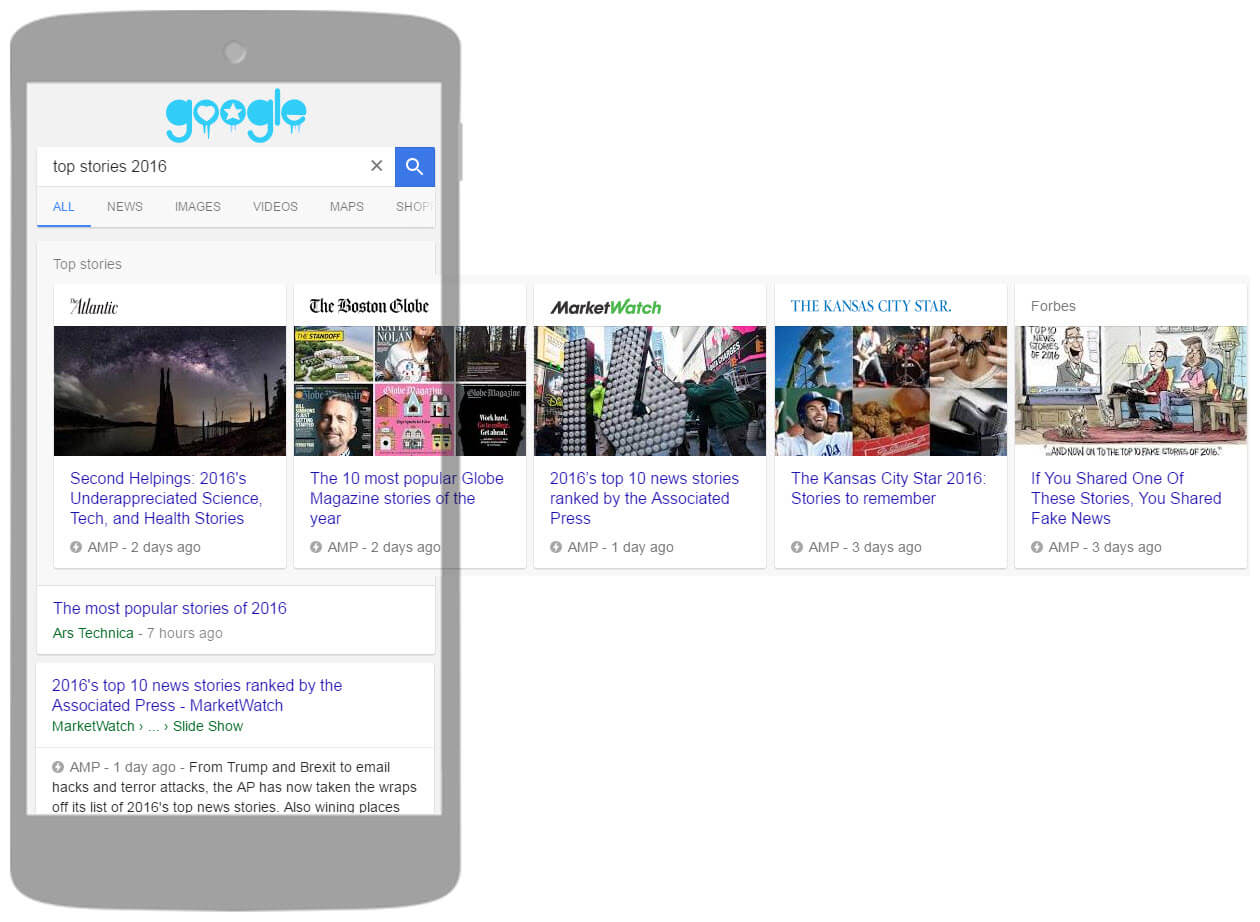
Google’s AMP rich cards look like they should work. The format is visually appealing, and AMP rich card carousels usually appear at the top of mobile search results, dominating the first viewport.
They also provide a brand showcase publishers should love.
But recently, publishers have been scratching their heads over analytics indicating AMP content has a lower click-through rate from rich cards than from general search results. They’re finding this data in Google Search Console (GSC), which now allows publishers to filter AMP performance in search based on appearance as rich cards in a carousel vs. non-rich text links.
Here’s the GSC dashboard for an aggregated group of news publishers, showing an average CTR of 3.14 percent for AMP rich results vs. 4.39 percent for AMP non-rich results, even though the rich results have a higher average position.
These numbers are perplexing at first  — but, if we dig in, they begin make sense.

Reason #1: Relevance and supply

In a nutshell, the rich card carousel favors broad searches. The carousel is invoked when a query returns at least three AMP results Google deems relevant enough to display together. The broader and more popular the search, the more likely the threshold will be met and the results displayed as a carousel of up to 10 rich cards. However, broad searches often result in lower click-through rates than precise searches.
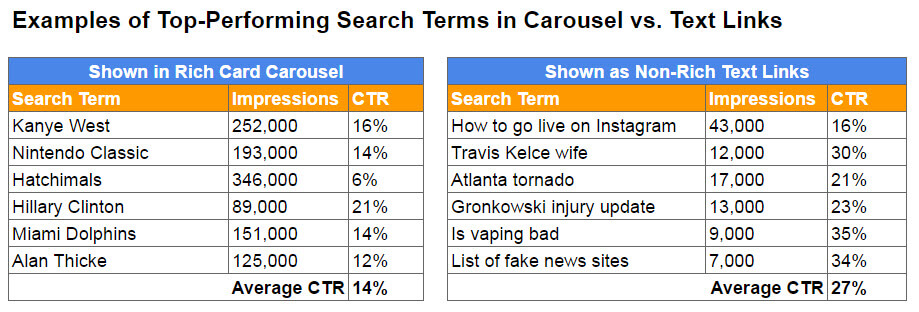
For example, for the aggregated news publishers above (a mix of hyperlocal, local and national brands), “Kanye West” was one of the most successful search terms for the time span analyzed, by volume of resulting AMP impressions and clicks. Because there’s a vast supply of close-match AMP results for the general term “Kanye West,” the results were always displayed as a rich card carousel — with a very good click-through rate of 16 percent.  
Measured by engagement, however, the most successful Kanye-related search term was “What Did Kanye Say,” with a phenomenal click-through rate of 65 percent. The precise query was searched less often, producing a lower volume of impressions and clicks — but yielded highly relevant results. Without enough close matches to meet the AMP carousel threshold, Google displayed the results as text links.
There are many exceptions to this rule. The universe of AMP content is large and growing every day as more publishers become AMP-enabled, such that many granular searches are now invoking the AMP carousel — especially for news and entertainment topics of broad interest.  
But on balance, broad and popular search results seem to be concentrated in the AMP carousel, while the long tail of specific queries are more likely to be returned as text links only, tilting the average CTR toward non-rich results for many publishers.
To underscore this point, here are some of the top-performing rich and non-rich queries based on resulting clicks, for the news publishers analyzed:
This is a clear illustration of how mobile search exposure is shifting — and what many non-AMP-enabled publishers are missing by being excluded from the rich card carousel.
Naturally, these metrics will vary by publisher, depending on the publisher’s topical and geographical focus, the pool of competitive AMP content for that focus, overall search optimization and how often users find the publisher’s content from topical searches vs. branded searches.

Reason #2: Carousels are not awesome

As a user interface, scrolling carousels don’t have a great reputation; mostly, they seem to be good at hiding content from users. It appears Google’s AMP carousel is no exception.
On mobile phones, the first two cards in an AMP carousel are visible — or three cards in landscape view. It seems users aren’t scrolling or clicking much beyond that.
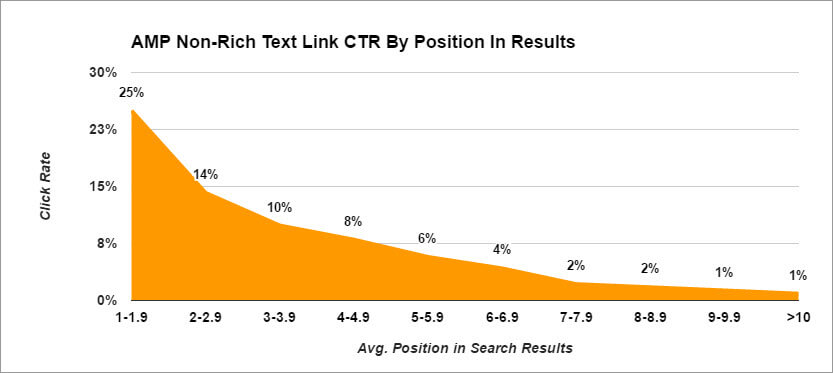
Using the same news publishers and looking at the top 1,000 queries by clicks for both rich and non-rich results, here are the respective click-through rates based on average position in results:

While both formats show significant declines after the first positions, carousel activity falls off a cliff after positions one and two. Evidently, users are more likely to scroll down to engage with text links than to scroll horizontally to discover additional carousel results.
When publishers rank at the top of results, this isn’t a huge issue — but for publishers who tend to appear deeper in the carousel, it could be a contributing factor to lower rich result CTRs. While this sounds bad, keep in mind that Google often duplicates a publisher’s results in the AMP carousel and in text links.  If the publisher’s text link position isn’t affected by carousel appearance, then deep carousel slots are like “bonus” exposure. If deep carousel links displace or replace text links, then concerns would be justified.
Meanwhile, Google seems to be doubling down on AMP carousels — now displaying publisher-specific carousels when certain publishers have a number of results for a query. It would be interesting to know whether engagement for these single-publisher carousels differs from the multi-source Top Stories carousel. Scrolling notwithstanding, single-publisher carousels are a nice content and brand showcase for publishers who get them.
This search for “trump cabinet” produced four single-publisher AMP carousels in addition to the standard Top Stories carousel:

Conclusion: Blame the carousel, not the cards

All of this analysis suggests AMP carousel CTR is being throttled by (a) the minimum result threshold which prevents rich cards from being displayed for very granular queries; and (b) the shortfalls of carousels in general, which depress CTR for “hidden” content which must be scrolled to view. None of this says anything about the effectiveness of rich cards themselves.
Google could probably boost AMP rich card CTR immediately by reducing or eliminating the threshold for showing results as rich cards, and by displaying them as tiles instead of a scrollable carousel. (Although this might lead to trimming the maximum number of cards in a collection from 10 to something like three or four, in turn reducing rich card impression and click volume.)
The AMP format is a work in progress, as is Google’s careful approach to surfacing AMP in search.  Given Google’s focus on performance measurement and fundamental commitment to AMP, we should expect continued optimizations. We might see refinements to GSC reporting as well.
Meanwhile, publishers shouldn’t interpret the click-through rates in their GSC dashboards as an indictment of AMP, or of rich cards for that matter. For a publisher to opt out of AMP based on comparatively lower CTR in the AMP carousel makes no sense at all; that exposure won’t shift back to standard text links — it’ll just go to another AMP-enabled publisher.
To know more latest update or tips about Search Engine Optimization (SEO), Search Engine Marketing (SEM) - Fill ContactUs Form or call at +44 2032892236 or Email us at - adviser.illusiongroups@gmail.com.