Pages

Showing posts with label BING. Show all posts

Sunday, 17 September 2017

Spark Foundry takes home Bing’s 2017 Agency of the Year & Innovator of the Year awards

Hosted by the Daily Show's Trevor Noah, Bing's 2017 Agency Awards event celebrated "the practice of search" by recognizing key executives and agencies.

Spark Foundry was the big winner at last night’s Bing 2017 Agency Awards event.
With offices in both New York City and Chicago, Spark Foundry was named Agency of the Year for the US and Innovator of the Year, and the team’s Colette Trudeau took home the Trailblazer of the Year Award.
Bing handed out 15 different awards during the program to search industry executives and agencies.
“This is a glamorous black-tie affair that celebrates the practice of Search and recognizes our key agency partners for their outstanding creative, effective and passionate work with Bing Ads in the Americas,” wrote Bing on its Search Blog, when it announced the event back in June.
Spark Foundry shared its Agency of the Year Award for the US with Performics Practices Team. Bing also gave an Agency of the Year Award for Canada to iProspect and an Agency of the Year award for Brazil to Blinks.
In addition to Trudeau, other individuals to be recognized included iProspect’s Jeremy Hull, who won Executive of the Year, and Performics’ David Gould, who was awarded the Lifetime Achiever Award.
Here’s the full list of Bing’s 2017 Agency Award Winners:
  • Agency of the Year for the US: Spark Foundry and Performics Practices Team
  • Agency of the Year for the Canada: iProspect
  • Agency of the Year for the Brazil: Blink
  • Executive of the Year: Jeremy Hull (iProspect)
  • Trailblazer of the Year: Colette Trudeau (Spark Foundry)
  • Lifetime Achiever Award: David Gould (Performics)
  • Account team of the year: Mindshare
  • Innovator of the year: Spark Foundry
  • Growth agency of the year: Initiative Search Team at Reprise
  • Independent agency of the year: iCrossing
  • Optimizer of the year: LQ Digital
  • Partner of the year: Resolution Media
  • Philanthropist of the year Seer Interactive
  • Accreditation champion of the year: US’s Sapient Razorfish and Canada’s Catalyst
  • Rising star of the year: Metric Theory
“Our agency partners play a critical role in shaping the future of search and bringing to life the opportunities search offers marketers to both better understand consumer intent and drive impactful and measurable digital engagement,” wrote Paul Longo, Bing’s head of agency development, on Bing’s blog post announcing the winners.
This was the second year for Bing’s Agency Awards event. It was held at the Capitale in New York with celebrity emcee Trevor Noah.

know more latest update or tips about Search Engine Optimization (SEO), Search Engine Marketing (SEM) - Fill ContactUs Form or call at +44 2032892236 or Email us at - adviser.illusiongroups@gmail.com. 

Friday, 15 September 2017

Spark Foundry takes home Bing’s 2017 Agency of the Year & Innovator of the Year awards

Spark Foundry was the big winner at last night’s Bing 2017 Agency Awards event.
With offices in both New York City and Chicago, Spark Foundry was named Agency of the Year for the US and Innovator of the Year, and the team’s Colette Trudeau took home the Trailblazer of the Year Award.
Bing handed out 15 different awards during the program to search industry executives and agencies.
“This is a glamorous black-tie affair that celebrates the practice of Search and recognizes our key agency partners for their outstanding creative, effective and passionate work with Bing Ads in the Americas,” wrote Bing on its Search Blog, when it announced the event back in June.
Spark Foundry shared its Agency of the Year Award for the US with Performics Practices Team. Bing also gave an Agency of the Year Award for Canada to iProspect and an Agency of the Year award for Brazil to Blinks.
In addition to Trudeau, other individuals to be recognized included iProspect’s Jeremy Hull, who won Executive of the Year, and Performics’ David Gould, who was awarded the Lifetime Achiever Award.
Here’s the full list of Bing’s 2017 Agency Award Winners:
  • Agency of the Year for the US: Spark Foundry and Performics Practices Team
  • Agency of the Year for the Canada: iProspect
  • Agency of the Year for the Brazil: Blink
  • Executive of the Year: Jeremy Hull (iProspect)
  • Trailblazer of the Year: Colette Trudeau (Spark Foundry)
  • Lifetime Achiever Award: David Gould (Performics)
  • Account team of the year: Mindshare
  • Innovator of the year: Spark Foundry
  • Growth agency of the year: Initiative Search Team at Reprise
  • Independent agency of the year: iCrossing
  • Optimizer of the year: LQ Digital
  • Partner of the year: Resolution Media
  • Philanthropist of the year Seer Interactive
  • Accreditation champion of the year: US’s Sapient Razorfish and Canada’s Catalyst
  • Rising star of the year: Metric Theory
“Our agency partners play a critical role in shaping the future of search and bringing to life the opportunities search offers marketers to both better understand consumer intent and drive impactful and measurable digital engagement,” wrote Paul Longo, Bing’s head of agency development, on Bing’s blog post announcing the winners.
This was the second year for Bing’s Agency Awards event. It was held at the Capitale in New York with celebrity emcee Trevor Noah.

know more latest update or tips about Search Engine Optimization (SEO), Search Engine Marketing (SEM) - Fill ContactUs Form or call at +44 2032892236 or Email us at - adviser.illusiongroups@gmail.com. 

Wednesday, 1 March 2017

Bing Ads Editor for Mac is now available to everyone

The highly requested desktop tool is now out of beta.


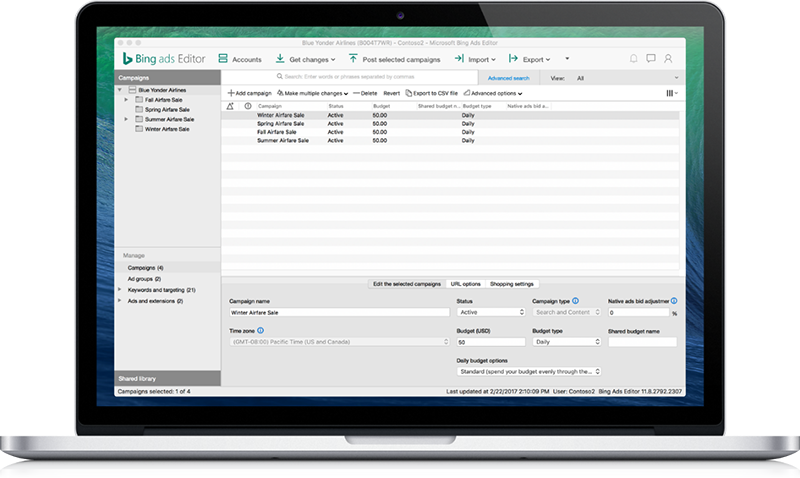
After running in beta in the US since last June, Bing Ads Editor is now available globally.
The Mac version of the desktop editing tool for Bing Ads campaigns has been at the top of advertisers’ feature requests lists for years. The Mac version has parity with the Windows desktop editor, including the ability to manage multiple accounts and copy and paste items across accounts.
Anyone who’s tried knows that making multiple updates to campaigns through the web interface can be very slow going (as it is with AdWords). That’s where the desktop tools come in. Bing Ads Editor enables advertisers to build out campaigns and make several changes at once. Advertisers can also make edits to campaigns before pushing them live.
The availability of a desktop editor for Mac could increase adoption of Bing Ads by Mac-heavy advertisers and agencies. The beta has largely been well received by advertisers, and Bing says the Mac Editor is now faster than it was in beta.
Advertisers can download Bing Ads Editor for Mac here.
To know more latest update or tips about Search Engine Optimization (SEO), Search Engine Marketing (SEM) - Fill ContactUs Form or call at +44 2032892236 or Email us at - adviser.illusiongroups@gmail.com.


Tuesday, 28 February 2017

Bing UK now displaying National Health Service data for GP & hospital search queries

Searching for nearby GPs and hospitals on Bing UK will surface information pulled from the country's publicly-funded national healthcare system.

According to the UK’s National Health Service (NHS), the publicly funded national healthcare system has been working with Bing UK during the last year to improve search results for general practitioner and hospital queries.
“Over the last year, we have collaborated with our friends at Bing to provide users with a comprehensive GP and hospital search experience,” reports a recent post on the NHS Choices blog.
The NHS says that queries for “GP in [location]” on Bing UK will now surface a list of local options with information on specific locations, open times and user reviews — all data that has been pulled from the NHS

Clicking on a result will display more information for the GP’s office.
To know more latest update or tips about Search Engine Optimization (SEO), Search Engine Marketing (SEM) - Fill ContactUs Form or call at +44 2032892236 or Email us at - adviser.illusiongroups@gmail.com.


Friday, 17 February 2017

How retailers can leverage search and social media data for optimal local marketing performance

Which search and discovery sites do your customers rely on?

Gathering insights such as who your consumers are, how they found you, when they’re likely to visit your store, and the products they’re interested in, can help your business make intelligent decisions backed by actionable analytics.
This white paper from Sweet IQ, reveals why your brand needs to gather data from Google My Business, Facebook, Foursquare, Bing and Yelp for smarter marketing.
Visit Digital Marketing Depot to download “Data for Retailers: Harnessing Insights for Optimal Local Performance.
To know more latest update or tips about Search Engine Optimization (SEO), Search Engine Marketing (SEM) - Fill ContactUs Form or call at +44 2032892236 or Email us at - adviser.illusiongroups@gmail.com.

Tuesday, 31 January 2017

Branch unveils AMP Deepviews, so content in uninstalled apps can be previewed from search results

The new solution shows app-based content in Google as fast-loading and preferred AMP pages, if the app has not been installed.

Let’s say you create a mobile app. And you get it accepted into Apple’s and Google’s app stores.
Now what?
There are zillions of apps added to the app stores every week, so your biggest problem is simply getting found. Maybe you could luck out and get featured by the App Store. Or maybe you invest a considerable budget in ads encouraging users to install your app — even though they don’t really know it.
Palo Alto, California-based Branch is out with a free solution that it believes could dramatically change these choices, by changing how app content is discovered via search engines if you don’t have the app installed.
Currently, Google can lead you to content in apps via app indexing, where deep links can be found in mobile search results and lead you to content in the app. If the app is installed. If not, it leads you to the app store, and then to that content once you’ve installed the app.
The new Branch solution, called AMP Deepviews, is designed to accomplish three things: present in-app content when the app is not installed, load quickly and get the preferential mobile search treatment that Google gives to AMP pages.

To know more latest update or tips about Search Engine Optimization (SEO), Search Engine Marketing (SEM) - Fill ContactUs Form or call at +44 2032892236 or Email us at - adviser.illusiongroups@gmail.com.

Thursday, 19 January 2017

Bing Ads rolls out scheduling for ad extensions

The option to show extensions during store hours or time-sensitive promotions is available in all markets.

Advertisers can now choose when to show certain ad extensions in Bing Ads. Ad extension scheduling is rolling out for nearly all extensions globally.
When ad extension scheduling becomes available in your account, you’ll see the “Selected days and hours” section at the ad extension level, where you’ll be able to set times for specific days and choose whether to set the timing based on the user’s time zone or the time zone set at your account level.
Scheduling will be available via the Bing Ads API, Bing Ads Bulk Upload and the Google Import function. It is not yet available in Bing Ads Editor. Scheduling is an option for app, sitelink, callout, call, review, location and structured snippet extensions.
To know more latest update or tips about Search Engine Optimization (SEO), Search Engine Marketing (SEM) - Fill ContactUs Form or call at +44 2032892236 or Email us at - adviser.illusiongroups@gmail.com.


Tuesday, 10 January 2017

Bing Ads shares Valentine’s Day CPC & CTR trends, including surprising mobile stats

Mobile plays a significant role, accounting for nearly half of all Valentine's Day-related searches on Bing.

Valentine’s Day is fast approaching, and Bing has released insights based on last year’s shopping behavior and advertising performance in the US to help inform marketers’ plans for this year.
Just over half of US adults say they celebrate Valentine’s Day, and they continue to spend more, online in particular, according to the National Retail Federation. Who’s spending the most? Unmarried men ages 25–34, according to a composite of studies. However, when it comes to search, it seems women are more active. Bing says that last year, 17 percent of “Valentine’s Day gifts for …” search queries on the engine were for “boyfriend,” whereas just 4 percent were for “girlfriend.” “Husband” topped the list at 22 percent, while “wife” came in at 16 percent of Valentine’s Day “gifts for” queries.
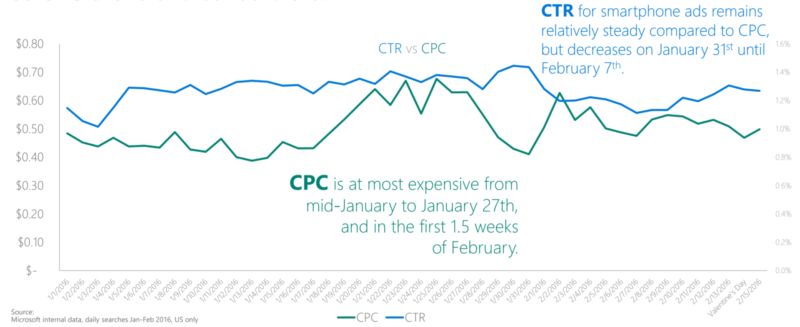
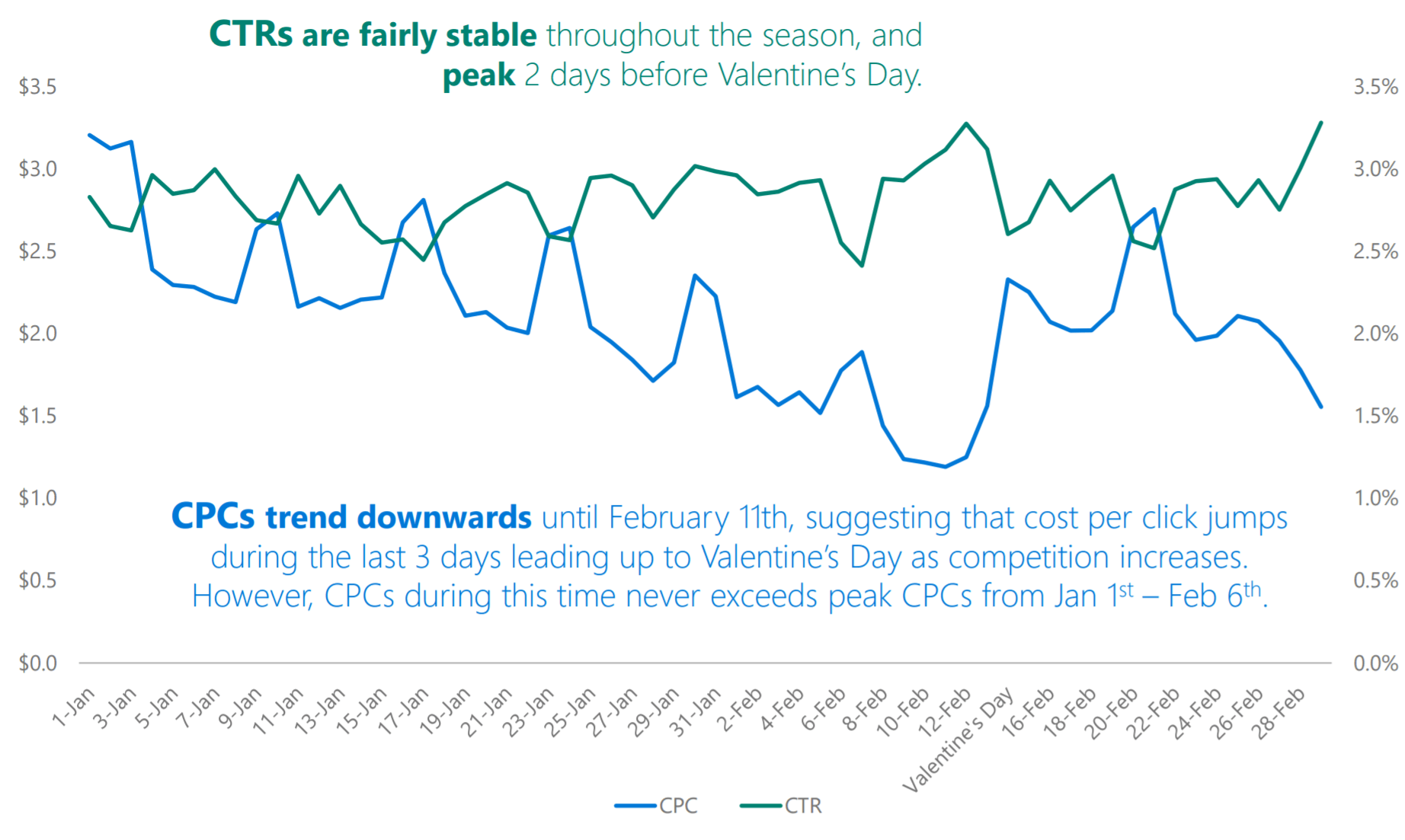
Most Valentine’s Day-related searches occurred within two weeks before February 14 in 2015. Last-minute shoppers sent searches soaring on Valentine’s Day. Clicks on ads rose significantly in the week leading up to Valentine’s Day and peaked the day before.
Interestingly, that final week is also when CPCs have historically trended down from the highs of January. They then rise again starting February 11, when panic presumably sets in. Bing also notes that CTRs are highest and CPCs are lowest on weekdays.
In 2016, Valentine’s Day searches on Bing were split nearly evenly, with 48 percent occurring on mobile (up from 40 percent the previous year) and 52 percent on PC/tablet from January to February. That’s somewhat surprising given Bing’s relative weakness on mobile compared to Google, and it’s something for advertisers to keep in mind when optimizing their Bing Valentine’s Day campaigns this year. Mobile click share rose less significantly year over year on Bing, increasing from 18 percent in 2015 to 21 percent in 2016.
See the complete report on SlideShare for more on Valentine’s Day trends and optimization recommendations.
To know more latest update or tips about Search Engine Optimization (SEO), Search Engine Marketing (SEM) - Fill ContactUs Form or call at +44 2032892236 or Email us at - adviser.illusiongroups@gmail.com.


Sunday, 11 December 2016

NORAD’s Santa Tracker counts down the days until Christmas 2016 with Bing’s help

Google’s not the only one with its eye on Santa’s whereabouts. For 61 years now, the North American Aerospace Defense Command (NORAD) has tracked Santa’s December 24 trip around the world.

In 1955, NORAD's number was mistakenly printed in a Sears Roebuck & Co. holiday ad. The organization has been tracking Santa ever since.


The practice started in 1955 when a Sears, Roebuck & Co. advertisement mistakenly included NORAD’s phone number to call Santa. According to NORAD’s website, the number dialed directly into the Commander-in-Chief’s operations hotline.
“The Director of Operations at the time, Colonel Harry Shoup, had his staff check the radar for indications of Santa making his way south from the North Pole,” says NORAD. “Children who called were given updates on his location, and a tradition was born.”
Bing has long been listed among NORAD’s many contributors to its Santa Tracker program. While Microsoft has not released an official announcement this year, a Bing spokesperson sent the following comments when asked about their contributions to the 2016 NORAD Santa Tracker:

“Microsoft is happy to support the North American Aersopace Defense Command (NORAD) tracker for Santa’s Christmas Eve flight once again for the 61st consecutive year. Millions of youngsters and kids-at-heart visit the site each December to track Santa on his global journey, making it the perfect blend of Christmas tradition and technology.”
Not only is NORAD counting down the days until Santa takes flight, NORAD’s Santa Village website offers a full host of holiday-themed activities, from games, movies and books to a gift shop where you can get a personalized NORAD Santa Tracker certificate, a letter from Santa and other merchandise.

In addition to helping out NORAD track Santa, Bing has decorated its home page with an Advent Calendar: Bing home page gets 31 holiday-themed surprises for each day of December
To know more latest update or tips about Search Engine Optimization (SEO), Search Engine Marketing (SEM) - Fill ContactUs Form or call at +44 2032892236 or Email us at - adviser.illusiongroups@gmail.com

Saturday, 26 November 2016

How do our biases impact PPC performance?

With experience comes wisdom, but columnist Brett Middleton believes that search marketers can sometimes limit themselves by clinging to old habits.


I’ve come to believe that the essence of PPC management can be boiled down to two things:
  1. Never let one thing (keyword research, bid management, A/B testing ad copy and so on) take up so much of your attention that you let something else slip.
  2. What you did yesterday probably needs to be changed, and failing to adapt your methodology is as bad as having an empty “Change History” log.
As you gain more experience in PPC, you start to develop patterns and favorite tactics out of necessity. We bring tools that worked in the past to each new campaign or ad account. People are paying us for our past experiences and how these experiences translate into future potential.
But are the things we believe about PPC the very things holding us back from fully optimizing an account?
I will absolutely agree with anyone out there who feels that the biases we develop in fact make us much more efficient in management. However, I would also say that our biases can hold us back.
Let’s take a look at a three examples. As you read along, consider your own management habits and how you may have sped up the process over the years.

Spare the Bing, spoil the Google

I personally have been guilty of neglecting Bing Ads. I let Bing Ads move in but made it live in the closet under the stairs (and, much as you would expect, it became a wizard).
Now, part of this was because Bing’s universal event tracking (UET) is much less intuitive, and we simply didn’t take the right steps to make sure revenue tracking was working perfectly. It’s Bing Ads! Do we really need to try that hard to get it going? Why can’t it just be more like Google? After a meeting in which we reviewed the UET code implementation and got Bing’s revenue tracking working correctly, I watched the results in horror/excitement.
Our Bing campaigns are operating at an ROAS five times higher than Google. The search volume isn’t as high, that’s absolutely true — but almost every campaign has been severely limited by budget because we just didn’t see it as worth a major investment.
Every time you have taken on a new client (or, if you’re in-house, every time you’ve evaluated your PPC for optimization paths) and have failed to do a significant test of Bing Ads, you have probably done yourself a disservice. Obviously, there are several reasons that this bias came to be.
Video Player
People think Bing Ads is less reliable than AdWords, want to find out if it’s any good, and are just generally wondering if it’s even worth trying. I’ve always said that these are all reasons you should be in Bing Ads. As marketers, don’t we dream of finding that converting channel that our competitors aren’t in?
Can we all agree to get on board here and give Bing Ads a shot? Unless you’re in my industry, in which case, just ignore all of this.

Separating match types

Now, I don’t have another 1,000 words to get into the question of whether or not you should segment your ad groups and campaigns by match type. (I don’t think you should — but if you must, do it at the campaign level, please! At least you can control the budget that goes to each match type that way.)
The fact is, you probably made the decision on separating or not separating match types fairly early in your PPC career; you very likely also made the decision after someone told you what to do. I was very opposed to separating by match-type, but my current campaigns do it at the campaign level. That’s fine with me for right now, although I cringe when I see the number of campaigns.
screen-shot-2016-11-16-at-9-48-41-am
I can’t stress enough that when people make recommendations, it’s based on their own experience and biases. Don’t let that be the factor that determines EXACTLY how you will manage PPC campaigns. Every piece of advice, including the words I’m writing now, should be examined and tested by yourself.
If you have always separated match types into different ad groups within a campaign, why don’t you try separating them into campaigns for a quarter, and then don’t separate them at all in the next quarter? Shake things up! Make your own decisions!
Very subtle, Google.
One thing I have learned from attending search marketing conferences is that there is always someone out there who knows more than you do, and he or she will say things that get you excited to go home and try them out. That is an incredible thing to experience.
You should always chase after something if it makes you excited about your job, but I caution you to always test each idea against your current philosophy. The tactics and strategies you learn should give you something not only to potentially mimic, but also to act as a catalyst for ideas of your own.

Ad copy formatting

Oh boy, here’s another place where I’m simply not going to dive deep into how you should write your ad copy; that’s is a big topic. But consider how you typically write ads. Do you…
  • include a CTA in the headline, or just give info?
  • use all caps in the description, or follow capitalization rules?
  • use URLslugs as another line of copy, or leave it blank?
  • keep it short and sweet, or use every single character available?
Don’t you think you should have a constantly evolving process that encourages testing and retesting (and then testing that again)? Ad copy isn’t always brilliant. It isn’t always right. But when you write something new, spend some time on it and change the way you do it. You’re absolutely not going to like each ad, but keep iterating.
00:00
02:44

Final thoughts

The very next thing you do when you log into your AdWords account (after importing it into Bing) should be to start testing what I’ve said here, and not just think about the specifics I outline. Evaluate your entire management strategy on a monthly basis, and look for gaps, testing areas, things you do that you have just… always done.
Pushing yourself and adapting is how you make a noticeable difference. Best of luck, PPC people!
To know more latest update or tips about Search Engine Optimization (SEO), Search Engine Marketing (SEM) - Fill ContactUs Form or call at +44 2032892236 or Email us at - adviser.illusiongroups@gmail.com

Tuesday, 11 October 2016

Forget about unique content. Try actually BEING local!

Columnist Greg Gifford notes that when all your competitors have unique content, then that alone won't be enough to help you stand out from the crowd.


Is it just me, or does it really seem lately like every marketer is looking for a silver bullet when it comes to SEO? Even though nothing even close to a silver bullet exists, the search is always on for the “one big thing” that can really jump a site up in the rankings.
It’s time for another installment of Greg’s Soapbox. Stop trying to look for silver content bullets! Stop trying to be lazy or look for shortcuts! If you put in the time and do things correctly, you’ll win in the long run.
It’s fall conference season, and I’ve sat in on countless sessions that preach the same thing over and over again: you’ve got to create unique content if you want to succeed.
Technically, that’s true. But in the real world, I’m just gonna say it: it’s a load of BS.

The myth of unique content as a differentiator

Let’s look at the majority of businesses out there. Unless you’re the only underwater basket-weaving supply company in the state, there are going to be competitors in your market. Depending on your vertical and your city, you could have anywhere from a handful of competitors to hundreds, all fighting for the top few spots on page one.
Unique content is important, but there are only so many ways you can write unique content about whatever you sell. There might be 50 plumbers in your market, and they could all have unique content on their sites, but their sites are all still about plumbing. The actual copy might be unique, but the overall content is pretty much the same.
Citations used to be a big game-changer in Local SEO, but they’ve become more of a basic building block. I typically explain to businesses that citations are like your ante in a poker game. You’ve got to have a clean citation profile to be able to sit at the big boy Local SEO poker table.
Unique content is becoming the same thing. As more marketers and business owners become SEO-savvy, more and more websites feature unique content. Does that really make a difference any more? Once everyone has unique content, that factor is no longer a differentiator.
So here’s my push for the rest of the year: If you’re doing Local SEO, worry less about uniquecontent and put more effort into local content. Don’t simply include city and state info in different on-page elements — actually write local content!

Local is the new unique. It’s totally fetch!

I wrote a post here a year and a half ago about making your blog a local destination. Go back and read it. Go old-school Wil Reynolds and do RCS. Don’t pretend — actually BE local.
Share useful information about your area. Interview local figures. Share local news. But don’t just limit your new local focus to your blog — put a local spin on your standard website pages as well.
I’m talking about a fundamental change in the way you write your content, and the way you run your business. If you’re not involved in the community, get involved. Donate your time to local groups, participate in the neighborhood community, support local charities and so on. You can’t fake being a part of the local community. If you’re truly involved, writing local content will be incredibly simple.
Yes, that’s technically still writing unique content — but unique content for its own sake won’t matter if all of your competitors are doing the same thing.
Truly local content will help you stand out. Google will love the legitimate local signals of relevancy, and your customers will flock to your site because those local signals are genuine.
To know more latest update or tips about Search Engine Optimization (SEO), Search Engine Marketing (SEM) - Fill ContactUs Form or call at +44 2032892236 or Email us at - adviser.illusiongroups@gmail.com 
Referece taken by - SearchEnginLand

Sunday, 9 October 2016

Why are payday loan ads still showing on Google after the ban?

A deep look at how the payday loan industry is able to keep advertising despite Google's policy changes.


To consumer advocates, payday loans have become synonymous with predatory lending. The small short-term loans often come with astronomical interest rates that can pull consumers who are trying to get by from paycheck to paycheck into a deepening hole of debt.
Just this week, the FTC fined a payday lending group $1.3 billion for deceptive loan practices. Industry watchdog groups have been advocating for more regulation and pressing for change, and in May, Google announced it would start to ban payday and high-interest loan ads.
The ban started rolling out the week of July 20. There were estimates the move could cost Google millions in lost ad revenue. Yet, more than two months later, it appears the ban is likely having little to no impact on Google’s bottom line. as ads continue to fill the available slots on desktop and mobile. Why? Because it’s not an actual ban, and the advertisers quickly figured out how to change their messaging to meet Google’s policies.
In a review over the past month, I have found advertisers showing messaging on landing pages from Google ads that complies with the new restrictions (APR rates no higher than 36 percent and minimum repayment period of 60 days). But the fine print shows the ranges shown on the landing pages are essentially just a way of getting around payday loan policy. And fine print isn’t the only way the companies are evading the rules.

Non-Direct lenders aren’t responsible for actual APRs
With very few exceptions — Discover Personal Loans and CashNetUSA being two — the advertisers are lead generators, or loan brokers, which means they aren’t doing the actual lending. By being one step removed from the actual lending process, these advertisers can list terms that fall within Google’s payday loan policy on their ad landing pages without having to actually be beholden to those terms.
The terms listed on the landing pages (often in fine print at the bottom of the page) from the lead generators’ advertising varies, but often you’ll see some terms that fall within the range of Google’s policy, but when read carefully, make clear that the actual APR could vary outside that range (i.e., higher). Here are just two examples (bolding is mine).
From LoansOfSuccess.com:
“LoansOfSuccess cannot guarantee any APR, since we are a lending network. Though a Representative APR can range between 5.99–35.99%. The Maximum APR is 35.99. When accepting a loan from a lender, the lender can provide a different APR than our range. Please check the loan disclosure before approving and signing the agreement for your loan.”
From WeLoan2U.com:
“Consumers, who qualify with a lender, can be offered loans with APRs below 36% and have payment terms ranging from 61 days to 60 months, or more. Cash transfer times may vary between lenders and may depend on your individual financial institution. For details, questions or concerns regarding your loan, please contact your lender directly.”

LendingTree took this a step farther by explicitly stating on its landing page that because I clicked through “via a paid Google advertisement,” the offers I’ll see on LendingTree will feature quotes “of no greater than 35.99 percent APR with terms from 61 days to 180 months.” Sounds great, except “Your actual rate depends … and will be agreed upon by you and the lender.”

No easy answers

This is an industry that has considerable lobbying power. It is currently fighting the Consumer Financial Protection Bureau’s proposed rule to address the debt traps that often occur with these types of loans. The National Association of Federal Credit Unions is among the groups pushing backon the proposed changes.
In some ways, Google’s efforts to crack down on predatory lending within its ads has only acted to further mask the actual workings of these companies as they keenly adapt to the policies without having to change practices. And it’s yet another game of whack-a-mole for the search giant.
A Google spokesperson told Search Engine Land, “We continue to implement our policy and will take action on ads and advertisers that are not in compliance. These actions include removing ads and permanently banning advertisers from using AdWords.”
I’m told that since introducing the policy change, Google has disapproved more than three million policy-violating ads before they could enter the ad auction and has taken action on thousands of advertisers’ accounts that were in violation of the payday loan policies.
The implementation of the new policy is only a few months old at this point, and Google is sure to continue to fine-tune how it gets implemented on the back end. Whether it will have a material effect on consumers remains to be seen. Google certainly has its part to play — and is still benefiting financially from these advertising practices — but in many ways, this is much bigger than a “Google problem.” And it’s is one of those cases where Google and Bing (and others) should be encouraged to coordinate on ad policies in the interest of consumers online.
To know more latest update or tips about Search Engine Optimization (SEO), Search Engine Marketing (SEM) - ContactUs or call at +44 2032892236
Referece taken by - SearchEnginLand