Pages

Showing posts with label AMP GOOGLE. Show all posts

Tuesday, 31 January 2017

Branch unveils AMP Deepviews, so content in uninstalled apps can be previewed from search results

The new solution shows app-based content in Google as fast-loading and preferred AMP pages, if the app has not been installed.

Let’s say you create a mobile app. And you get it accepted into Apple’s and Google’s app stores.
Now what?
There are zillions of apps added to the app stores every week, so your biggest problem is simply getting found. Maybe you could luck out and get featured by the App Store. Or maybe you invest a considerable budget in ads encouraging users to install your app — even though they don’t really know it.
Palo Alto, California-based Branch is out with a free solution that it believes could dramatically change these choices, by changing how app content is discovered via search engines if you don’t have the app installed.
Currently, Google can lead you to content in apps via app indexing, where deep links can be found in mobile search results and lead you to content in the app. If the app is installed. If not, it leads you to the app store, and then to that content once you’ve installed the app.
The new Branch solution, called AMP Deepviews, is designed to accomplish three things: present in-app content when the app is not installed, load quickly and get the preferential mobile search treatment that Google gives to AMP pages.

To know more latest update or tips about Search Engine Optimization (SEO), Search Engine Marketing (SEM) - Fill ContactUs Form or call at +44 2032892236 or Email us at - adviser.illusiongroups@gmail.com.

Monday, 23 January 2017

Google AMP carousels are multiplying!

Columnist Barb Palser says the growing number of single-source AMP carousels in Google search sweetens the deal for AMP-enabled publishers.

In case you missed it, Google has launched a new type of AMP rich card carousel in mobile search results — in addition to the Top Stories carousel we’re used to seeing.  
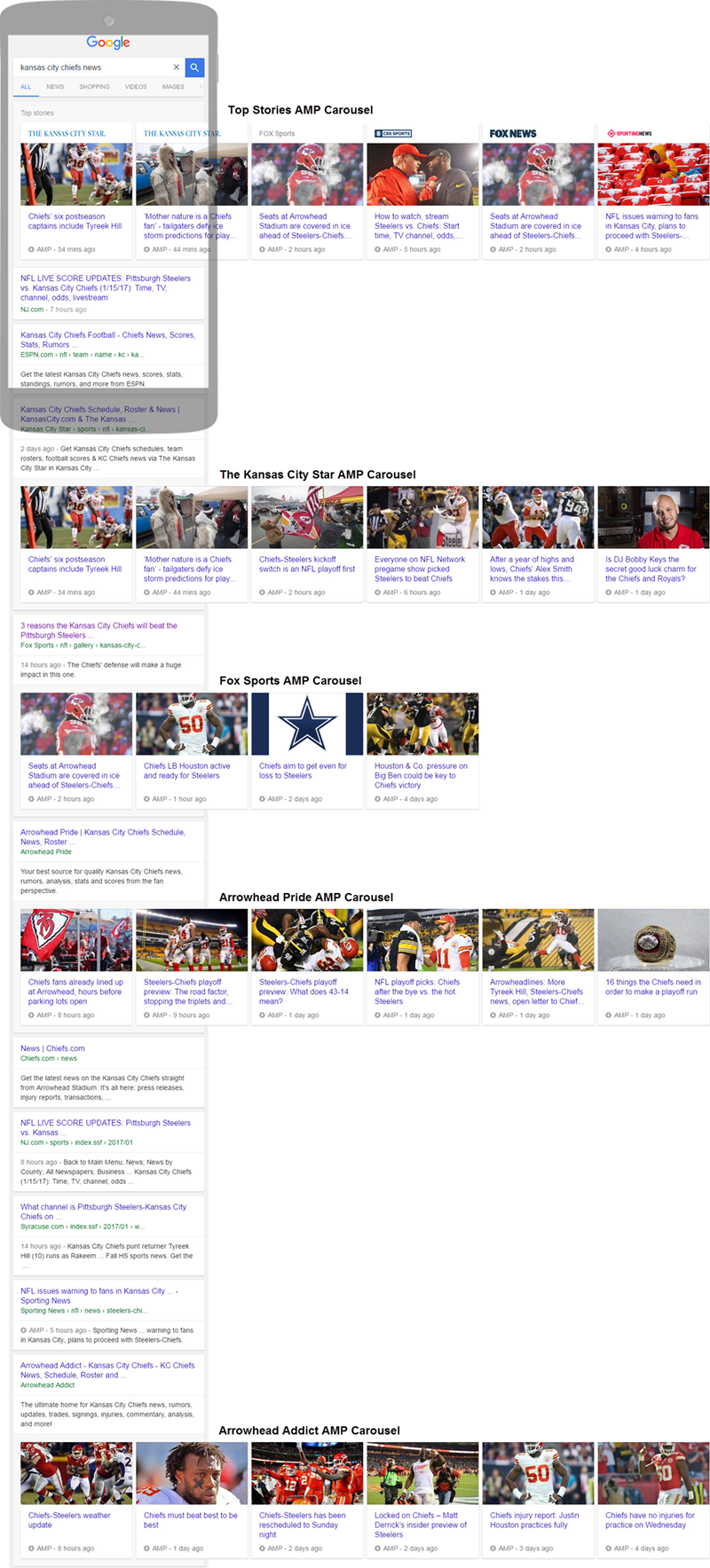
The new AMP carousels appear in the main mobile results list, showcasing related articles from a single publisher. They started appearing at the end of 2016 without fanfare from Google. Let’s call them “single-source carousels.”
Single-source AMP carousels are most likely to appear in results for popular queries, particularly for news stories. A January 15 search for “Kansas City Chiefs News” produced four single-source AMP carousels in addition to the Top Stories carousel:
Search for any big news story, and you’ll likely get several single-source carousels in mobile results. They also appear frequently for recipe searches — try “cookie recipes,” for example.
Google appears to be invoking the single-source AMP carousel when a publisher offers multiple AMP results with high relevance to the search term. However, there’s no guarantee a publisher will get a carousel for a particular query, even if they have numerous relevant results. The “when” and “why” of the single-source carousel is a mystery.
What’s obvious is that single-source rich card carousels are a bonus to AMP-enabled publishers. Unlike the Top Stories carousel, where publishers compete for the coveted first and second spots, the entire single-source carousel and subsequent viewer experience belong to one publisher. AMP rich cards offer a high-impact showcase that helps publishers stand out against their competition, with better opportunity for onward engagement than a plain text link. Even a modest rate of horizontal scrolling in the single-source carousel is icing on the cake for the publisher.  
This approach also enables Google to thread the needle between promoting AMP and preserving the integrity of result relevance. Google has stated that AMP content won’t be explicitly favored in search rankings and presumably is keeping that promise. Google still shows non-AMP content at the top of mobile results when that content is the most relevant — while at the same time highlighting AMP results and inviting users to engage with AMP rich cards.
Meanwhile, the expanded flow of audience to AMP content will provide Google with additional engagement data to inform future user interfaces and enhancements.
For publishers of news content and other high-density AMP categories, it’s becoming harder to hold out against AMP — as Google continues to sweeten the deal for those who jump in.

Some opinions expressed in this article may be those of a guest author and not necessarily Search Engine Land. Staff authors are listed here.
To know more latest update or tips about Search Engine Optimization (SEO), Search Engine Marketing (SEM) - Fill ContactUs Form or call at +44 2032892236 or Email us at - adviser.illusiongroups@gmail.com.


Saturday, 8 October 2016

AMP is now one year old and growing faster, will it ultimately outplay responsive design?

There are now 600 million AMP pages on 700,000 domains.


On the heels of new Google research that shows the importance of mobile in a cross-device world, the company is rejoicing the first birthday of Accelerated Mobile Pages (AMP) and proposing a roundup of milestones and success metrics.
There are now 600 million AMP pages on 700,000 domains. AMP producers are seeing more repeat traffic and better engagement/CTRs. For example:
  • Washington Post: 23 percent rise in mobile search users who return within 7 days
  • Wired: 25 percent rise in click through rates from search results, with CTR on ads in AMP stories up 63 percent.
  • The Miami Herald: mobile users who start with an AMP article apply 10 percent more time than those who land on regular mobile pages.
  • In a DoubleClick study: 80 percent+ of AMP publishers understood higher viewability rates; 90 percent of AMP publishers drove greater engagement with higher CTRs; one publisher saw 600 percent superior CTR after AMP
Last month Google rolled out AMP in the main mobile search results. The company highlighted that AMP is not a ranking factor. However Google said it will show links to AMP-enabled pages vs. other versions of the same page.
Google spent a great deal of time over the past numerous years convincing developers and publishers to adopt responsive design to advance the mobile user experience. Responsive design and AMP are not mutually exclusive; however, AMP pages typically load faster than responsive pages. It’s conceivable that AMP will ultimately be preferred over responsive pages; however, the establishment has not taken an official position on this question.
More controversially, Google’s Adam Greenberg said at SMX East that AMP pages will overrule app deep links “for the foreseeable future.” It can be argued whether this transports the best user experience.
AMP is at its core an creativity to improve the mobile web knowledge. While AMP is open-source and being accepted by a wide array of companies, Google sees the feasibility of the mobile web (vs. apps) as vital to its continued success.
To know more latest update or tips about Search Engine Optimization (SEO), Search Engine Marketing (SEM) - ContactUs or call at +44 2032892236
Referece taken by - SearchEnginLand