Pages

Showing posts with label GOOGLE WEB SEARCH. Show all posts

Tuesday, 19 September 2017

Google Search lets readers find e-books at their local libraries

The new search feature is currently available on mobile.

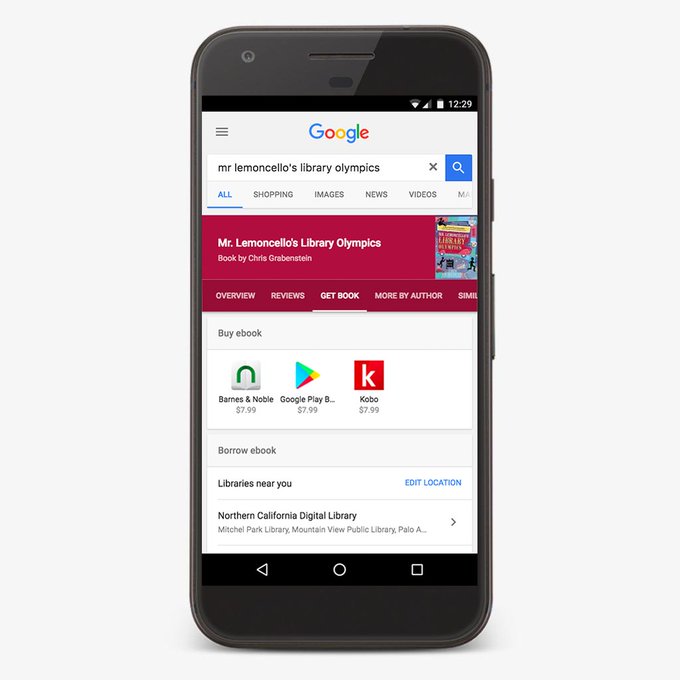
Google just made it easier for readers to find an e-book at their local library.
Per the following tweet from Google, mobile search results for a book now include a “Borrow e-book” option under the “Get Book” section.
Tapping on the library from where you want to check out the e-book will return the sign-in page for the library, along with the option to download the book or read a sample:
The library location can be edited within the search app by tapping on the “edit location” link next to the “Libraries Near You” option. This new feature appears to only be available on mobile.
 know more latest update or tips about Search Engine Optimization (SEO), Search Engine Marketing (SEM) - Fill ContactUs Form or call at +44 2032892236 or Email us at - adviser.illusiongroups@gmail.com. 

Monday, 4 September 2017

Google adds trending searches and instant answers to iOS app

Google adds previously introduced Android search capabilities to iOS app.

With a new search app update for iOS, Google has added trending searches and instant answers. (TechCrunch noticed it earlier today.) It replicates a previously introduced Android feature which reportedly resulted in an outcry, causing Google to enable an opt-out.
In the “what’s new” discussion in the iOS App Store, Google says:

  • See searches that are trending around you when you tap on the search box to start a search
  • Get instant answers to your questions as you type them, before you even complete the search. Try it out by typing for “goog stock” or “how tall is the eiffel tower” and see the answer show up in the suggestions below the search box
  • Easily give feedback on any suggestions you see while typing — just swipe left and tap on the “info” icon

The trending searches appear to be national rather than specific to my location. The data appear to be Knowledge Graph data, but it’s not consistent — answers don’t always appear to factual questions — or as rich as the Google Answer Box, which appears after the search is actually entered.


Apple offers a somewhat richer version of instant answers with its Spotlight Search on Safari, though there’s no trending data.
Trending searches will be interesting to some people. Others will be indifferent; still others may be horrified (“Starbucks Pumpkin Spice Latte”). If they were truly local queries, it would be more interesting to me.
Instant answers has some utility for quick facts. But it’s now faster, easier and more efficient to use voice search or Google Home, if you have one. I can ask for the time in London or “what’s the population of the United States?” much more quickly with my voice than my phone keyboard.

know more latest update or tips about Search Engine Optimization (SEO), Search Engine Marketing (SEM) - Fill ContactUs Form or call at +44 2032892236 or Email us at - adviser.illusiongroups@gmail.com.

Tuesday, 4 April 2017

Google testing ‘tags’ label in search results snippets

SMX Advanced has sold out for the last decade; don't miss your only chance to attend this year.

A new Google experiment updates the search results snippets to show tags related to the page. But these tags don't seem to do much of anything.

Google has confirmed to Search Engine Land that they are experimenting with a new feature in the search results. I happened to stumble upon a search results snippet in Google that showed “tags” within the snippet. The unusual part of this was that the “tags” didn’t offer any additional functionality.
Google would list “tags” relevant to the page content in the actual search results listing snippets. You were not able to filter by those tags, click on them or anything. It just listed “tags” in the snippets without showing you anything more.
Here is a screen shot:
Google confirmed this was a real experiment but would not explain what they are for and how they should work.
know more latest update or tips about Search Engine Optimization (SEO), Search Engine Marketing (SEM) - Fill ContactUs Form or call at +44 2032892236 or Email us at - adviser.illusiongroups@gmail.com.


Friday, 3 March 2017

Google makes it easier to search for programming languages answers

Google can now handle queries containing sequences of 2–3 special characters.

Google announced they now let you search using sequences of two or three special characters, something many coders do when looking for programming help in search. So now you can go to Google and search for technical queries such as [== vs ===] and [+=].
Google gave the example, if you’re searching for the meaning of [c++17], you will get results for the well-known programming language instead of c17, which brings up a Boeing airplane.
Here is an example of a search result page for such technical queries:
Google also made it better for organization and product names that include punctuation. So for companies name She++ and Notepad++, Google will now return more accurate results.
To know more latest update or tips about Search Engine Optimization (SEO), Search Engine Marketing (SEM) - Fill ContactUs Form or call at +44 2032892236 or Email us at - adviser.illusiongroups@gmail.com.

Friday, 17 February 2017

Google brings back emojis in the search results snippets for relevant queries

Google has brought back displaying emojis in the search results when the query thinks it is relevant.

Google has confirmed with Search Engine Land that they have brought the ability for emojis to be displayed in the search results listing page.
In June 2015, Google removed emojis from showing up in the results after promising to disable them over webmaster abuse.
Well, I guess Google had a change of heart and wants them to show up for queries related to emojis.
A Google spokesperson told us they added it back when emojis are relevant. “We have added a feature to our snippets to feature emojis where relevant, useful and fun,” Google told us. “You’ll see them crop up across various snippets moving forward,” Google said.
So if you search in Google for emojis, Google will show emojis. For example, my query for [google display emojis] has search results that display emojis in the listings:

But if I search for [google panda], our [panda page] is listed, but even though the title tag has a panda emoji, it doesn’t show in the search results listings.

To know more latest update or tips about Search Engine Optimization (SEO), Search Engine Marketing (SEM) - Fill ContactUs Form or call at +44 2032892236 or Email us at - adviser.illusiongroups@gmail.com.


Tuesday, 14 February 2017

Google: No comment on possibility of a Feb. 7 algorithm update

Did your rankings in Google get better or worse over the past week? Many webmasters and SEOs are noticing some significant changes in Google's search rankings algorithm.

Last Tuesday, Feb. 7, there seems to have been a Google algorithm change that adjusted how many sites rank — both for good and bad. I’ve been tracking the update since Feb. 8, and over time, more and more webmasters and SEOs have been taking notice of the ranking changes at Google.
This seems to be unrelated to the unconfirmed link algorithm change from earlier in February. This new update seems to be more related to Panda, based on such things as content and site quality, versus link factors.
Google has not confirmed the update and would not comment on what webmasters and SEOs have been noticing over the past week in the search results. So we cannot confirm if this was a content quality shift, link quality change or something else. But what we can say is that webmasters and SEOs are very busy noticing these ranking changes, through looking at ranking reports or their traffic from Google in their analytics, or using tracking tools that track visibility and other means.
The automated tracking tools from Mozcast, RankRanger, Accuranker and others also all showed evidence of an algorithm update on Feb. 7.
This update seems to have been somewhat significant, which is why we reached out to Google for a comment. If we hear more from Google, we will update you. But for now, this is all based on the conversation and chatter that I track closely within the industry.
To know more latest update or tips about Search Engine Optimization (SEO), Search Engine Marketing (SEM) - Fill ContactUs Form or call at +44 2032892236 or Email us at - adviser.illusiongroups@gmail.com.

Thursday, 9 February 2017

Data: Google monthly search volume dwarfs rivals because of mobile advantage

Google likely has 30+ billion queries per month across platforms.

In the past year, comScore has de-emphasized its search market share and mobile market share reports. Part of the reason is that the numbers don’t change that much anymore.
In addition, for reasons that remain mysterious, the measurement firm has declined to present a consolidated view of the search marketplace that includes both desktop and mobile. Mobile search is now both larger and, in many respects, more important than desktop search.
Below are the most recent comScore PC search market share and query volume figures for December 2016:
Across the board, desktop search queries are down vs. November. Google’s overall share remains basically stable at 63 percent (plus). Microsoft continues its slow growth on the PC, while the others continue their slow declines. It’s worth noting again that Bing powers search results for AOL, Yahoo, Siri + Spotlight search and Amazon, which is not reflected above.
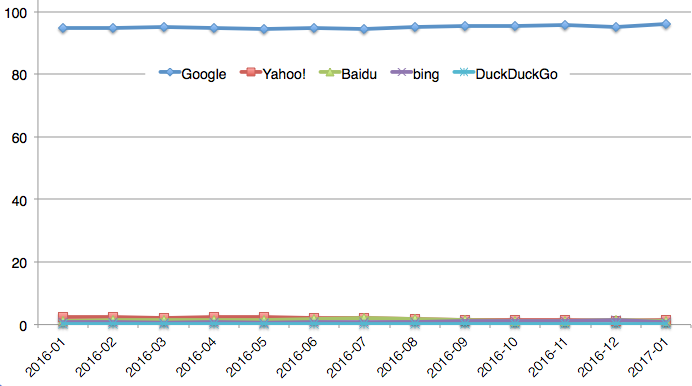
On mobile devices it’s mostly a story about Google, however. According to data from StatCounter, Google controls about 95 percent of mobile search query volume on a global basis. Even if this number is not entirely accurate — some people are critical of StatCounter data — it’s beyond dispute that Google has a massive lead in mobile search.
Global Smartphone Search Market Share (StatCounter)
We know from Google itself that at least 50 percent of its global query volume is now from mobile devices. The number varies by category but is probably closer to 60 percent overall.
If we assume that the comScore PC query volume figures are accurate, Google had roughly 15 billion desktop searches in the US this past December. If so, Google is seeing at least 15 billion more from US mobile devices, which is partly how the company is able to keep generating strong financial results even as desktop queries are flat.
At the end of last year, according to comScore, smartphone penetration among mobile phone owners passed 80 percent. That means there are now more than 200 million smartphone in the US, which is probably a conservative number.

To know more latest update or tips about Search Engine Optimization (SEO), Search Engine Marketing (SEM) - Fill ContactUs Form or call at +44 2032892236 or Email us at - adviser.illusiongroups@gmail.com.


Sunday, 18 December 2016

Google studying ways to deal with offensive search suggestions & results

As Google has come under fire for search suggestions like “are women evil” or actual results questioning whether The Holocaust happened, those who oversee its search engine aren’t ignoring the issue. They’re just taking time to figure out the best and most comprehensive response.
This week, I met with several engineers and executives involved with Google’s search results, including Ben Gomes, vice president of core search. There’s no question that Google has heard the concerns. There’s no question those within Google itself are disturbed by what’s being raised. But the desire is to find solutions that are generally defensible, rooted in policy and which can be implemented through algorithms, as much as possible.
In a statement Google gave me after our meeting, it said:
The goal of search is to provide the most relevant and useful results for our users. Clearly, we don’t always get it right, but we continually work to improve our algorithms. This is a really challenging problem, and something we’re thinking deeply about in terms of how we can do a better job. Search is a reflection of the content that exists on the web. The fact that hate sites appear in Search results in no way means that Google endorses these views.

Dealing with autocomplete

Google won’t go on the record about what it may do, largely because it’s not even certain yet what that will be, only that it knows it needs to do something. It has two chief challenges.
The first is dealing with search suggestions, also called “autocomplete.” These are suggestions that appear as people are typing in the search box. The feature is designed to speed up the searching process, especially for those on mobile devices, where typing can be difficult. Autocomplete allows for typing a few characters and having a list of popular searches appear in response.
For example, typing in “best place to eat” brings up a suggestion such as “best place to eat near me,” which is handy and saves some time:
best place to eat
However, because the suggestions are drawn from actual popular searches that people do, they can also reveal ugly truths about society. For example, some ask why Chinese people are rude:
chinese people rude
Some also ask if white people are human:
are white people human
Personally, I’ve long been for filtering out as much of the negative from such suggestions as possible. My concern is that autosuggest can present things that are often stereotypes or not necessarily true to those who neither knew such things nor wanted to know them. It can “detour” searchers into areas they didn’t want to go into. Worse, as is emerging, some of the actual results that appear for these type of search suggestions might not provide balance.
What Google will do here is uncertain, but it’s definitely an area that’s being explored for change.
Whatever Google implements won’t be perfect. That’s why it will be important, in my opinion, that Google also develops an easy mechanism to report objectionable suggestions that get through and a policy that’s flexible and sensible enough to allow for manual removals of what the algorithm fails to catch.
Right now, you have to know where the autocomplete help page is to get to the report form, where it’s entirely unclear why Google might remove something other than if it’s considered hate speech or sexually explicit or abusive content. More clarity, reasons and transparency are needed.
While suggested searches should be better filtered, I also hope that Google makes it easier to research some of these things through Google Trends. It’s a different environment there, where people are deliberately seeking to see what search reveals about society. Sadly, search reveals some ugly things. But understanding that there are real people — in significant numbers — who may hold or be curious about stereotypes is one of the best ways to understand where education needs to happen.

Filtering the results?

What’s suggested is one thing, but it’s really the results that you get which matter. For example, as was demonstrated this week, Google came under fire for having a Holocaust-denial page listed first in its results for a search on “did the holocaust happen,” as shown in this example from the Guardian, which first wrote about it:

How to deal with this type of result? There have been many knee-jerk calls to remove it simply because it’s not factually-correct. But a one-off removal of the page wouldn’t solve the problem for other searches and with other sites.
It also poses another challenge. If the policy is that you just remove things that aren’t based in fact, much of the web can become vulnerable to censorship from Google. For example, would you have to remove major religious organizations because these groups are based on unprovable faith — the very essence for most of them — rather than demonstrable fact?
Google needs some type of policy to deal with the type of “post-truth world” that is of a growing concern to so many. One thought of mine — and of others that I’ve seen voiced — is that potentially, it could partner with third-party organizations to develop a list of particular sites that should be flagged or filtered, such as Facebook announced this week that it would do to combat fake news.
Google does already flag fact-checking sites within Google News, something it put into place last month. Filtering would be the opposite. It would penalize or lessen the chance of sites that seem to be pushing fake news from appearing for popular searches.
As with filtering search suggestions, no system Google puts into place would be perfect. That’s why, again, having a good policy that can handle what gets past any algorithmic change would be important.

Explain more about sites & ranking?

Another thought is that Google might find a way to do a better job providing details about sites that are listed. Right now, you’re given a title, description and URL. But those with long memories can recall when Google used to provide a “PageRank” score next to listings, a way it was trying to indicate how authoritative a site might be.
Bringing back PageRank scores isn’t the answer, but there might be another way that Google could indicate the general authority of a site or the “neighborhood” of sites that it’s associated with.
Finally, more transparency would be helpful in terms of ranking. This is always a touchy subject with Google, because it fears giving too much information away helps people manipulate its search engine.
However, it’s bizarre that something like that Holocaust denial post is showing tops in Google. It has no great number of links pointing at it, according to a Moz tool I used. The Wikipedia page below it should carry far more authority.
Maybe Google is indeed rewarding clickthrough rates as some speculate. IE, the type of person who searches for “did the holocaust happen” might be more likely to click on sites that suggest it did not, if that was already their preconception — and thus the results start to become one-sided for certain searches, if you reward those that get the most clicks.
Google has been steadfast that it does not use clickthrough rates in the way described above, by the way. But the mystery remains. We can’t even see backlinks via Google itself, now that the specific command for that, endangered earlier this year, seems finally dead. We have to depend on third-party tools, instead. Overall, it makes it difficult for external experts to help Google diagnose its own search ranking sicknesses.

Not just Google

I think it’s important to note that the issue being raised isn’t just happening with Google. For example, Bing has drawn praise when some searches on Google bring up unsavory results while Bing is more balanced. And personally, I’ve felt Bing does seem to deal with the problem better, when I’ve done some comparative searching recently. It appears to have a more robust algorithm for these types of searches, including rewarding Wikipedia more.
However, even Bing isn’t perfect. Type in “was the holocaust” and you get suggestions like “was the holocaust real” or “was the holocaust justified,” as shown below:

Select the second suggestion on whether it was justified, and the first result is from an online debate site finding that it was:

The second listing, by the way, is not justifying it. It sounds like that, but it’s actually an examination of those who do.
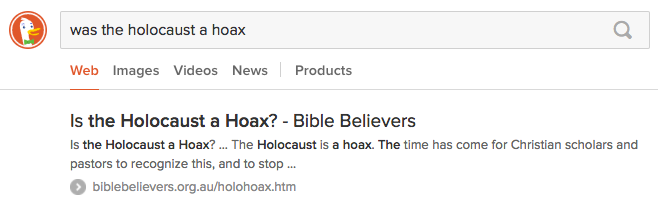
Similarly, at the often-praised Duck Duck Go — which itself largely depends on the search results from Bing — a search for “was the holocaust” suggests “was the holocaust real” and “was the holocaust a hoax.” Select the hoax suggestion, and the top result is from a denial site (and most of the results are from similar denial places):

But Google is reacting

Search is hard. For all the talk of machine learning magic, machines still can’t actually know fact from fiction. They learn from humans. And humans can be tricky. It’s even worse when you’re in situations where matters are up for debate.
Google’s taking the brunt of this issue because, in the end, it’s the leading search engine. It’s also continuing to take the brunt because it’s easy to cherry-pick searches that aren’t actually done by that many people to come up with a fresh angle for attack.
It’s also easy to suggest that this is somehow something new (we don’t know this at all, nor has any proof been shown) or that it’s only being done by the right-wing manipulation (it’s not) because both themes feed into a growing concern about fake news.
Make no mistake. It’s good that the issue has been brought to light, regardless of how broadly it’s actually impacted the general searching public. The Guardian’s original article two weeks ago, highlighting the “are women evil” search and other problems is well worth reading and played a good and important role in elevating concern here.
It’s also important for Google to act promptly to correct these issues, in the way that it has tackled other problems in search such as with content farms. It has let autocomplete issues fester for years. It doesn’t get yet more years to deal with that. Within a few weeks, at most a few months, we really need to see visible and meaningful change. That’s enough time for a solution to be done with thought and care.

The role for better content

I’ll close with a last thought. One of the best ways to combat these type of results is with good information. It likely doesn’t occur to some good authorities to write content about why the Holocaust really did happen or why some stereotype isn’t true, phrased in the way that someone who has doubts or misbeliefs might search.
Google can and should make changes. But as I said earlier, these search suggestions also shed light on the type of education that needs to happen and the language in which it may need to be expressed. Creating that type of content will help Google, Bing and others deal with the problem.
Lastly, if you are debunking fake news and other wild claims, don’t link back to the originating sites. Or if you do, make use of the nofollow attribute. When a reputable site links to a disreputable one directly — without using nofollow — it’s ironically passing along some of its authority that helps the disreputable site rank better in search engines. Don’t do it.
To know more latest update or tips about Search Engine Optimization (SEO), Search Engine Marketing (SEM) - Fill ContactUs Form or call at +44 2032892236 or Email us at - adviser.illusiongroups@gmail.com
Wednesday, 7 December 2016

Google begins rolling out a new desktop search user interface

Check out the new desktop search interface rolling out to a Google near you.


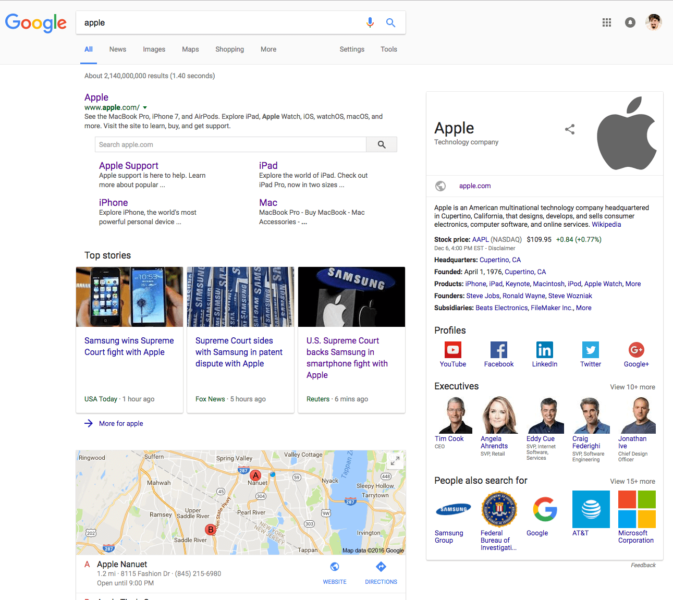
Google has confirmed with Search Engine Land that they have begun rolling out a new design and look for their desktop search results page. The new design has a more boxy look resembling a mobile user interface.
I believe the official rollout began yesterday, but I spotted tests of this new design a few weeks ago.
Here is a screen shot of the new design:


It is unclear how long this new design will take to full roll out to all searchers, but I am personally able to replicate this across dozens of desktop browsers and operating systems.
To know more latest update or tips about Search Engine Optimization (SEO), Search Engine Marketing (SEM) - Fill ContactUs Form or call at +44 2032892236 or Email us at - adviser.illusiongroups@gmail.com
Wednesday, 30 November 2016

Google & Bing increase the file size limit of Sitemaps files

While the 50,000 URL limit has not changed, your Sitemaps file size can now be up to 50MB.

Both Google and Bing announced jointly that they have increased the file size limit of Sitemaps files from 10MB to 50MB.
That means, the uncompressed version must now be under 50MB, no longer under 10MB.
Fabrice Canel, Principal Program Manager at Bing, said “while most sitemaps are under this 10 MB file limit, these days, our systems occasionally encounter sitemaps exceeding this limit.” “Most often this is caused when sitemap files list very long URLs or if they have attributes listing long extra URLs (as alternate language URLs, Image URLs, etc), which inflates the size of the sitemap file,” he added.
The 50,000 URL limit per Sitemaps file has not changed, you can still only have up to 50,000 URLs in a single Sitemap file. But the file size has increased significantly.
Here is Google’s tweet about that this morning: 

We've updated the Sitemaps protocol with Bing! Sitemaps & indexes can be considerably larger now. More at http://sitemaps.org 

To know more latest update or tips about Search Engine Optimization (SEO), Search Engine Marketing (SEM) - Fill ContactUs Form or call at +44 2032892236 or Email us at - adviser.illusiongroups@gmail.com