Pages

Showing posts with label SMARTPHONES. Show all posts

Tuesday, 19 September 2017

Report: Google to debut ‘Home Mini’ smart speaker for $49 on October 4

The device is Google's answer to the low-cost Amazon Echo Dot.

Google is set to reveal the Pixel 2 smartphone and potentially other hardware at an event on October 4, in time for holiday shopping. While the Pixel 2 is set to be the star of the event, a prominent supporting role will be played by the new “Google Home Mini.”
This is apparently Google’s answer to the low-cost Amazon Echo Dot. According to Droid Life, it will be priced comparably at $49 and be available in three colors.
The device will support the Google Assistant and reportedly will provide the same functionality as Google Home. It’s all but certain the sound quality won’t be as good. And there may be other hardware compromises to bring costs down. It will very likely broaden the market for Google Home and the Google Assistant.
Amazon has created multiple Alexa devices for different budgets:
  • Dot — $49
  • Echo Tap — $129
  • Echo — $179
  • Echo Show — $229
Amazon often discounts the devices and offers multiple purchase incentives, including on the Dot. To date, Google has only introduced the Home, which retails for $129 but is often discounted to $99. Apple’s Siri-powered HomePod is going to retail for $349 and is positioned as a higher-end smart speaker for the Sonos demographic.
According to one estimate, Amazon dominates the US smart speaker market today. It has also been projected that by the end of 2017, there will be 30 million of these devices in US households. Assistant-enabled smart speakers are the cornerstone for the smart home ecosystem, and we’re in the midst of a land-grab right now.
ComScore has projected that roughly 50 percent of US search queries will be voice-initiated by 2020. More smart speakers in more American homes will help accelerate that trend.
 know more latest update or tips about Search Engine Optimization (SEO), Search Engine Marketing (SEM) - Fill ContactUs Form or call at +44 2032892236 or Email us at - adviser.illusiongroups@gmail.com. 

Monday, 6 March 2017

Google Assistant might take weeks to reach your Android phone

Google Assistant is officially available for my Android phones this week, but the rollout will take time.

Excited to get Google Assistant on your Android phone? You might have to hang in there. While Google Assistant officially rolled out this week to phones beyond Google’s own Pixel, the company says it might take a few weeks to reach your device.
Google Assistant is Google’s new digital assistant to take on the likes of Siri. It allows you to easily speak what you want and get back answers. It’ll even have a conversation with you and complete some actions like movie ticket bookings, when all goes well. When it doesn’t go well, you might prefer to do a regular Google search.
Until this week, the only smartphones with Google Assistant were Google’s own Pixels. However, the company announced earlier this week that smartphones running Android 6 or Android 7 would get Google Assistant.
That rollout started yesterday. Meanwhile, my Galaxy S7 Edge and my Moto G4 Play stare at me Google Assistant-less, asking what’s up. That’s even despite my Galaxy S7 taking about an hour doing various updates last night.
Both of those phones should get Google Assistant eventually. But as Google told me today in a follow-up, it might take weeks for this to happen.
In particular, phones running Android 6 apparently need to be updated to Android 6.13, Google told Search Engine Land. Anyone with Android 7 should have it — but the only phones shipping with Android 7 are Google’s Pixel and the newly announced LG G6.
Phones also have to have 1.5GB of memory or higher and 720p or higher screen resolution. It’s only offered to those with phones set to use English in the US, Australia, Canada and the UK. German speakers in Germany will also get it. More countries and language support are promised later this year.
To be clear, Google Assistant isn’t an app that you can download. It’s part of the Android operating system, much as Siri is part of iOS. If Google decides your phone can handle Google Assistant, you’ll get that as part of an Android OS update. If not, you can always try Google Assistant by using Google’s Allo app.
For those who do qualify, when you get it, a long hold on your home button or icon launches the Google Assistant. You should know it’s Google Assistant if it asks you, “Hi, how can I help.”
To know more latest update or tips about Search Engine Optimization (SEO), Search Engine Marketing (SEM) - Fill ContactUs Form or call at +44 2032892236 or Email us at - adviser.illusiongroups@gmail.com.
Thursday, 9 February 2017

Data: Google monthly search volume dwarfs rivals because of mobile advantage

Google likely has 30+ billion queries per month across platforms.

In the past year, comScore has de-emphasized its search market share and mobile market share reports. Part of the reason is that the numbers don’t change that much anymore.
In addition, for reasons that remain mysterious, the measurement firm has declined to present a consolidated view of the search marketplace that includes both desktop and mobile. Mobile search is now both larger and, in many respects, more important than desktop search.
Below are the most recent comScore PC search market share and query volume figures for December 2016:
Across the board, desktop search queries are down vs. November. Google’s overall share remains basically stable at 63 percent (plus). Microsoft continues its slow growth on the PC, while the others continue their slow declines. It’s worth noting again that Bing powers search results for AOL, Yahoo, Siri + Spotlight search and Amazon, which is not reflected above.
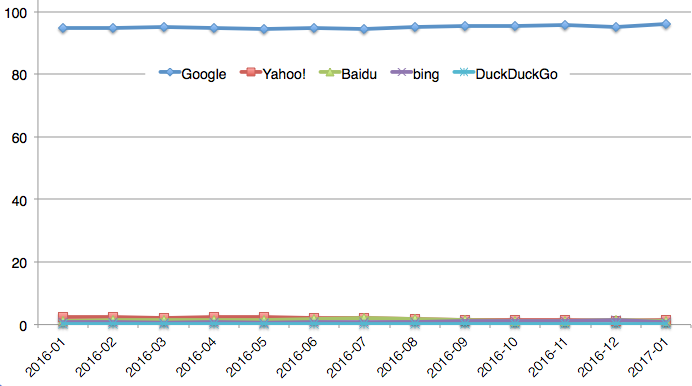
On mobile devices it’s mostly a story about Google, however. According to data from StatCounter, Google controls about 95 percent of mobile search query volume on a global basis. Even if this number is not entirely accurate — some people are critical of StatCounter data — it’s beyond dispute that Google has a massive lead in mobile search.
Global Smartphone Search Market Share (StatCounter)
We know from Google itself that at least 50 percent of its global query volume is now from mobile devices. The number varies by category but is probably closer to 60 percent overall.
If we assume that the comScore PC query volume figures are accurate, Google had roughly 15 billion desktop searches in the US this past December. If so, Google is seeing at least 15 billion more from US mobile devices, which is partly how the company is able to keep generating strong financial results even as desktop queries are flat.
At the end of last year, according to comScore, smartphone penetration among mobile phone owners passed 80 percent. That means there are now more than 200 million smartphone in the US, which is probably a conservative number.

To know more latest update or tips about Search Engine Optimization (SEO), Search Engine Marketing (SEM) - Fill ContactUs Form or call at +44 2032892236 or Email us at - adviser.illusiongroups@gmail.com.



Wednesday, 18 January 2017

Survey: 60 percent of voice users want more answers and fewer search results

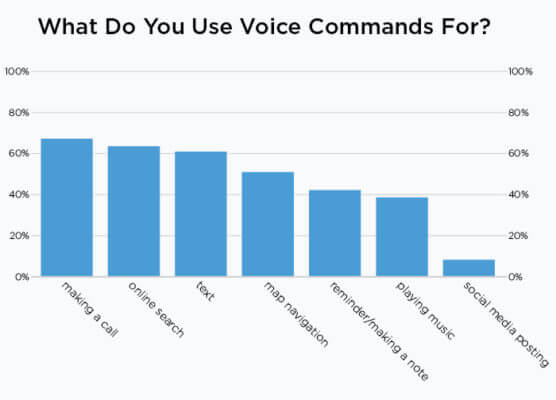
Making calls, searching, texting and map lookups were the most common use cases for voice.

oice search and use of voice commands on mobile devices is on the rise. However, there’s still some embarrassment or reluctance to use it, according to a new survey of more than 900 US smartphone owners from Stone Temple Consulting.
The survey found that people were more likely to use voice when they were alone at home or work. They were much less likely to talk to their devices in public.
Men, younger (and older) users and higher income groups were somewhat more inclined to use voice; however, the differences by category were generally not significant. The exceptions were that men and higher income earners appeared somewhat less inhibited about using voice in public situations.
Ironically, those same high income earners “are more likely to get annoyed by people using voice commands with their phone in public,” although they themselves are more likely to do it as well.
Making a call, searching, texting and map lookups were top use cases. Driving, “hands full” and “hands dirty” were the top contexts for voice, with roughly 60 percent citing these as dominant scenarios. However, the vast majority (80 percent) still preferred to text by hand (this may go to accuracy).
The top three rationales behind voice usage were:
  1. It’s fast.
  2. The answer is read back to me.
  3. I don’t have to type.
About 40 percent of both men and women said that voice made using their smartphones easier. Men were more likely than women to strongly agree. This answer and other data in the survey reflect a mostly positive experience with voice.
Perhaps the most interesting data in the survey findings pointed to the transformation of the search experience with virtual assistants and voice on smartphones. Users wanted more direct answers and fewer conventional search results with their corresponding need to go to third-party websites.
Respondents said they also wanted “more integration with other applications.” That’s a strange response, given that on both the iPhone and Android devices, speech is integrated with third-party apps.
We should see these responses as further indicators of satisfaction with virtual assistants and voice. I wish there were additional data unpacking this response. It’s the one with the most dramatic implications for the search user experience, for marketers and for Google.
To know more latest update or tips about Search Engine Optimization (SEO), Search Engine Marketing (SEM) - Fill ContactUs Form or call at +44 2032892236 or Email us at - adviser.illusiongroups@gmail.com.